



 Healthcare Software Development Services
 Healthcare App Development Services
 Real Estate Web Development Services
 Real Estate App Development Company
 E-Commerce App Development Services
 E-Commerce Web Development Services
 Blockchain E-commerce Development Company
 Fintech Software Development
 Fintech App Development Services
 E-Learning App Development Services
 Restaurant App Development Company
 Mobile Game Development Company
 Travel App Development Company
 Automotive Web Design
 AI Traffic Management System
 AI Inventory Management Software
 Logistics App Development Services
 Machine Learning Development
 ChatGPT integration services
  AI Development Company
  AI Integration Services
  Natural Language Processing Company
 Mobile App Development
  IOS App Development
  Android App Development
  Cross-Platform App Development
  Augmented Reality (AR) App Development
  Virtual Reality (VR) App Development
  Web App Development
  SaaS App Development
 Custom Software Development Services
  Flutter
  React Native
  Swift (IOS)
  Kotlin (Android)
  Mean Stack Development
  AngularJS Development
  MongoDB Development
  Nodejs Development
  Database Development
 Ruby on Rails Development
 Expressjs Development
  Full Stack Development
  Web Development Services
  Laravel Development
  LAMP Development
  Custom PHP Development
  .Net Development
  User Experience Design Services
  User Interface Design Services
  Automated Testing
  Manual Testing
  Digital Marketing Services
 Ride-Sharing And Taxi Services
 Food Delivery Services
 Grocery Delivery Services
 Transportation And Logistics
 Car Wash App
 Home Services App
 ERP Development Services
 CMS Development Services
 LMS Development
 CRM Development
 DevOps Development Services
 AI Business Solutions
 AI Cloud Solutions
 AI Chatbot Development
 API Development
 Blockchain Product Development
 Cryptocurrency Wallet Development
 About Talentelgia
  Our Team
  Our Culture
 Healthcare App Development Services
 Real Estate Web Development Services
 E-Commerce App Development Services
 E-Commerce Web Development Services
 Blockchain E-commerce
Development Company
Blockchain E-commerce
Development Company Fintech App Development Services
 Blockchain Fintech
Development Company
Blockchain Fintech
Development Company E-Learning App Development Services
 Restaurant App Development Company
 Mobile Game Development Company
 Travel App Development Company
 AI Traffic Management System
 AI Inventory Management Software
 AI Development Company
 ChatGPT integration services
 AI Integration Services
 Machine Learning Development
 Machine learning consulting services
 Blockchain Development
 Blockchain Software Development
 Smart contract development company
 NFT marketplace development services
 Asset tokenization companies
 DeFi Wallet Development Company
 IOS App Development
 Android App Development
 Cross-Platform App Development
 Augmented Reality (AR) App
Development
Augmented Reality (AR) App
Development Virtual Reality (VR) App Development
 Web App Development
 Flutter
 React
Native
React
Native Swift
(IOS)
Swift
(IOS) Kotlin (Android)
 MEAN Stack Development
 AngularJS Development
 MongoDB Development
 Nodejs Development
 Database development services
 Expressjs Development
 Full Stack Development
 Web Development Services
 Laravel Development
 LAMP
Development
LAMP
Development Custom PHP Development
 User Experience Design Services
 User Interface Design Services
 Automated Testing
 Manual
Testing
Manual
Testing About Talentelgia
 Our Team
 Our Culture
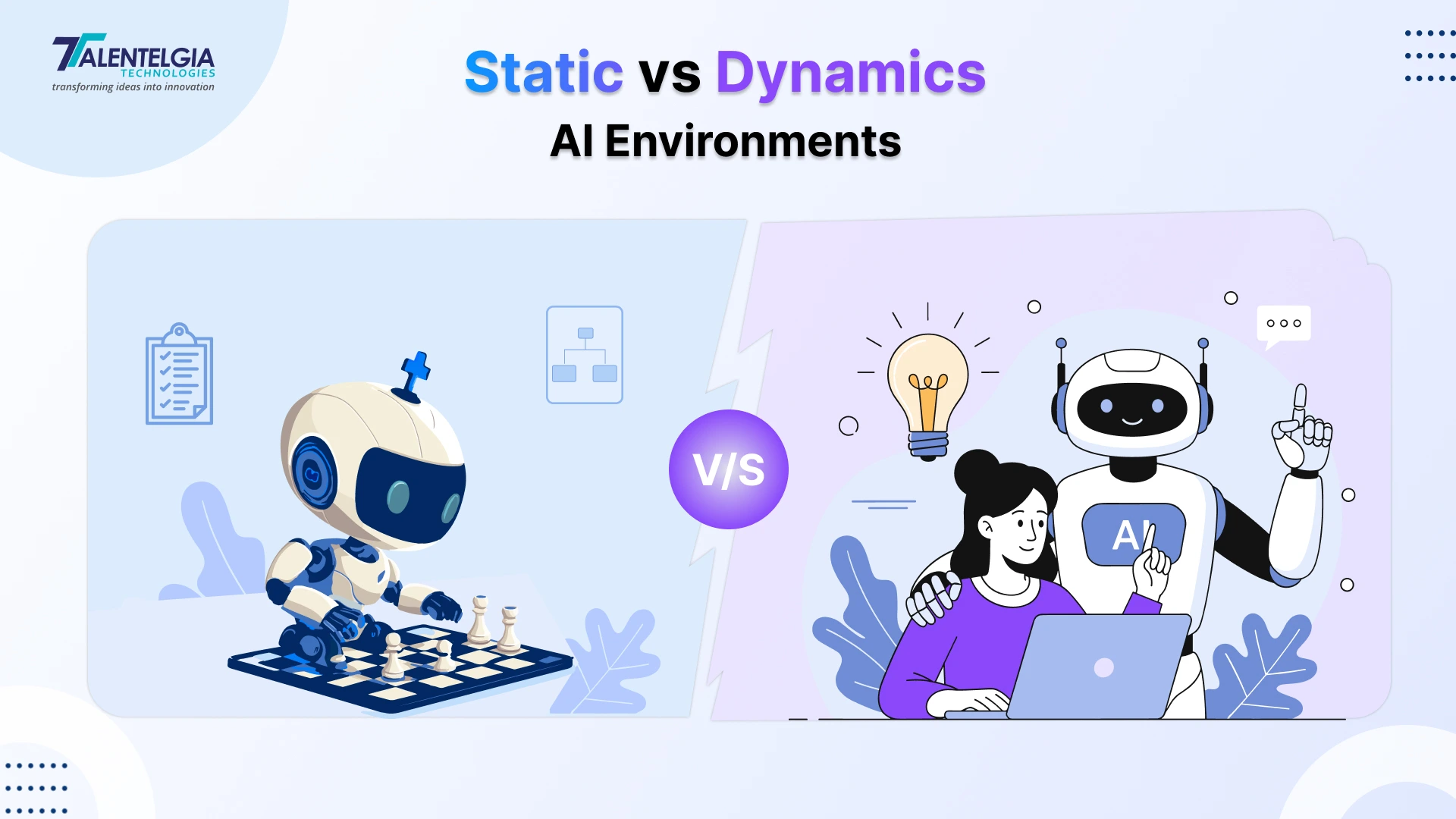
When you’re building an AI agent, environment design makes the difference between an elegant solution and a catastrophic failure. A chess engine knows exactly what’ll happen next as the board’s always stable and the rules never shift. But throw that same logic into traffic prediction or autonomous driving, and you’ve got a system that’ll stumble fast.
Here’s the thing: AI environments split into two fundamentally different worlds. Static environments are closed, predictable, and unchanging. Your agent can precompute everything, plan, and move with certainty. Dynamic environments? They’re fluid. They shift while your agent’s deciding. Real-world systems live here, and they’re messy.
It is this differentiation between static vs dynamic environments in AI that defines all of that: how you design your AI agent to learn, which techniques and algorithms will do the job, how much computational power is required, and even whether your application can survive the real world.
We’re walking through exactly what separates these two, why it matters for practical AI development, and where each environment shows up in real systems you interact with daily. By the end, you’ll know which approach your problem actually needs and why that choice cascades through every other decision you make.
What is an AI Environment and Why It Matters?
An AI environment is the architect of behavior itself. Think of it as everything your agent encounters: the rules it must follow, the data flowing from sensors, other agents it interacts with, and even the time pressures it faces. The environment shapes how AI thinks, what it prioritizes, and how it makes decisions.
Environment Dimensions That Shape Behavior:
- Observability – Can your agent see everything (fully observable) or only partial information (partially observable)?
- Predictability – Are outcomes deterministic (always the same input = same output) or stochastic (randomness involved)?
- Changeability – Does the world stay static or constantly shift around your agent?
- Discreteness – Are states and actions finite (discrete) or infinite (continuous)?
- Sequentiality – Does each action stand alone (episodic) or influence future states (sequential)?
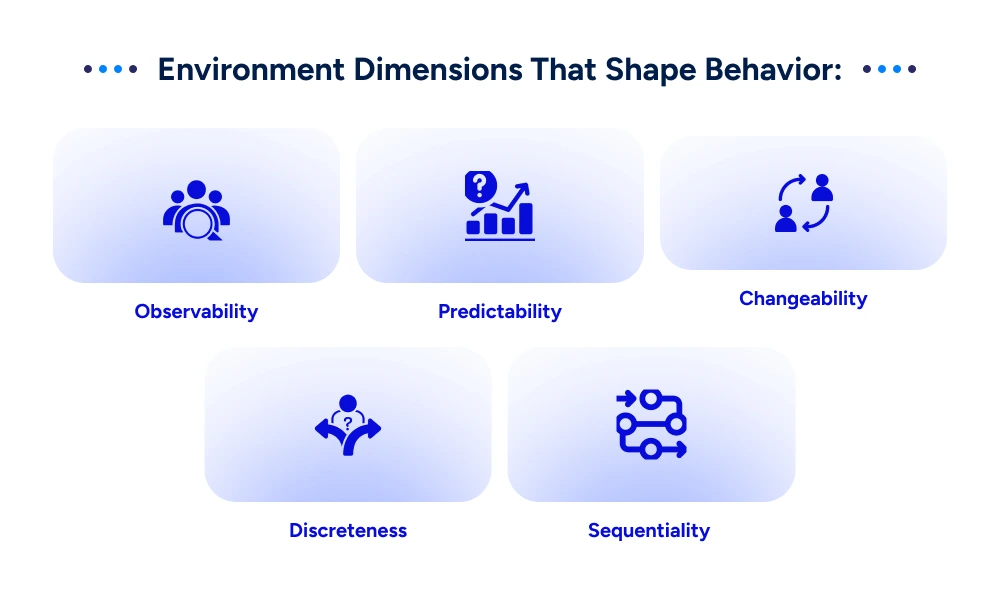
Each dimension forces your agent into different strategies.
This is why understanding static vs dynamic environments in AI is foundational. It determines your choice of algorithm, computational needs, training approach, and whether your system actually works in the real world. Get the environment wrong, and nothing else matters.
What Is a Static Environment in AI?
A static environment is simple: the world ceases to evolve while the agent is thinking. Everything your AI sees remains unchanged until an agent makes a decision. The environment will not change, transform, or surprise you while you are trying to decide what your next step will be.
| Take a chessboard as an example. All pieces stand still in their places. They do not drift; they do not arrange themselves while you are thinking about your next move. The board remains the same. |
Characteristics of Static AI Environments
- Constancy
- Predictability
- Stability
- Simplicity
- No time pressure on decisions
- Precomputable results
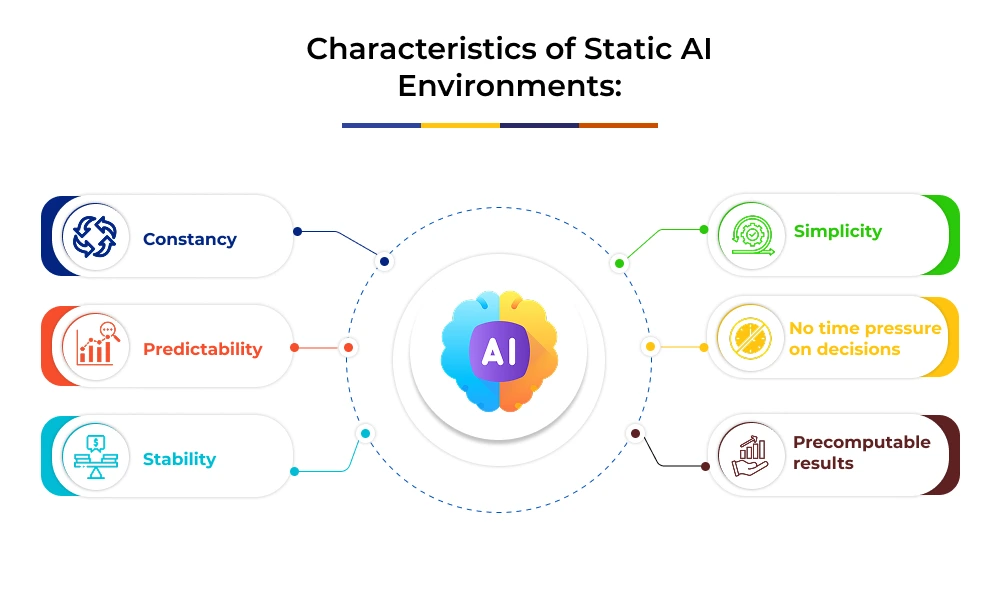
Why This Matters:
Static AI system environments let your AI think methodically. There’s no time pressure baked into the decision-making process. You can precompute. You can plan well ahead because there are no changes in the rules in between. That’s the reason a static AI environment is suitable for classic AI problems such as puzzles and chess.
Real-World Industry Examples
ChatGPT/GPT-4o — Knowledge Frozen in Time
GPT-4o has a knowledge cutoff of October 2023, meaning it was trained on data collected through October 2023 and does not have inherent knowledge of events after that date. This is textbook static.
The limitation hits hard: if your website was built or significantly updated after GPT-4o’s October 2023 cutoff, the model has no trained knowledge of you. You simply don’t exist in its learned understanding of your category. This is exactly why businesses turn to ChatGPT integration services, to layer in live data retrieval and bridge the gap a frozen training cutoff leaves behind.
Transurban (Australian Toll Road Company)
Transurban’s rule-based toll payment chatbot failed on three fronts:
- Customers struggled to find information in rigid menus
- Web/app platforms required constant manual synchronization
- Each new payment method demanded reprogramming.
The static system couldn’t learn, adapt, or scale without human intervention. The rule-based system couldn’t adapt. It was trained on assumptions that no longer matched reality.
Why This Is Static:
Even though the FAQ chatbot excels in guiding customers through initial problem diagnosis and offering around-the-clock service, its limitations become evident after a few questions, necessitating the involvement of traditional customer service methods.
The bot can’t learn. It can’t improve. It can’t adapt to new customer behaviors. Once deployed, it stays frozen.
What Is a Dynamic Environment in AI?
Now, what is a dynamic environment? Just flip the script. A dynamic environment is one where the world doesn’t wait for your agent to finish thinking. While your AI is processing information and deciding on an action, everything around it is already changing. The pieces move while you’re still calculating. The ball keeps rolling. The traffic shifts. Reality doesn’t pause for contemplation.
Real-life dynamic environments are inherently unpredictable in the moment of action. The agent perceives its surroundings, but by the time it formulates an action, the environment that was perceived will change. There is a perpetual mismatch between perception and action, and this is where complexity lies.
| Take autonomous driving. A self-driving car detects a pedestrian at point X. However, by the time it makes its decision, the pedestrian has moved to point Y. The car needs to project into the future state, not simply respond to what is happening in the current state. Or take football. A player identifies an opportunity, but before he can act on it, his opponent has changed his position. |
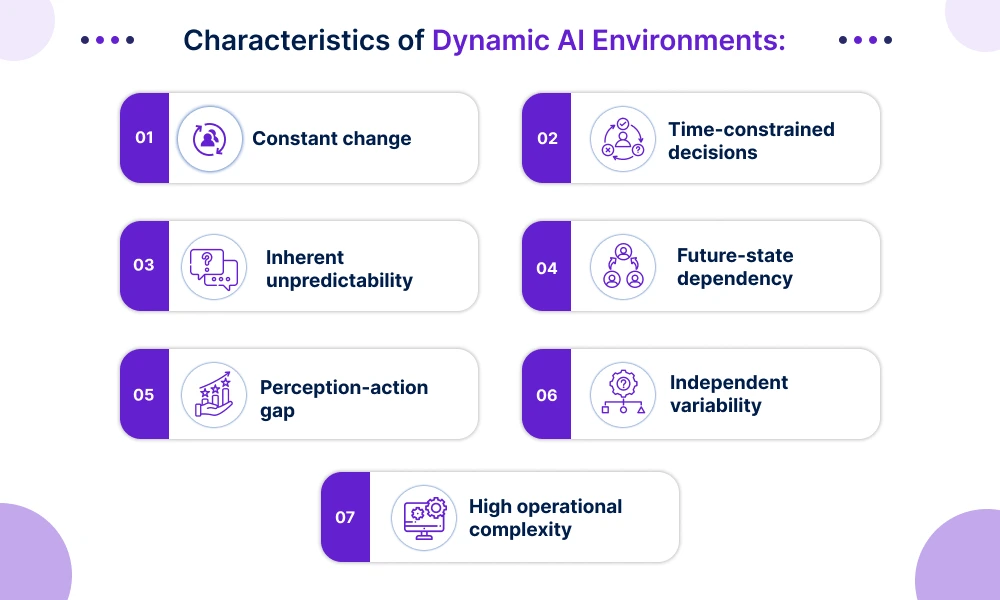
Characteristics of Dynamic Environments
- Constant change
- Inherent unpredictability
- Perception-action gap
- Time-constrained decisions
- Future-state dependency
- Independent variability
- High operational complexity
Why This Changes Everything:
Dynamic environments demand different computational approaches, especially when building scalable AI business solutions that must adapt to real-time data and changing conditions. Your agent can’t precompute everything. There are too many variables, too many possible states. It needs to adapt in real-time, learn continuously, handle uncertainty, and make decisions under time pressure.
This is where real-world AI lives. It’s messier, harder, and far more interesting than the predictable world of static environments.
Real-World Industry Examples
Stripe Radar — Fraud Detection in 100 Milliseconds
This is a real-time dynamic at scale.
Every time you buy something online from a Stripe-powered business, a machine learning model evaluates over 1,000 signals about your transaction and decides in under 100 milliseconds whether to let it through. Across billions of legitimate payments, it reaches the correct verdict 99.9% of the time.
Why It Must Be Dynamic:
So what’s the AI static models problem? Well, fraudsters adapt constantly. A pattern that detected fraud yesterday becomes obsolete today. Fraud changes quickly, and static rules often struggle to keep pace. ML models, by contrast, retrain on new data, which is why organizations often invest in machine learning development services to build systems that continuously learn and improve. They learn from both confirmed fraud and previously missed cases, which allows detection systems to adapt as fraud patterns shift.
Radar’s AI learns from data across millions of global businesses. Radar’s advanced machine learning is available to every Stripe account and is trained on over $1 trillion in annual payment volume.
$1 trillion in annual volume. That’s the dataset feeding continuous learning.
Tesla Autopilot — Neural Networks Learning from Millions of Vehicles
Tesla’s Full Self-Driving system is the gold standard of dynamic environments.
Tesla developed a multi-layered AI-driven safety system that enhances vehicle awareness, driver monitoring, and collision prevention. The challenge is that AI must interpret real-world environments just as a human driver would, which is incredibly complex, with unpredictable roads, pedestrians, cyclists, traffic signals, construction zones, and sudden lane changes creating a dynamic environment.
The Scale:
A full build of Self-Driving neural networks involves 48 networks that take 70,000 GPU hours to train. Together, they output 1,000 distinct tensors (predictions) at each timestep. Tesla’s networks learn from the most complicated and diverse scenarios in the world, iteratively sourced from their fleet of millions of vehicles in real time.
48 neural networks. 70,000 GPU hours per training cycle. 1,000 predictions per millisecond. And it never stops learning. Every Tesla on every road feeds data back into the system.
Also Read – How Much Does It Cost To Develop an AI Agent?
Static vs Dynamic Environment in AI
| Dimension | Static Environment | Dynamic Environment |
|---|---|---|
| Environmental Change | No change unless agent acts | Changes independently of agent actions |
| Predictability | Highly predictable; outcomes consistent | Unpredictable; outcomes variable |
| Decision-Making Window | Unlimited thinking time | Real-time constraints; millisecond pressures |
| Complexity Level | Low; straightforward reasoning | High; requires adaptive processing |
| Memory Requirements | Minimal; no state tracking needed | Essential; must track environmental shifts |
| Algorithms | Search, optimization, exhaustive planning | Reinforcement learning, probabilistic models, adaptive algorithms |
| Learning Type | Offline (pre-training only) | Continuous (online, real-time feedback) |
| Computational Cost | Lower; batch processing efficient | Higher; real-time monitoring required |
| Resource Efficiency | Less resource-intensive | More demanding (compute, storage, surveillance) |
| Adaptability | Fixed; inflexible post-deployment | Adaptive; evolves during operation |
The Core Difference: Who Controls Time
In static environments, your agent owns the clock. It observes → thinks → executes. The environment waits. Nothing changes while your agent deliberates.
Dynamic environments flip this entirely. The world moves whether your agent is ready or not.
Decision-Making Architecture
Static Agents:
- Precompute exhaustively because plans don’t get invalidated mid-execution
- A chess engine calculates 20 moves deep—the board won’t suddenly shift
- Can afford to think methodically
Dynamic Agents:
- Embrace probabilistic reasoning instead
- Can’t plan comprehensively—too many unknowns
- Observe → adapt → adjust in milliseconds
- Require memory to track environmental shifts
- Need real-time sensing mechanisms
The Planning Spectrum
- Static: THINK (unlimited time) → PLAN FULLY → EXECUTE
- Dynamic: OBSERVE → REACT QUICKLY → ADAPT CONTINUOUSLY
Computational Reality: The Budget Question
This is where things get expensive.
| Factor | Static | Dynamic |
|---|---|---|
| Computing Power | Lower; batch processing | Higher; real-time monitoring |
| Storage | Minimal state tracking | Extensive memory for state changes |
| Surveillance Needs | None | Continuous environmental monitoring |
| Cost | Easier to install, cheaper | Resource-intensive, demanding |
Static recommendation systems (Netflix offline analysis) avoid real-time processing costs but sacrifice adaptability. Dynamic systems must constantly feed new data through learning algorithms, paying for flexibility with computing resources.
Learning After Deployment: The Fundamental Split
Static Systems:
- Knowledge locks in at training time
- Won’t update unless developers retrain them manually
- Trade-off: predictability for inflexibility
- Outputs remain consistent but stale
Dynamic Systems:
- Continuously updated via machine learning
- Real-time feedback loops drive improvement
- Learn as they operate; improve with each interaction
- Complexity and overhead are the price
Complexity & Adaptability Axis
Static environments are relatively simpler and more predictable. Your agent knows the rules won’t change mid-game.
Dynamic environments are messier. Complexity spikes because the agent must handle uncertainty, anticipate changes, and adjust strategies in real-time.
Real Algorithmic Implications
What Works in Static:
- Search algorithms (exhaustive, planned)
- Decision trees (rigid, rule-based)
- Optimization (comprehensive solutions)
What Works in Dynamic:
- Reinforcement learning (learns through trial/error)
- Probabilistic models (embraces uncertainty)
- Adaptive algorithms (adjusts on the fly)
Static agents can use slow, thorough algorithms. Dynamic agents must use fast, approximate ones.
Where These Show Up
Static Examples:
- Mathematical problems and logic puzzles
- Static datasets (once loaded, they don’t change)
- Historical data analysis
- Offline recommendation systems
Dynamic Examples:
- Self-driving cars (other vehicles, pedestrians, and road conditions constantly shift)
- Stock market trading (external economic factors cause continuous change)
- Video games with opponent AI (opponents react and adapt)
- Robotics in cluttered environments (obstacles and task distributions change)
Conclusion
Here’s the brutal truth: there’s no universal “better” environment type. Static systems give you certainty and efficiency but only if your problem actually stays constant. Dynamic systems demand computational complexity and continuous learning, but they’re the only choice when reality refuses to wait.
Your job isn’t to prefer one. It’s to recognize which world your problem lives in. Build a static solution for a dynamic problem and watch it fail silently. Force dynamic learning onto a static domain and waste resources on unnecessary computation.
The architecture you choose cascades through every other decision. Get it right from the start.












 Sales Enquiries:
  Business queries:
  HR:
HR: 


