


 Healthcare Software Development Services
 Healthcare App Development Services
 Real Estate Web Development Services
 Real Estate App Development Company
 E-Commerce App Development Services
 E-Commerce Web Development Services
 Blockchain E-commerce Development Company
 Fintech Software Development
 Fintech App Development Services
 E-Learning App Development Services
 Restaurant App Development Company
 Mobile Game Development Company
 Travel App Development Company
 Automotive Web Design
 AI Traffic Management System
 AI Inventory Management Software
 Logistics App Development Services
 Machine Learning Development
 ChatGPT integration services
  AI Development Company
  AI Integration Services
  Natural Language Processing Company
 Mobile App Development
  IOS App Development
  Android App Development
  Cross-Platform App Development
  Augmented Reality (AR) App Development
  Virtual Reality (VR) App Development
  Web App Development
  SaaS App Development
 Custom Software Development Services
  Flutter
  React Native
  Swift (IOS)
  Kotlin (Android)
  Mean Stack Development
  AngularJS Development
  MongoDB Development
  Nodejs Development
  Database Development
 Ruby on Rails Development
 Expressjs Development
  Full Stack Development
  Web Development Services
  Laravel Development
  LAMP Development
  Custom PHP Development
  .Net Development
  User Experience Design Services
  User Interface Design Services
  Automated Testing
  Manual Testing
  Digital Marketing Services
 Ride-Sharing And Taxi Services
 Food Delivery Services
 Grocery Delivery Services
 Transportation And Logistics
 Car Wash App
 Home Services App
 ERP Development Services
 CMS Development Services
 LMS Development
 CRM Development
 DevOps Development Services
 AI Business Solutions
 AI Cloud Solutions
 AI Chatbot Development
 API Development
 Blockchain Product Development
 Cryptocurrency Wallet Development
 About Talentelgia
  Our Team
  Our Culture
 Healthcare App Development Services
 Real Estate Web Development Services
 E-Commerce App Development Services
 E-Commerce Web Development Services
 Blockchain E-commerce
Development Company
Blockchain E-commerce
Development Company Fintech App Development Services
 Blockchain Fintech
Development Company
Blockchain Fintech
Development Company E-Learning App Development Services
 Restaurant App Development Company
 Mobile Game Development Company
 Travel App Development Company
 AI Traffic Management System
 AI Inventory Management Software
 AI Development Company
 ChatGPT integration services
 AI Integration Services
 Machine Learning Development
 Machine learning consulting services
 Blockchain Development
 Blockchain Software Development
 Smart contract development company
 NFT marketplace development services
 Asset tokenization companies
 DeFi Wallet Development Company
 IOS App Development
 Android App Development
 Cross-Platform App Development
 Augmented Reality (AR) App
Development
Augmented Reality (AR) App
Development Virtual Reality (VR) App Development
 Web App Development
 Flutter
 React
Native
React
Native Swift
(IOS)
Swift
(IOS) Kotlin (Android)
 MEAN Stack Development
 AngularJS Development
 MongoDB Development
 Nodejs Development
 Database development services
 Expressjs Development
 Full Stack Development
 Web Development Services
 Laravel Development
 LAMP
Development
LAMP
Development Custom PHP Development
 User Experience Design Services
 User Interface Design Services
 Automated Testing
 Manual
Testing
Manual
Testing About Talentelgia
 Our Team
 Our Culture
For today’s organizations, risk has become a constant, interconnected, and increasingly expensive reality. It can arrive suddenly in the form of a ransomware attack on a Friday or a regulatory update that changes the entire industry overnight.
Approximately 72% of organizations report increased exposure to operational and cybersecurity risks. Yet a staggering number continue to manage these threats the old way. Nearly half of companies still depend on spreadsheets for risk management, while 41% have already experienced an impactful third-party breach. That’s how wide the gap between risk exposure and risk readiness has grown.
And this is exactly where enterprise risk management software solutions come in as a saviour. ERM platforms are built to replace fragmented, manual processes with centralized intelligence. They give organizations the ability to identify, assess, monitor, and mitigate risks actively, at scale, and across every layer of the business. But the market has tons of options. How do you know which one works the best for your Custom Enterprise Software Development?
Let’s talk about it all in detail: what ERM software really is, what features matter, and the top platforms worth your attention in 2026.
Also Read – Risk Management Strategies for Tech Projects
What Is Enterprise Risk Management Software?
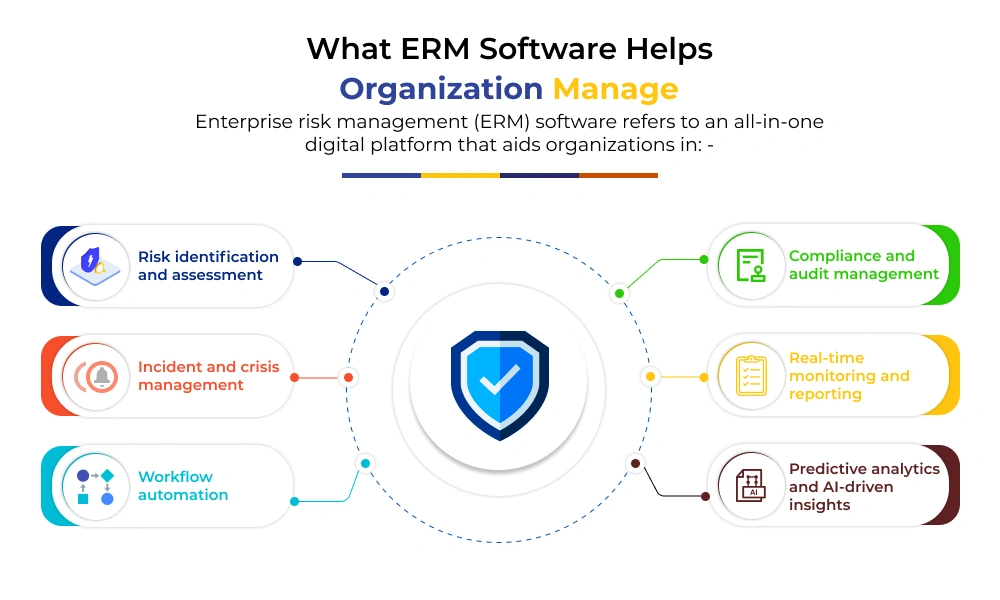
Enterprise risk management (ERM) software refers to an all-in-one digital platform that aids organizations in: –
- Risk identification and assessment
- Incident and crisis management
- Workflow automation
- Compliance and audit management
- Real-time monitoring and reporting
- Predictive analytics and AI-driven insights
Enterprise risk management software is designed around globally accepted frameworks for managing risk to assist organizations in achieving standardization of governance and improved resilience. The most widely adopted frameworks include:
- COSO ERM Framework for enterprise-wide governance and structured risk oversight
- ISO 31000 for universal risk management principles and guidelines
- ITIL Service Lifecycle for IT service and operational risk management
- NIST Risk Management Framework for cybersecurity, privacy, and system security integration
Why Traditional Risk Management No Longer Works
Risk management has always been about manual audits and departmental checklists. At least for the past decades. That model was built for a slower, simpler world. Sadly, that world is no more.

Today’s risks don’t wait for your quarterly review cycle. They compound, interconnect, and escalate at a speed that traditional processes simply cannot match.
The core failures of the old approach:
- Siloed by design – Compliance, IT, finance, legal, and operations each manage risk independently, with separate tools & priorities with no shared view. This traps information within teams, preventing a comprehensive view of enterprise-wide risk. It results in undetected threats that span multiple departments and duplicated efforts with conflicting controls.
- Reactive, not proactive – Traditional programs are reactive to audits or incidents rather than being proactive by continuously monitoring. That is because, most times, by the time a risk is assessed, it has already caused enough damage.
- Spreadsheets as a liability – Workflows on spreadsheets slow down incident response, invite human error, and render ongoing governance impractical.
- Regulatory complexity outpacing manual capacity. The increase in ever-changing regulations now makes it impossible to track them manually, whereas isolated systems create failures between key teams. That leads to missed updates, compliance lapses, and ineffective operations for enterprises.
- Third-party blind spots – Annual vendor assessments just don’t cut it anymore. Risks from partners, suppliers, and service providers now require continuous visibility, not static snapshots reviewed once a year. According to a survey done by Gartner, 45% of organizations experienced business interruptions related to third parties over the last two years, demonstrating how vendor ecosystems and external dependencies are now enterprise risk factors.
Key Features of Enterprise Risk Management Software
Let us have a look at some of the features that separate enterprise risk management software from the traditional ones: –
Continuous Monitoring and Analytics
Threats don’t follow your review schedule. By the time a quarterly risk report reaches the right desk, the threat it describes may have already escalated. Real-time monitoring changes this dynamic entirely. Live dashboards, dynamic risk heat maps, and KRI threshold alerts give risk owners and boards a continuous, up-to-date view of the organization’s risk exposure. Built-in simulation engines let teams stress-test scenarios and prioritize the risks that warrant immediate attention. And trend analysis makes the direction of travel clear: is your risk exposure growing, shrinking, or shifting? That’s the difference between reporting on risk and actually managing it.
Compliance and Audit Management
Regulatory complexity is accelerating across every industry. Leading ERM platforms provide automated compliance mapping with support for multiple frameworks like ISO 27001, NIST, SOC 2, GDPR, HIPAA, with the ability to map controls across frameworks simultaneously. This eliminates the effort of maintaining separate compliance programs per regulation. Every change in your risk rating, each assessment and approval, & every escalation is logged immutably so that when regulators show up, you show them a fully timestamped snapshot of your entire risk program rather than the scrambled reconstruction.
Third-Party and Cybersecurity Risk Management
With increased demand for third-party risk, the ability to assess vendors needs to be more mature than simply sending static questionnaires. Organizations now require not only continuous monitoring of supply chain performance but also 24/7 visibility into vendor security compliance. From a cybersecurity perspective, risk management software solutions have always come together with the go-to one-stop shop for dealing with everything from breaches to data extortion to smeared reputations. Advanced ERM platforms integrate directly into security tools, continuously monitoring the attack surface in real-time, alerting teams as soon as vulnerabilities arise.
Integration and Scalability
An ERM platform that can’t talk to your existing systems isn’t a solution – it’s another silo. Enterprise-grade ERM software connects directly with ERP, CRM, HRIS, cybersecurity, and compliance tools through APIs, pre-built connectors, and flexible data import options. Risk data flows in automatically from operational systems, finance tools, and vendor feeds. And as your organization grows, acquires subsidiaries, or expands into new markets and jurisdictions, the platform scales with you. No costly overhauls. No rip-and-replace. Just a risk infrastructure that evolves as fast as your business does.
What Types of Risks Does an ERM Software Manage
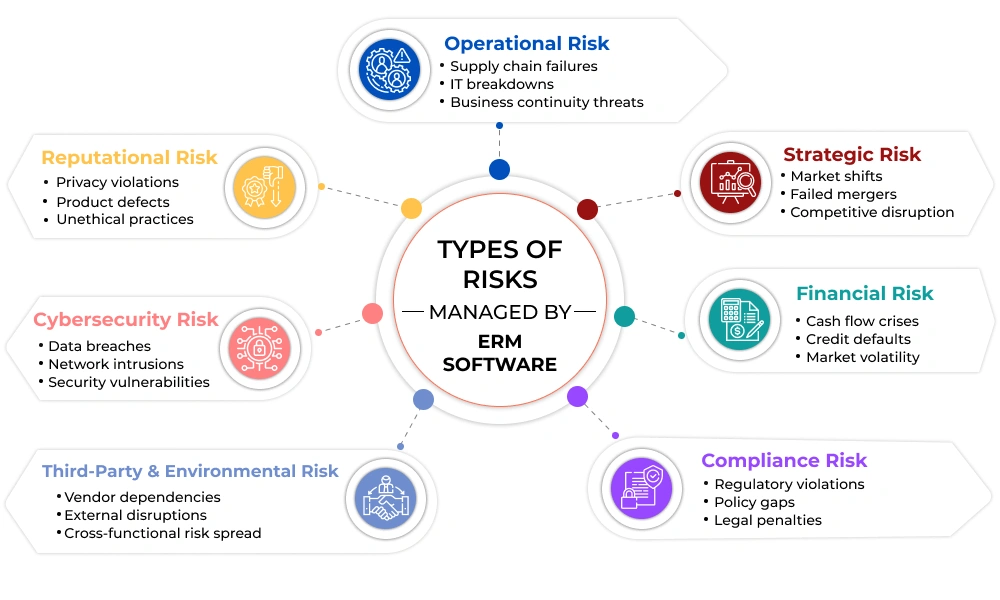
Below are the most common types of risks that Enterprise Risk Management Software helps organizations identify, track, and mitigate. By providing a centralized view of risk across the business, ERM solutions enable teams to make informed decisions and respond to potential threats more effectively.
- Strategic Risk – Competitive disruption, failed mergers, and market shifts.
- Operational Risk – Supply chain failures, IT system breakdowns, personnel issues, business continuity threats, and workplace health and safety incidents.
- Financial Risk – Cash flow crises, credit defaults, market fluctuations, and currency volatility.
- Compliance Risk – Regulatory violations and policy gaps that result in legal penalties, operational shutdowns, and lost stakeholder trust.
- Cybersecurity Risk – Data breaches, network intrusions, and technology vulnerabilities costing organizations an average of $4.44 million per incident.
- Reputational Risk – Data breaches, privacy violations, product defects, and unethical business practices.
- Third-Party and Environmental Risk – When risk hits one category, it tends to spread very readily from neighboring categories of risk.
How Enterprise Risk Management Software Improves Business Resilience
Here’s what implementing ERM software looks like in practice:
Smarter, Faster Decision-Making
Bad decisions rarely come from a lack of information or data. Most organizations struggle because they are unable to get the right data at the right time. Enterprise risk management software solutions fix this by replacing fragmented, outdated reporting with live dashboards and standardized risk intelligence that travels across the entire organization. Executives get an ongoing view of emerging threats, KRI thresholds, and mitigation progress. Risk owners get clarity on what they’re accountable for. And the board gets the visibility it needs to make strategic calls with confidence, not assumptions built on last quarter’s spreadsheet.
Proactive Risk Detection
ERM tools uncover hidden threats and opportunities that might otherwise go unnoticed by harnessing data across departments. It enables leaders to anticipate challenges and respond proactively rather than reactively. Automated threshold alerts and early warning indicators ensure that risks are raised whilst they are still controllable, rather than when damage has already occurred.
| Organizations with proactive risk management processes reduce incident response times by 60%, freeing teams to focus on analysis and strategy rather than data consolidation. |
Operational Efficiency and Resource Optimization
Risk teams are expensive, and burning their hours on duplicate assessments, chasing approvals over email, and manually updating spreadsheets is a complete waste of time for organizations. ERM software automates the routine. It schedules assessments and tracks mitigation progress so risk professionals spend their time on analysis, judgment, and strategy rather than data entry. This leads to a leaner, faster risk function that does more work with the same amount of manpower, and responds to incidents before they escalate into crises.
Increased Stakeholder Confidence
Trust is built on transparency, and transparency requires proof. Investors, regulators, and partners don’t take risk management on faith. They want to see it. Documented audit trails. Defined risk appetites. Evidence of continuous monitoring. ERM software makes all of it demonstrable and defensible. Organizations that can show a functioning, dynamic risk program can build the kind of institutional credibility that strengthens investor relationships, accelerates partnerships, and holds up under scrutiny when it matters most.
A Risk-Aware Culture Across the Organization
That is possibly the most underrated benefit: ERM embeds risk thinking into everyday operations. When every department is able to see the risks relevant to their individual functions, risk management stops being just a compliance matter. It instead becomes a regular organizational discipline that leads to collaboration, accountability, and long-term resilience.
The Role of AI In Enterprise Risk Management
According to a survey, 88% of organizations had adopted AI in one or more functions in 2025 (compared to 78% last year). That adoption is fundamentally transforming what is possible in risk management. Here’s the role of AI in enterprise risk management software solutions:
- Continuous monitoring over periodic reviews – AI analyzes transactions, vendor signals, and operational data automatically rather than waiting for the next scheduled assessment.
- Predictive risk identification – Machine learning identifies patterns across siloed business data, bringing to light the emergence of threats well before they become large-scale issues, correlating risks between departments, geographies, and risk domains that most manual processes miss.
- Automated risk scoring – It also runs historical incident data, control effectiveness metrics, and external threat intelligence side by side to consistently improve scoring accuracy as new, fresh batch of data arrives without needing manual recalibration.
- Smarter regulatory compliance – Natural Language Processing scans regulatory announcements, industry news, and competitor disclosures in real time. This helps identify regulatory shifts before they take effect.
Also Read: Predictive Analytics in Supply Chain: A Comprehensive Guide
Top Enterprise Risk Management Software Solutions in 2026
The tables below represent the strongest enterprise risk management software solutions in India today, evaluated on core capabilities, scalability, ease of use, and real-world fit.
| Platform | Best For | Key Strengths | Frameworks Supported |
| Riskonnect | Enterprise-wide ERM across all risk types | Broadest risk coverage — operational, strategic, insurable, IT, third-party; highly configurable out-of-the-box templates | ISO, COSO, SOX, GDPR, HIPAA, NIST, DORA |
| Sprinto | Cloud-first organizations automating compliance + risk | 200+ native integrations; automates 90%+ of compliance tasks; 24/7 monitoring | SOC 2, ISO 27001, HIPAA, GDPR, NIST |
| IBM OpenPages | Large enterprises needing AI-assisted GRC at scale | Unlimited entity hierarchies; AI-powered analytics; FedRAMP authorized; Cognos dashboards | SOX, GDPR, HIPAA, NIST, Basel |
| MetricStream | Highly regulated industries (banking, pharma, insurance) | Risk quantification in financial terms, a regulatory intelligence engine, extensive | COSO, ISO 31000, GDPR, HIPAA, SOX, NIST |
| LogicGate Risk Cloud | Teams needing fully configurable, no-code ERM workflows | No-code builder; Monte Carlo risk quantification; 35+ pre-built GRC apps; Open FAIR model | NIST, ISO 27001, SOC 2, HIPAA, GDPR |
| Diligent One Platform | Board-level governance and reporting | No-code builder; Monte Carlo risk quantification; 35+ pre-built GRC apps; Open FAIR model | ISO, NIST, SOX, ESG frameworks |
| AuditBoard | Audit-heavy organizations unifying ERM and SOX | Connected audit + risk workflows; strong data visualization; executive dashboards | SOX, ISO 27001, NIST, HIPAA |
| LogicManager | Mid-sized organizations needing cross-functional ERM | Taxonomy-driven risk linkages; Risk Ripple Analytics; 7,000+ no-code integrations | ISO, NIST, COSO, SOX |
| OneTrust | Privacy, data governance, and third-party digital risk | Specialized in GDPR/CCPA compliance; strong vendor risk modules; clean UI | GDPR, CCPA, ISO 27001, NIST |
| Onspring | Teams prioritizing fast setup and time-to-value | No-code configuration; Microsoft 365 integration; quick launch and measurable ROI | ISO, NIST, CMMC |
How to Choose the Right Enterprise Risk Management Software
Buyers investing in risk management solutions in 2026 prefer platforms that connect risk domains rather than treating them as separate entities. Here’s what actually matters:
- Define your program maturity first. A team migrating from spreadsheets has fundamentally different requirements than one displacing a legacy GRC platform after years of customization. Know where you are before evaluating where a platform can take you.
- Align internally before demoing anything. Agree on risk ownership structure, reporting cadence, which frameworks apply, and integration requirements. Without this alignment, demos become feature tours rather than genuine fit evaluations.
- Prioritize risk-to-control linkage. If risks live in one tool, controls in another, and evidence in an email, you will always struggle during audits and reviews. The platform must connect risks directly to controls, mitigation plans, and compliance obligations.
- Evaluate integration depth, not just the list. The best ERM platform is useless if it can’t talk to your existing systems. Ask vendors to demonstrate a live connection to your stack, not a slide deck about API capabilities.
- Pressure-test scalability and AI claims. No one really wants AI for the sake of AI, at least, not most buyers. They are seeking solutions that enable them to do less and achieve more. Ask about the workload you most want to reduce, not what AI can deliver, in theory.
- Assess the total cost of ownership over 3 years, including implementation services, configuration costs, and ongoing support, not just the licensing fee. Don’t forget to compare the prices of multiple enterprise risk management software solutions.
Wrapping Up
Risk is no longer a concern managed by a single compliance team or reviewed during quarterly audits. It now touches each and every department of the enterprise, every decision you take, and relationships you have with your stakeholders. With the integration of ERM, you will be able to gain visibility, speed, and structure to face the risk side by side instead of just reacting after the damage is already done.










 Sales Enquiries:
  Business queries:
  HR:
HR: 


