



 Healthcare Software Development Services
 Healthcare App Development Services
 Real Estate Web Development Services
 Real Estate App Development Company
 E-Commerce App Development Services
 E-Commerce Web Development Services
 Blockchain E-commerce Development Company
 Fintech Software Development
 Fintech App Development Services
 E-Learning App Development Services
 Restaurant App Development Company
 Mobile Game Development Company
 Travel App Development Company
 Automotive Web Design
 AI Traffic Management System
 AI Inventory Management Software
 Logistics App Development Services
 Machine Learning Development
 ChatGPT integration services
  AI Development Company
  AI Integration Services
  Natural Language Processing Company
 Mobile App Development
  IOS App Development
  Android App Development
  Cross-Platform App Development
  Augmented Reality (AR) App Development
  Virtual Reality (VR) App Development
  Web App Development
  SaaS App Development
 Custom Software Development Services
  Flutter
  React Native
  Swift (IOS)
  Kotlin (Android)
  Mean Stack Development
  AngularJS Development
  MongoDB Development
  Nodejs Development
  Database Development
 Ruby on Rails Development
 Expressjs Development
  Full Stack Development
  Web Development Services
  Laravel Development
  LAMP Development
  Custom PHP Development
  .Net Development
  User Experience Design Services
  User Interface Design Services
  Automated Testing
  Manual Testing
  Digital Marketing Services
 Ride-Sharing And Taxi Services
 Food Delivery Services
 Grocery Delivery Services
 Transportation And Logistics
 Car Wash App
 Home Services App
 ERP Development Services
 CMS Development Services
 LMS Development
 CRM Development
 DevOps Development Services
 AI Business Solutions
 AI Cloud Solutions
 AI Chatbot Development
 API Development
 Blockchain Product Development
 Cryptocurrency Wallet Development
 About Talentelgia
  Our Team
  Our Culture
 Healthcare App Development Services
 Real Estate Web Development Services
 E-Commerce App Development Services
 E-Commerce Web Development Services
 Blockchain E-commerce
Development Company
Blockchain E-commerce
Development Company Fintech App Development Services
 Blockchain Fintech
Development Company
Blockchain Fintech
Development Company E-Learning App Development Services
 Restaurant App Development Company
 Mobile Game Development Company
 Travel App Development Company
 AI Traffic Management System
 AI Inventory Management Software
 AI Development Company
 ChatGPT integration services
 AI Integration Services
 Machine Learning Development
 Machine learning consulting services
 Blockchain Development
 Blockchain Software Development
 Smart contract development company
 NFT marketplace development services
 Asset tokenization companies
 DeFi Wallet Development Company
 IOS App Development
 Android App Development
 Cross-Platform App Development
 Augmented Reality (AR) App
Development
Augmented Reality (AR) App
Development Virtual Reality (VR) App Development
 Web App Development
 Flutter
 React
Native
React
Native Swift
(IOS)
Swift
(IOS) Kotlin (Android)
 MEAN Stack Development
 AngularJS Development
 MongoDB Development
 Nodejs Development
 Database development services
 Expressjs Development
 Full Stack Development
 Web Development Services
 Laravel Development
 LAMP
Development
LAMP
Development Custom PHP Development
 User Experience Design Services
 User Interface Design Services
 Automated Testing
 Manual
Testing
Manual
Testing About Talentelgia
 Our Team
 Our Culture
Money is moving faster than ever. Markets shift overnight. Tax laws change. Client needs grow more complex every year. For financial advisors and institutions, keeping up manually is no longer realistic.
The modern wealth management industry runs on speed, precision, personalization, and constant visibility. Advisors are expected to manage growing portfolios, deliver data-backed financial guidance, maintain regulatory compliance, and respond to clients instantly, all without increasing operational complexity. Traditional systems were never built for this level of demand.
That shift is driving rapid adoption of wealth management technology across the financial sector. The global wealth management software market is already worth billions and growing at nearly 14% annually, one of the strongest growth rates in financial technology today.
Today’s wealth management software solutions cover a wide range of functions, from portfolio management and financial planning to reporting, compliance monitoring, risk analysis, automation, and so much more. This guide provides a complete overview of how these platforms work, the different types available, the core features firms should prioritize, and the role they play in modern wealth management operations.
What Exactly Is Wealth Management Software?
Wealth management software is a one-stop digital platform that enables financial advisors, private banks, and investment firms to manage all aspects of their clients’ financial lives from a single location. It is designed primarily for one reason: to replace the mess of spreadsheets, disparate tools, and manual processes with one integrated real-time system.
Here is what it typically handles:
- Portfolio management – monitoring investments, asset allocation and performance across every client account.
- Financial planning – retirement projections, goal setting, scenario modelling, and cash flow analysis
- Risk assessment – evaluating a client’s risk tolerance and adjusting strategies accordingly
- Compliance and reporting – staying audit-ready and meeting regulatory requirements without the manual effort
- Client relationship management (CRM) – storing client data, communication history, preferences, and financial goals in one profile
What separates modern wealth management software solutions from older systems is intelligence. Simple robo-advisors no longer suffice. Today’s platforms rely on AI integration services and machine learning development services for predictive analytics, hyper-personalization, and scaling advisory services profitably.
Modern Software vs. Traditional Systems
| Area | Wealth management software | Traditional systems |
|---|---|---|
| Data management | Centralised, unified data across all accounts and custodians with real-time sync and a single source of truth | Fragmented across spreadsheets, emails, and siloed systems, requiring constant manual reconciliation |
| Portfolio monitoring | Real-time visibility into holdings, performance, and drift with automated rebalancing triggered by rule-based logic | Periodic, delayed reporting, typically monthly statements with no live view into portfolio performance |
| Client experience | Personalised dashboards, secure client portals, proactive outreach, and 24/7 access to financial data | Reactive, advisor-led updates, clients depend entirely on scheduled calls or meetings for any visibility |
| Risk management | Continuous monitoring with AI-driven risk flags, stress testing, and proactive alerts before issues surface | Risk is reviewed periodically: problems are often identified after the fact, leaving little room for early intervention |
| Reporting | On-demand, automated, and fully customisable reports generated in minutes, tailored to each client | Manual report building, time-consuming, error-prone, and standardised rather than client-specific |
| Security | Enterprise-grade encryption, multi-factor authentication, role-based access, and continuous threat monitoring | Outdated access controls with limited encryption standards, significant exposure to modern cyber threats |
Core Features of Wealth Management Software Solutions
Not every platform is built the same. But the best share a common set of capabilities that separates functional tools from truly powerful ones. Here is what to look for.
The Must-Have Features
Portfolio Management & Analytics: Good portfolio management monitors performance across multiple asset classes and custodians in real-time. It even carries out exposure analysis and provides attribution reports that immediately display from where returns were generated. Sophisticated rebalancing engines support robust client restrictions, tax sensitivity options, and multi-asset classes to maintain portfolios in line with target allocations without human intervention.
Financial Planning Tools: Whether you are looking at retirement, education funding, buying a house or estate planning, the best platforms will be able to model all of this together simultaneously. Advisors run interactive “what-if” scenarios so clients can see the real, tangible impact of saving more, retiring later, or shifting their investment mix.
Risk Assessment & Management: Client circumstances shift even faster. Risk tools are continuously monitoring whether a portfolio continues to match the actual risk preference of your clients (and not just what they said at onboarding). Drift is detected, and the system informs it and recommends remediation to alert before intervention needs to take place.
Compliance & Reporting: Compliance in financial services is stricter than ever. Automated reporting, audit trails, and proactive risk alerts reduce the burden while protecting firms from penalties. Advisors generate custom, client-ready reports on demand with no manual formatting or data chasing.
Security: Financial data is one of the most attractive targets in the world. Multi-factor authentication, end-to-end encryption, and role-based access controls are built into enterprise-grade platforms. Others offer client-controlled encryption keys and private cloud infrastructure, effectively ensuring that not even the software provider can access client data.
API & Integration Capabilities: Modern software solutions for private wealth management thrive on connectivity. APIs are changing the way wealth managers design and deliver workflows, combining market feeds, custodian data, banking tools, and CRM development into one consistent view of truth. No tab-switching. No manual reconciliation. No data gaps.
The Features Separating Good from Great
Beyond the basics, AI-powered platforms are enabling firms to automate advanced portfolio and compliance operations. Specifically:
- Predictive AI forecasts portfolio performance and flags risks before they surface
- Generative AI auto-creates personalized client reports, financial summaries, and proposal documents
- ESG Tools build portfolios around client values like sustainability, ethics, and governance, without sacrificing returns
The Biggest Challenges in Wealth Management (And How Software Fixes Them)
Behind every modern wealth management firm are challenges that slow down growth, increase risk, and weaken client experience until they are solved through the right technology. Let us talk about them: –
Data Scattered Everywhere
The Problem: Client data is everywhere, split across stale spreadsheets, discordant emails, unintegrated CRMs and custodian portals. Advisors spend hours every week chasing the same data to respond to basic questions from clients.
The Fix: Wealth management software solutions consolidate everything in one platform. Single location for every account, transaction, document, and client note, all in real-time.
Compliance That Never Stops Changing
The Problem: Regulations shift constantly. Simultaneously serving clients in multiple countries, firms must contend not only with contradictory data privacy and reporting requirements but also with differing rules of jurisdiction. Managing this manually is not just slow; it is a serious liability.
The Fix: Automated compliance tools keep track of regulatory changes, create audit trails, and notify of concerning issues to avoid violations. Advisors stay audit-ready without dedicating their entire week to paperwork.
Generic Client Experiences
The Problem: Clients today expect personalization. Research shows 72% of high-net-worth individuals now prefer firms offering personalized products and services and they are quick to leave firms that treat them otherwise.
The Fix: AI-powered platforms build complete client profiles – goals, risk tolerance, life events, communication preferences, and use that data to deliver advice and outreach that feels genuinely tailored, not templated.
Inconsistent, Impersonal Client Experiences
The Problem: Without centralized systems, every advisor operates differently. Some clients get proactive outreach. Others hear nothing for months. There is no consistency, no standard, and no scalable way to personalize service across a growing client base.
The Fix: CRM tools, automated communication triggers, and AI-driven personalization ensure every client receives timely, relevant, and tailored interactions, regardless of which advisor they work with.
Cybersecurity Gaps That Put Everything at Risk
The Problem: Wealth management firms hold some of the most sensitive data, like client portfolios, tax records, estate plans, wire transfer instructions, and personal identification. That puts them at the top of your target list. The threat is no longer simply from hackers with password guesses. We are today bearing witness to the assault of cybercriminals deploying AI-generated phishing emails, deepfake voice scams, and ransomware that exfiltrates it to sell. Legacy systems with outdated access controls, no encryption standards, and zero threat monitoring are essentially leaving the front door open.
The Fix: Using multi-factor authentication, end-to-end encryption, role-based access controls, and continuous threat monitoring, modern wealth management platforms transform security into a competitive advantage rather than a vulnerability.
Benefits of a Wealth Management Software
Let’s take a closer look at the key benefits of a wealth management software solution: –
Stronger Assets Under Management (AUM) Growth
Assets Under Management (AUM) refers to the total value of client money and investments managed by a financial advisor or wealth management firm. Growing AUM is one of the clearest indicators of a firm’s success because it reflects stronger client trust, larger portfolios, and long-term retention.
When advisors spend less time on administrative work and more time on strategy, client portfolios are managed with greater precision and attention. Better-served clients invest more, diversify more, and trust advisors with a larger share of their overall wealth. Software creates the conditions for AUM growth, not by accident, but by design.
Client Retention That Compounds Over Time
Losing a client is rarely about performance alone. It is almost always about feeling neglected, uninformed, or underserved. Software ensures every client receives proactive communication, real-time portfolio visibility, and consistent service quality, regardless of how large the firm’s client base grows. Retention stops being a relationship skill and becomes a systems outcome.
A Measurable Competitive Edge
Firms running on modern platforms simply move faster, faster onboarding, faster reporting, faster responses to market changes. That speed is visible to clients. It builds confidence. And in a competitive market where clients have more choices than ever, that confidence is what keeps them from looking elsewhere.
Readiness for the Great Wealth Transfer
Trillions in wealth are moving from one generation to the next over the coming decades. Younger inheritors expect digital-first experiences like client portals, mobile access, and real-time data. Firms without those capabilities will not get the chance to make a case for retaining those assets.
Revenue Expansion Without Proportional Cost Growth
Modern platforms allow firms to serve significantly more clients without adding headcount at the same rate. That directly widens margins, turning operational efficiency into measurable bottom-line profitability.
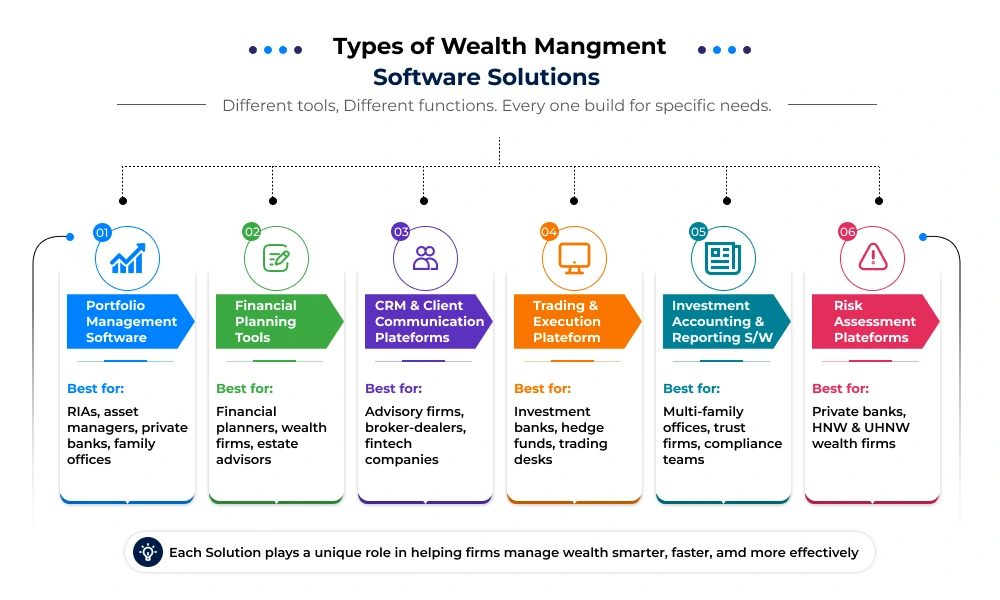
Types of Wealth Management Software Solutions
Wealth management software is not a single product. It is an entire ecosystem of specialized tools. Each of them is built for a different function, a different firm type, and a different set of client needs. Here is a breakdown of the main categories and who each one actually serves.
1. Portfolio Management Software
This kind of software tracks client investments across multiple asset classes and custodians in real time. It monitors performance, flags drift from target allocations, and automates rebalancing without manual intervention. Advisors get a live, accurate picture of every client’s holdings, not a delayed monthly snapshot.
Best for: Independent financial advisors, registered investment advisors (RIAs), asset management firms, private banks, family offices, etc.
2. Financial Planning Tools
These platforms go well beyond investment selection. They model retirement scenarios, education funding, estate planning, and cash flow projections through interactive dashboards. Interactive goal tracking and scenario modelling allow advisors to show clients exactly how financial decisions shape their futures.
Best for: RIAs, holistic financial planners, wealth management firms, family offices, estate planning professionals, insurance-linked advisory firms, etc.
3. CRM & Client Communication Platforms
CRM platforms monitor all life events and record every single client touchpoint, automate the follow-ups, and also determine the perfect time to reach out. The best software solution for private wealth managers is one that acts in concert with your planning and portfolio tools, maintaining client information across systems without redundant entry.
Best for: Boutique advisory firms, large broker-dealers, private banks, insurance companies with advisory arms, fintech startups, and any client-facing financial business where relationship management and retention directly drive revenue.
4. Trading & Execution Platforms
Built for speed and precision. These end-user platforms provide direct market access, execute multi-asset orders, and typically feature algorithmic trading powers and pricing feeds that read from real-time sources. Time is of the essence here, and these tools are built around that.
Best for: Active wealth managers, investment banks, brokerage firms, hedge funds, proprietary trading desks, and institutional investors executing high-volume or algorithmically driven strategies across multiple asset classes.
5. Investment Accounting & Reporting Software
Manages the full back-office financial infrastructure, like performance calculations, tax reporting, billing fees, reconciliation, and documentation needed for compliance. Addepar, for example, aggregates data from public and private investments into a single dashboard in near-real time, providing transparency across the most complex multi-asset holdings, addressing both values and performance attribution.
Best for: Multi-family offices, trust companies, fund administrators, compliance teams within large financial institutions, accounting firms serving investment clients, and any firm managing alternative, illiquid, or cross-border assets.
6. Risk Assessment Platforms
Dedicated tools to measure client risk appetite, stress-test portfolios against market scenarios, and highlight exposure discrepancies before they become an issue. They add an element of detachment to what is usually a purely emotional dialogue between adviser and client.
Best for: Private banks, wealth management firms serving high-net-worth and ultra-high-net-worth clients.
Top Wealth Management Software Solutions in 2026
There are hundreds of platforms competing for attention. Therefore, choosing the right one matters much more than ever. Here are the top six solutions worth your time:
Crunchbase
Crunchbase gives wealth managers access to predictive private market intelligence that helps identify high-net-worth prospects before major liquidity events occur. Unlike traditional research platforms focused on historical performance, Crunchbase combines private company data, investor activity, proprietary partnerships, government filings, and AI models to deliver predictive intelligence across millions of companies worldwide.
It offers:
- AI-powered predictions for IPOs, acquisitions, and funding events
- Real-time private company intelligence and trend tracking
- CRM and analytics integrations for advisor workflows
- API access for embedding market intelligence into existing systems
- Visibility into emerging private market opportunities
Best for: Wealth managers, private banks, and advisory firms tracking private market opportunities and liquidity events
Empower
Empower covers the gap between robo-advisory convenience and real human guidance. It’s Personal Dashboard gives users a complete view of every financial account in one place, be it savings, investments, retirement, or daily spending.
It offers:
- Full financial account aggregation with goal tracking
- Access to human advisors for personalised strategy
- High-yield savings with competitive APY for cash growth
Best for: Individuals seeking a blend of digital tools and human advisory access
Salesforce Financial Services Cloud
Salesforce Financial Services Cloud remains one of the most widely used wealth management platforms for advisory firms, centralising client profiles, meeting history, financial goals, and communication tracking in one place.
- Centralised client journey management across the full advisory lifecycle
- Einstein AI for engagement recommendations and performance modelling
- Deep integration across the broader Salesforce product ecosystem
Best for: Large advisory firms already embedded in the Salesforce ecosystem
Betterment
Betterment pioneered automated investing and remains one of the most trusted names in the space. It’s very simple to use. Users select a goal, set a timeline, and the platform handles everything else.
- Automated portfolio management with zero manual intervention
- Tax-advantaged IRAs, including Traditional, Roth, and SEP options
- High-yield cash reserve account with strong FDIC insurance coverage
Best for: Beginner to intermediate investors who prefer a hands-off approach
Wealthfront
Wealthfront’s award-winning robo-advisory engine is built around one promise – maximising after-tax returns without requiring the investor to do anything. The platform handles rebalancing, reinvestment, and tax-loss harvesting automatically.
- Industry-recognised automated investing with full rebalancing
- Automated bond ladder using US Treasuries
- Thematic stock collections and ETFs with zero commission trading
Best for: Long-term investors who value automation and tax efficiency
Creatio
Creatio operates at an entirely different level from the other consumer platforms mentioned above. It is an AI-native CRM and no-code workflow automation platform built specifically for investment managers, financial advisors, and wealth management firms. Its composable architecture allows firms to customise every workflow without writing a single line of code. Its 700+ third-party integrations mean it connects cleanly with virtually any existing tech stack.
- 360-degree client profiles with full portfolio, risk, and interaction history
- AI-powered KYC, onboarding, and case management automation
- Starting from $40 per user/month with AI included across all plans
Best for: Financial advisory firms and wealth management businesses needing enterprise-grade CRM with AI
Wrapping Up
Wealth management is no longer built on relationships alone. It now relies on how intelligently a firm can turn data, technology, and human advice into a seamless client experience. Successful firms today operate with better systems, faster insights, stronger personalization, and infrastructure designed to scale without sacrificing trust.

That is exactly where modern wealth management software solutions create their value. They remove operational friction, strengthen compliance, improve decision-making, and give advisors more time to focus on what clients actually care about, building and protecting wealth.

Because in an industry where expectations rise every year, technology is no longer supporting the business. It is becoming the business advantage itself.










 Sales Enquiries:
  Business queries:
  HR:
HR: 


