


 Healthcare Software Development Services
 Healthcare App Development Services
 Real Estate Web Development Services
 Real Estate App Development Company
 E-Commerce App Development Services
 E-Commerce Web Development Services
 Blockchain E-commerce Development Company
 Fintech Software Development
 Fintech App Development Services
 E-Learning App Development Services
 Restaurant App Development Company
 Mobile Game Development Company
 Travel App Development Company
 Automotive Web Design
 AI Traffic Management System
 AI Inventory Management Software
 Logistics App Development Services
 Machine Learning Development
 ChatGPT integration services
  AI Development Company
  AI Integration Services
  Natural Language Processing Company
 Mobile App Development
  IOS App Development
  Android App Development
  Cross-Platform App Development
  Augmented Reality (AR) App Development
  Virtual Reality (VR) App Development
  Web App Development
  SaaS App Development
 Custom Software Development Services
  Flutter
  React Native
  Swift (IOS)
  Kotlin (Android)
  Mean Stack Development
  AngularJS Development
  MongoDB Development
  Nodejs Development
  Database Development
 Ruby on Rails Development
 Expressjs Development
  Full Stack Development
  Web Development Services
  Laravel Development
  LAMP Development
  Custom PHP Development
  .Net Development
  User Experience Design Services
  User Interface Design Services
  Automated Testing
  Manual Testing
  Digital Marketing Services
 Ride-Sharing And Taxi Services
 Food Delivery Services
 Grocery Delivery Services
 Transportation And Logistics
 Car Wash App
 Home Services App
 ERP Development Services
 CMS Development Services
 LMS Development
 CRM Development
 DevOps Development Services
 AI Business Solutions
 AI Cloud Solutions
 AI Chatbot Development
 API Development
 Blockchain Product Development
 Cryptocurrency Wallet Development
 About Talentelgia
  Our Team
  Our Culture
 Healthcare App Development Services
 Real Estate Web Development Services
 E-Commerce App Development Services
 E-Commerce Web Development Services
 Blockchain E-commerce
Development Company
Blockchain E-commerce
Development Company Fintech App Development Services
 Blockchain Fintech
Development Company
Blockchain Fintech
Development Company E-Learning App Development Services
 Restaurant App Development Company
 Mobile Game Development Company
 Travel App Development Company
 AI Traffic Management System
 AI Inventory Management Software
 AI Development Company
 ChatGPT integration services
 AI Integration Services
 Machine Learning Development
 Machine learning consulting services
 Blockchain Development
 Blockchain Software Development
 Smart contract development company
 NFT marketplace development services
 Asset tokenization companies
 DeFi Wallet Development Company
 IOS App Development
 Android App Development
 Cross-Platform App Development
 Augmented Reality (AR) App
Development
Augmented Reality (AR) App
Development Virtual Reality (VR) App Development
 Web App Development
 Flutter
 React
Native
React
Native Swift
(IOS)
Swift
(IOS) Kotlin (Android)
 MEAN Stack Development
 AngularJS Development
 MongoDB Development
 Nodejs Development
 Database development services
 Expressjs Development
 Full Stack Development
 Web Development Services
 Laravel Development
 LAMP
Development
LAMP
Development Custom PHP Development
 User Experience Design Services
 User Interface Design Services
 Automated Testing
 Manual
Testing
Manual
Testing About Talentelgia
 Our Team
 Our Culture
The impact of bad code has always been costly! Since the 1980s, researchers have discovered that it can cost up to 100 times more to fix the issue after release than it would be to track down and fix a bug at an early stage. A CISQ report from 2022 revealed that the accumulated software technical debt has reached the ~$2 trillion mark! It is crucial to know that technical debt is not just a technical issue, but a business issue also. Failing to manage technical debt can directly affect your company’s profitability and competitiveness. A proper technical debt management process has become one of the top priorities for organisations.
Fast forward to 2026, bad code is still rampant in companies, pressing issues at times when businesses are increasingly dependent on the prowess of their software to run their operations and keep them competitive. While Generative AI has the potential to change how developers write and inspect code, and could take over some of that writing, the reality is that humans will always be in the loop.
And humans aren’t perfect, and GenAI tools, ever growing, it should be assumed there will always be mistakes. You must treat software as a business-critical asset, and that means the impact of bad code on software development cannot be underestimated but rather mitigated to ensure you succeed in your own business.
Read More:- How to Develop a Generative AI Solution?
Understanding Bad Code Beyond The Surface: The Hidden Cost
Software should help you to speed things up, not make everything slower. But over time, as codebases expand, each additional feature, patch, or integration gets harder and riskier, and more expensive to deliver. It is not due to the shortage of developers or tools; it’s something less visible, yet more impactful— Bad Code quality!
When build quality goes down, the price of change for every change grows. Teams spend more time fixing and testing and less time innovating. Overheads increase, deadlines creep, and the software portfolio slowly becomes a competitive advantage, turning into a liability. In summary, Poor code quality compounds operational cost and risk over time.
Read more:- A Complete Guide to the Best Low-Code Platforms in 2026
What Is Bad Code?
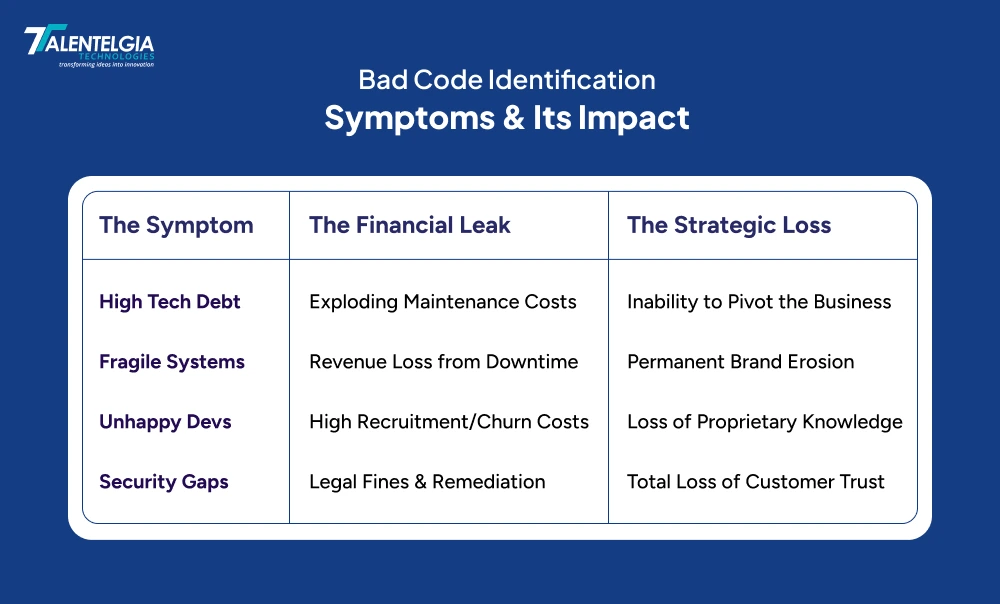
Bad code—often referred to as “Spaghetti Code” or “Technical Debt” is software that is written poorly, lacks documentation, or ignores best practices. While it might “work” today, it is fragile, difficult to read, and nearly impossible to change without breaking something else.
In 2026, bad code also includes “Lazy AI Code”, software generated by AI tools that was never properly vetted or refactored by a human architect, leading to bloated, insecure, and inefficient systems.
How To Identify Bad Code?
You don’t need to be a developer to spot the symptoms of a decaying codebase. Look for these business-level warning signs:
- Unnecessary Complexity
Bad code often suffers from “Over-Engineering.” This happens when a developer builds a massive, complex solution for a simple problem, or uses “clever” coding tricks that no one else can understand.
- Poor Structure
Think of your code like the blueprints of a building. Poor structure (or “Spaghetti Code”) means there is no clear organization. Logic is scattered everywhere, and different parts of the app are tangled together.
- Lack of Documentation
Code should tell a story. If there are no comments, README files, or architectural diagrams explaining why certain decisions were made, the code is “Silent.”
- Code Duplication
This is the “Copy-Paste” trap. Instead of creating a single, reusable tool, a developer copies the same block of code into ten different places.
- Excessive Dependencies
Modern software relies on external “libraries” and “packages” to function. However, bad code often relies on too many of them.
Why Does Bad Code Happen?
Bad code happens not because of bad developers; it is usually a result of Bad Management. Nobody wakes up every morning thinking, “Today, I will write horrible and unmaintainable code”. Bad code happens because:
- Tight Deadlines: Extreme pressure to hit unrealistic deadlines forces developers to take shortcuts.
- Lack of Code Reviews: Skipping the peer-review process allows “quick and dirty” fixes to become permanent.
- Inexperienced AI Usage: Over-reliance on AI coding assistants without senior-level oversight.
- Scope Creep: Constantly changing requirements mid-sprint leads to “bolted-on” logic that doesn’t fit the original architecture.
The Expansive Consequences of Bad Code On Businesses
When bad code infiltrates your system, it acts like a high-interest loan that your business never authorized. In 2026, where digital agility is a competitive requirement, poor coding doesn’t just cause minor issues, it slows development, drains budget, frustrates teams, and ultimately huts the businesses. Here is how “Bad Code” transforms from a technical annoyance into a full-scale business crisis.
1. The Spiral of Growing Technical Debt
Every shortcut taken today is a bill you’ll have to pay tomorrow—with interest. Technical debt is the cumulative cost of additional rework caused by choosing an easy, messy solution now instead of a better approach that would take longer.
Business Impact: Eventually, the “interest” becomes so high that your entire budget is spent just keeping the old system alive, leaving $0 for innovation.
2. The “Fixing vs. Building” Trap
When code is poorly written, your expensive engineering talent spends 70–80% of their time “archaeologically” digging through old bugs rather than building new features.
Business Impact: You aren’t paying for a development team; you’re paying for a digital maintenance crew. Your “Product Roadmap” essentially grinds to a halt.
3. Frequent Production Failures (and Angry Customers)
Bad code is inherently fragile. A small update in one area can cause a “domino effect” that crashes the entire system.
Business Impact: In 2026, customers have zero patience for “glitches.” Frequent downtime leads to high Churn Rates and directly pushes your clients into the arms of your competitors.
4. Loss of Productivity and Developer Frustration
Top-tier developers want to build great things, not move “digital sludge.” Working in a messy codebase is mentally draining and leads to rapid burnout.
Business Impact: Your most productive people will leave first because they have the most options. You are left with a demoralized team and a culture of “just getting by.”
5. Difficulty Hiring and Onboarding New Developers
When a codebase lacks structure and documentation, it can take a new hire 3–6 months to become productive. Furthermore, word gets out in the developer community; nobody wants to join a “sinking ship” of bad code.
Business Impact: Your recruitment costs skyrocket, and your “Time-to-Value” for new hires becomes a massive financial drain.
6. Critical Security Vulnerabilities
Messy code is a playground for hackers. When logic is tangled and dependencies are unmanaged, it is nearly impossible to audit the system for security holes.
Business Impact: Most modern data breaches aren’t caused by “super-hackers,” but by simple, overlooked flaws in poorly written code. One breach can cost millions in legal fees and 2026 compliance fines.
7. Long-Term Damage to Your Company’s Reputation
In a world of instant reviews and social media, a “buggy” product becomes your brand identity. Once you are known for having “unreliable software,” it takes years of perfect performance to win back market trust.
Business Impact: You lose “Market Authority.” Partners will be hesitant to integrate with your API, and investors will see your technical debt as a massive liability during valuation.
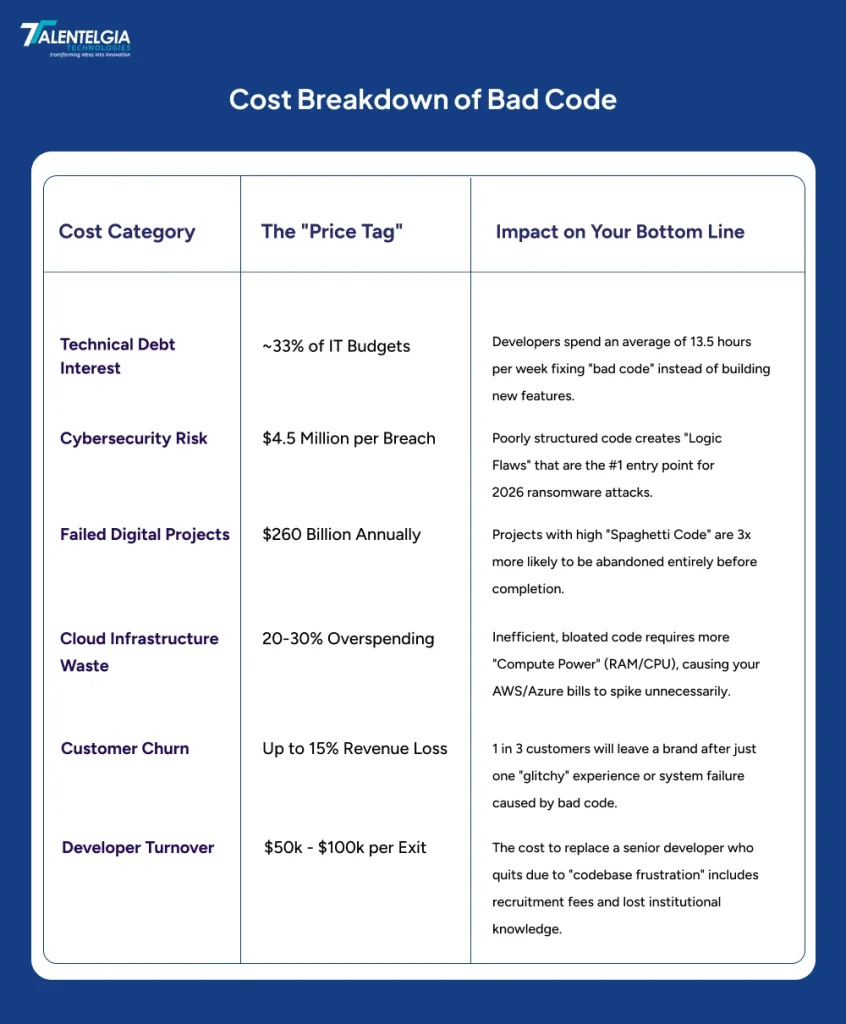
The Real Cost of Bad Code: Breaking Down ROI
When you ignore code quality, you aren’t just slowing down; you are actively leaking capital. Here is how those costs break down based on the most credible 2026 industry benchmarks.
How To Avoid The Cost of Bad Code?
Yes, as we already know: the cost of bad code is high! But here’s the good news— It can be prevented! Steering clear of the common issues created by poor software quality is a practice in project management, engineering best practices, and continuous improvement.
Although you can’t eliminate technical debt, you can manage it so it doesn’t sink your business. Thus, drawing on industry best practices and especially our experience, here’s how to deal with bad code and prevent it from creeping into your projects.
1. Follow Proven Software Engineering Principles
Modern development requires a “Back to Basics” approach. Adhering to standards like SOLID (for object-oriented design) and DRY (Don’t Repeat Yourself) ensures that code is modular and reusable.
The Strategy: Use AI-driven linting tools that automatically enforce these principles in real-time. If a developer tries to commit “spaghetti logic,” the system flags it before it ever reaches the repository.
2. Invest in Resilient Architecture
Architecture is the foundation of your digital house. A “Good Architecture” is decoupled, meaning a change in the payment system shouldn’t break the user profile page.
The Strategy: Prioritize Microservices or Modular Monoliths that allow teams to work independently. In 2026, “Clean Architecture” is the gold standard for ensuring that your business logic stays separate from external tools and databases.
3. Prioritize Code Reviews & Knowledge Sharing
Code should never be a “solo sport.” Rigorous peer reviews are the best defense against “The Lone Wolf” syndrome.
The Strategy: Treat code reviews as a knowledge-sharing session, not a police inspection. Use “Mob Programming” or “Pair Programming” for complex features to ensure that at least two people understand every critical line of code, preventing “Brain Drain” if a developer leaves.
4. Write Tests—And Actually Run Them
In 2026, “Manual Testing” is a relic of the past. To avoid the cost of bad code, you must implement Automated Testing Suites (Unit, Integration, and End-to-End tests).
The Strategy: Adopt Test-Driven Development (TDD), where tests are written before the code. More importantly, ensure these tests are part of a CI/CD Pipeline—if the tests don’t pass, the code cannot be deployed. This “Quality Gate” is your strongest shield against production failures.
5. Deeply Understand the Business Domain
Bad code often happens because developers don’t understand what they are building for. When code doesn’t align with business logic, you end up with “clunky” workarounds.
The Strategy: Use Domain-Driven Design (DDD). Developers should speak the same language as the marketing and sales teams. When the code accurately reflects the business domain, it becomes much more intuitive and easier to maintain as the business evolves.
6. Avoid Rushed Decisions & “Quick Fix” Culture
The most expensive code is the code written to meet an arbitrary Friday deadline. “Quick fixes” almost always become permanent technical debt.
The Strategy: Implement a “Technical Debt Ceiling.” If the debt gets too high, the team stops building new features and spends a full sprint “refactoring” (cleaning) the codebase. Educate leadership that “Slow is smooth, and smooth is fast”—quality code actually accelerates long-term growth.
Conclusion
Poor coding and technical debt are inevitable in software development, but they don't have to be a drag. Discovering its causes and preemptively addressing its effects will mean that technical debt won't prevent you from delivering on your projects or obstruct your innovation. To reemphasise, technical debt is not simply a technical matter; it’s a business one. Accumulated technical debt has a significant negative impact on your company’s bottom line. Deciding to invest in strategies and tools to manage technical debt is an investment in your company’s future. For more information, contact our software experts at Talentelgia!












 Sales Enquiries:
  Business queries:
  HR:
HR: 


