



 Healthcare Software Development Services
 Healthcare App Development Services
 Real Estate Web Development Services
 Real Estate App Development Company
 E-Commerce App Development Services
 E-Commerce Web Development Services
 Blockchain E-commerce Development Company
 Fintech Software Development
 Fintech App Development Services
 E-Learning App Development Services
 Restaurant App Development Company
 Mobile Game Development Company
 Travel App Development Company
 Automotive Web Design
 AI Traffic Management System
 AI Inventory Management Software
 Logistics App Development Services
 Machine Learning Development
 ChatGPT integration services
  AI Development Company
  AI Integration Services
  Natural Language Processing Company
 Mobile App Development
  IOS App Development
  Android App Development
  Cross-Platform App Development
  Augmented Reality (AR) App Development
  Virtual Reality (VR) App Development
  Web App Development
  SaaS App Development
 Custom Software Development Services
  Flutter
  React Native
  Swift (IOS)
  Kotlin (Android)
  Mean Stack Development
  AngularJS Development
  MongoDB Development
  Nodejs Development
  Database Development
 Ruby on Rails Development
 Expressjs Development
  Full Stack Development
  Web Development Services
  Laravel Development
  LAMP Development
  Custom PHP Development
  .Net Development
  User Experience Design Services
  User Interface Design Services
  Automated Testing
  Manual Testing
  Digital Marketing Services
 Ride-Sharing And Taxi Services
 Food Delivery Services
 Grocery Delivery Services
 Transportation And Logistics
 Car Wash App
 Home Services App
 ERP Development Services
 CMS Development Services
 LMS Development
 CRM Development
 DevOps Development Services
 AI Business Solutions
 AI Cloud Solutions
 AI Chatbot Development
 API Development
 Blockchain Product Development
 Cryptocurrency Wallet Development
 About Talentelgia
  Our Team
  Our Culture
 Healthcare App Development Services
 Real Estate Web Development Services
 E-Commerce App Development Services
 E-Commerce Web Development Services
 Blockchain E-commerce
Development Company
Blockchain E-commerce
Development Company Fintech App Development Services
 Blockchain Fintech
Development Company
Blockchain Fintech
Development Company E-Learning App Development Services
 Restaurant App Development Company
 Mobile Game Development Company
 Travel App Development Company
 AI Traffic Management System
 AI Inventory Management Software
 AI Development Company
 ChatGPT integration services
 AI Integration Services
 Machine Learning Development
 Machine learning consulting services
 Blockchain Development
 Blockchain Software Development
 Smart contract development company
 NFT marketplace development services
 Asset tokenization companies
 DeFi Wallet Development Company
 IOS App Development
 Android App Development
 Cross-Platform App Development
 Augmented Reality (AR) App
Development
Augmented Reality (AR) App
Development Virtual Reality (VR) App Development
 Web App Development
 Flutter
 React
Native
React
Native Swift
(IOS)
Swift
(IOS) Kotlin (Android)
 MEAN Stack Development
 AngularJS Development
 MongoDB Development
 Nodejs Development
 Database development services
 Expressjs Development
 Full Stack Development
 Web Development Services
 Laravel Development
 LAMP
Development
LAMP
Development Custom PHP Development
 User Experience Design Services
 User Interface Design Services
 Automated Testing
 Manual
Testing
Manual
Testing About Talentelgia
 Our Team
 Our Culture
Hiring developers is one of the most important decisions a founder makes — and one of the costliest when it doesn’t work out. From vague requirements and hurried hiring to the wrong skill set and hidden costs, it’s scary out there. As more and more startups hire programmers, internet-wide, they have to change their hiring strategies when hiring a developer during COVID. The technical skills that it takes to hire a software developer. However, in the current time and date, hiring a programmer is more than just digging into his technical knowledge, wherein you should judge his communication skills, ownership, time zone alignment , reliability for the long term, etc. These kinds of obstacles are particularly prevalent when founders are working to determine how they can hire remote developers for a startup with very little time and even less money.
This guide takes you through step by step on how to hire remote developers, along with guidance on how to hire a full-stack developer, and clears up the question, How much does it cost to hire an app developer? By uncovering true hiring stumbling blocks and implementing practical fixes, it empowers founders to hire their strong, scalable remote development team with no fear.
Who are Remote Developers?
Remote developers are software engineers who perform application development remotely, that is to say, from outside a company’s physical office. They work in partnership with teams via digital tools, follow clear workflows, and deliver code remotely — sometimes even on the other side of a city, state, or country. Organizations opt for remote developers to hire talent from across the globe, irrespective of geographical confines.
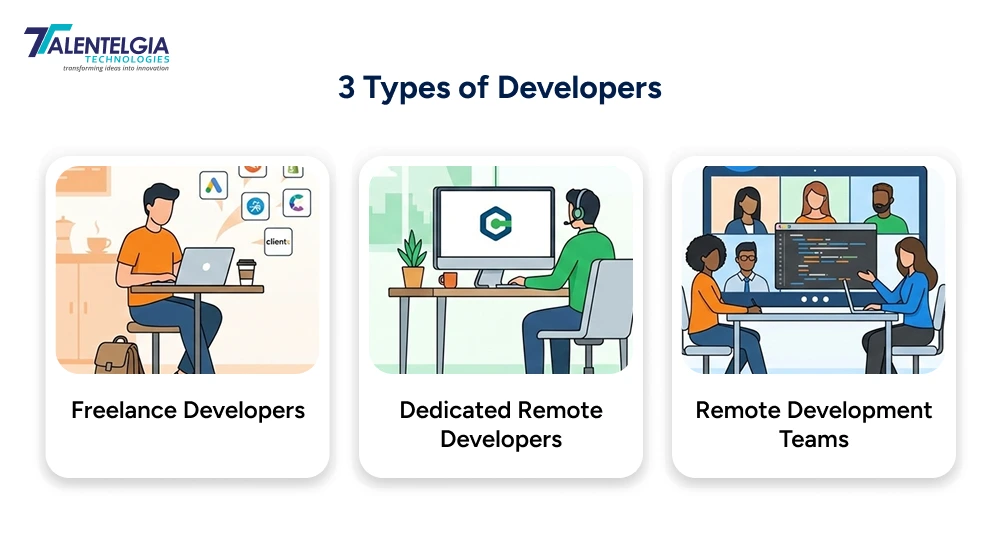
Remote developers can be freelancers, dedicated resources, or part of distributed software development teams, unlike in-house staff. Knowing how to hire a software developer in a remote environment involves more than just reviewing resumes; it’s about evaluating communication skills, accountability, and the ability to work independently while staying aligned with broader business and software development goals.
For startups and fast-growing businesses, having the knowledge of how to recruit developers remotely equals faster scaling, lower costs , and affordability. When executed effectively, remote developers work as an extension of the in-house team producing identical levels of quality, ownership, and impact to on-site engineers.
How to Hire Remote Developers?: 8 Steps
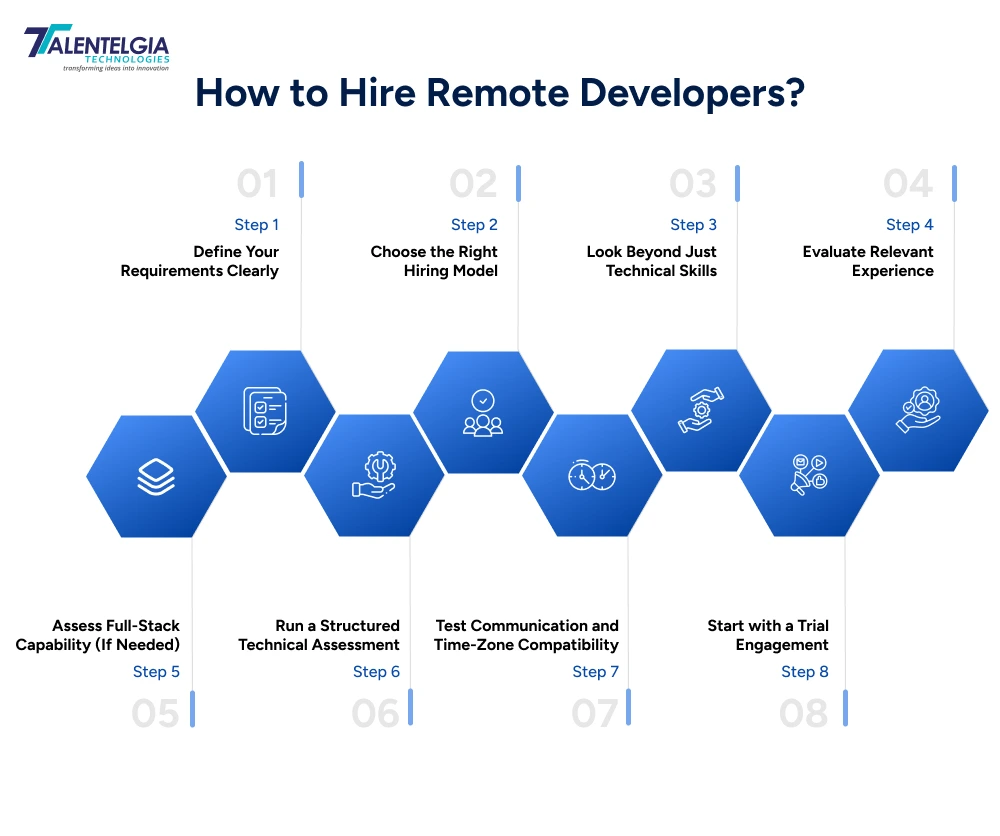
Step 1: Define Your Requirements Clearly
Before you contract remote developers, make sure that your tech stack and project scope is as clear as can be to avoid misinterpretations. Unclear requirements make up one of the most common hiring mistakes.
Before you hire remote developers, pause and answer this:
✔ What problem does the product solve?
✔ What features are needed now vs later?
✔ What tech stack fits your timeline and budget?
Clear answers here prevent rework, delays, and bad hires.
Step 2: Choose the Right Hiring Model
Decide whether you need a freelancer, a dedicated remote developer, or a full remote team based on your budget, project size, and long-term goals.
Ask yourself:
- Need speed and flexibility? → Freelancer
- Need ownership and consistency? → Dedicated remote developer
- Need scale and structure? → Remote development team
Choosing the wrong model is a silent budget killer.
Step 3: Look Beyond Just Technical Skills
Knowing how to hire developers isn’t only about coding ability. Assess communication skills, problem-solving approach, and how well they work independently.
Knowing how to hire developers means testing clarity, not just skills.
Ask:
✔ Can they explain their thought process?
✔ Do they ask the right questions?
✔ Are they proactive or reactive?
Remote success depends on communication first, code second.
Step 4: Evaluate Relevant Experience
When deciding how to hire a software developer, prioritize candidates with experience in similar products, industries, or architectures, not just generic portfolios. When learning how to hire a software developer, don’t stop at resumes. If your project is PHP or Laravel-based, having a framework-specific evaluation checklist makes this step even more effective. A detailed Laravel Developer Hiring Guide can help you ask the right technical questions and assess candidates more accurately.
When learning how to hire a software developer, don’t stop at resumes.
Check:
✔ Similar products or industries
✔ Decision-making in past projects
✔ Ability to handle real-world constraints
Experience reduces surprises later.
Step 5: Assess Full-Stack Capability (If Needed)
If your project demands versatility, understand how to hire a full stack developer who can handle both front-end and back-end responsibilities efficiently.
Before deciding how to hire a full stack developer, ask:
- One person for speed?
- Specialists for scale?
Hiring “everything in one” can help early—but hurt later if misused.
Step 6: Run a Structured Technical Assessment
Use coding tests, real-world tasks, or pair-programming sessions to evaluate code quality, logic, and decision-making—not just speed.
Skip trick questions. Use real scenarios:
✔ Small paid task
✔ Pair programming
✔ Code review from an actual feature
This shows how they’ll work with your team, not just for you.
Step 7: Test Communication and Time-Zone Compatibility
Successful remote work depends on clear communication, overlap hours, and responsiveness. This step is critical when you hire remote developers across regions.
Remote hiring works best with clarity:
✔ Overlap hours defined
✔ Response expectations set
✔ Communication tools agreed
This is where many founders underestimate friction.
Step 8: Start with a Trial Engagement
Before committing long-term, begin with a paid trial. This helps founders validate skills, reliability, and cultural fit—especially important when figuring out how to hire developers for a startup.
Smart founders start small.
A paid trial helps you validate:
✔ Skill consistency
✔ Ownership mindset
✔ Cultural fit
This step is especially critical when learning how to hire developers for a startup.
How much does it cost to hire a Developer?
The cost to hire a developer is influenced by several different things – where they’re located, what kind of tech stack you need help with, how experienced they are, and even what model you use to work with them. The point of founders seeking out app developers: there’s no one-size-fits-all answer, but knowing these ranges might prevent sticker shock down the road.
Location plays a major role: Devs in North America and Western European countries come with a premium price tag, while Eastern Europe, India and Southeast Asia have talent available at substantially lower costs. This is just one of the reasons why startups opt for remote developers at a global scale.In this context, working with a tech staffing partner in India helps founders reduce common remote hiring risks. Staffing partners handle vetting and screening, shorten hiring cycles, and improve role fit—while still leveraging India’s large, cost-efficient developer talent pool.
Role and level of experience also factor into what people charge. Junior developers are cheaper but require more oversight; senior/full-stack developers have higher rates because of their knowledge and decision-making authority. The model of engagement also counts — freelancers might cost less in the short-term, but committed remote developers or teams tend to offer better value and stability for the long run.
For founders and startups, the secret is not finding once upon a time cheap developers — it’s about hiring those who produce sustainable output that minimizes rework while scaling with your product. The right hiring model and clear requirements frequently save more than any cheap hourly rate.
Conclusion
Hiring remote developers can be a growth accelerator — or an expensive blunder based on how deliberately the process is managed. Everything from knowing who remote developers are to the choice of hiring model will dictate long-term success.
How to hire developers is critical to the future success of founders, and it’s not solely about getting butts in seats – it’s understanding who will be conducive to building a product according to brand vision, budget, and growth stage. When you prioritize clear requirements, effective communication, and smart evaluation, hiring remote developers that actually bring something to the table isn’t all that hard.

By steering clear of these pitfalls and taking a process-driven approach, startups can scale their tech teams with confidence while cost-effectively building products poised for the next stage of growth.













 Sales Enquiries:
  Business queries:
  HR:
HR: 


