



 Healthcare Software Development Services
 Healthcare App Development Services
 Real Estate Web Development Services
 Real Estate App Development Company
 E-Commerce App Development Services
 E-Commerce Web Development Services
 Blockchain E-commerce Development Company
 Fintech Software Development
 Fintech App Development Services
 E-Learning App Development Services
 Restaurant App Development Company
 Mobile Game Development Company
 Travel App Development Company
 Automotive Web Design
 AI Traffic Management System
 AI Inventory Management Software
 Logistics App Development Services
 Machine Learning Development
 ChatGPT integration services
  AI Development Company
  AI Integration Services
  Natural Language Processing Company
 Mobile App Development
  IOS App Development
  Android App Development
  Cross-Platform App Development
  Augmented Reality (AR) App Development
  Virtual Reality (VR) App Development
  Web App Development
  SaaS App Development
 Custom Software Development Services
  Flutter
  React Native
  Swift (IOS)
  Kotlin (Android)
  Mean Stack Development
  AngularJS Development
  MongoDB Development
  Nodejs Development
  Database Development
 Ruby on Rails Development
 Expressjs Development
  Full Stack Development
  Web Development Services
  Laravel Development
  LAMP Development
  Custom PHP Development
  .Net Development
  User Experience Design Services
  User Interface Design Services
  Automated Testing
  Manual Testing
  Digital Marketing Services
 Ride-Sharing And Taxi Services
 Food Delivery Services
 Grocery Delivery Services
 Transportation And Logistics
 Car Wash App
 Home Services App
 ERP Development Services
 CMS Development Services
 LMS Development
 CRM Development
 DevOps Development Services
 AI Business Solutions
 AI Cloud Solutions
 AI Chatbot Development
 API Development
 Blockchain Product Development
 Cryptocurrency Wallet Development
 About Talentelgia
  Our Team
  Our Culture
 Healthcare App Development Services
 Real Estate Web Development Services
 E-Commerce App Development Services
 E-Commerce Web Development Services
 Blockchain E-commerce
Development Company
Blockchain E-commerce
Development Company Fintech App Development Services
 Blockchain Fintech
Development Company
Blockchain Fintech
Development Company E-Learning App Development Services
 Restaurant App Development Company
 Mobile Game Development Company
 Travel App Development Company
 AI Traffic Management System
 AI Inventory Management Software
 AI Development Company
 ChatGPT integration services
 AI Integration Services
 Machine Learning Development
 Machine learning consulting services
 Blockchain Development
 Blockchain Software Development
 Smart contract development company
 NFT marketplace development services
 Asset tokenization companies
 DeFi Wallet Development Company
 IOS App Development
 Android App Development
 Cross-Platform App Development
 Augmented Reality (AR) App
Development
Augmented Reality (AR) App
Development Virtual Reality (VR) App Development
 Web App Development
 Flutter
 React
Native
React
Native Swift
(IOS)
Swift
(IOS) Kotlin (Android)
 MEAN Stack Development
 AngularJS Development
 MongoDB Development
 Nodejs Development
 Database development services
 Expressjs Development
 Full Stack Development
 Web Development Services
 Laravel Development
 LAMP
Development
LAMP
Development Custom PHP Development
 User Experience Design Services
 User Interface Design Services
 Automated Testing
 Manual
Testing
Manual
Testing About Talentelgia
 Our Team
 Our Culture
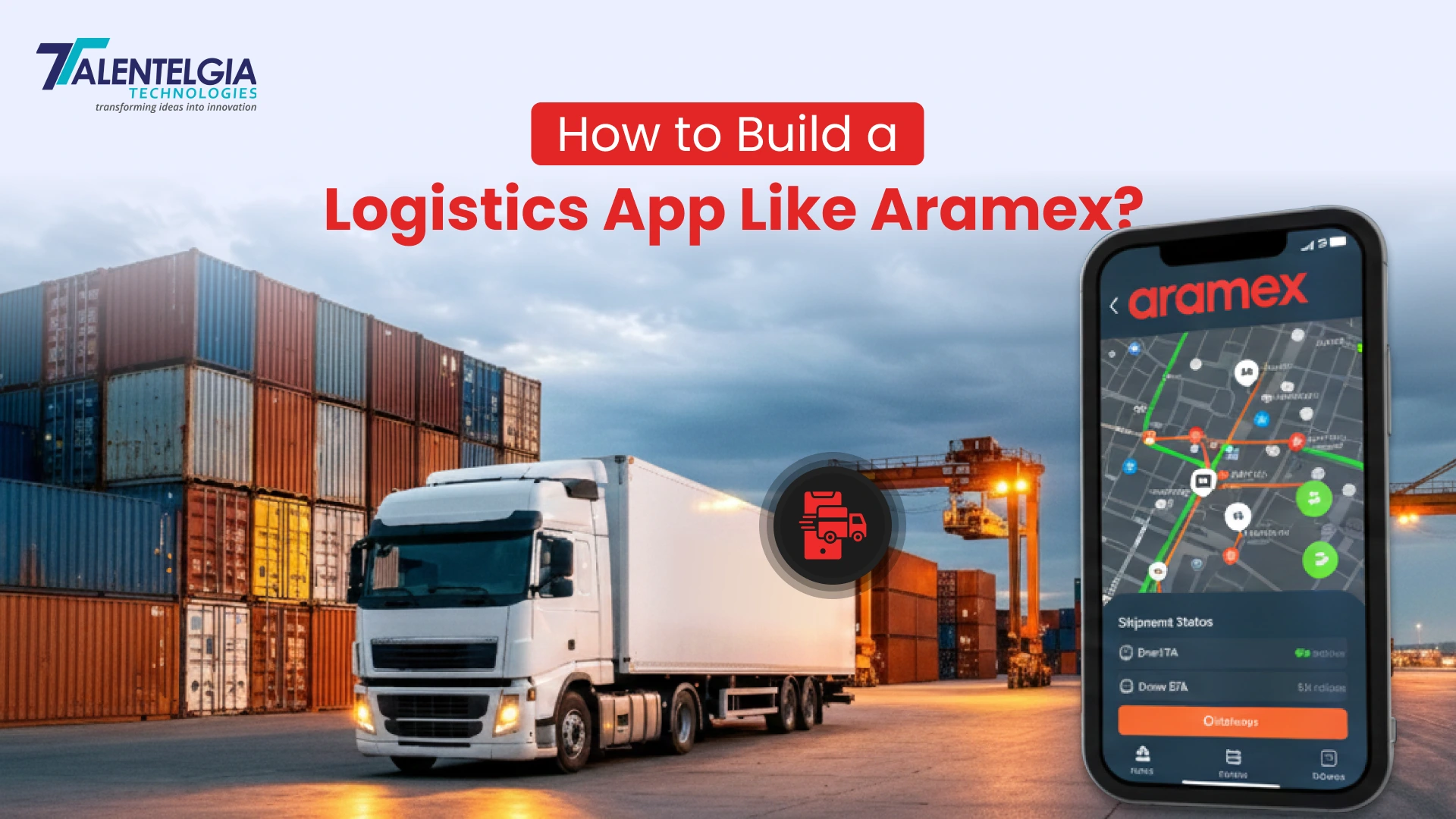
If you have ever ordered a package online and traced it from the warehouse to your doorstep, then you know how magical a well-tuned system feels. And of course, when we discuss reliable delivery experiences, one name sure stands out: Aramex.
With real-time tracking facilities to fast deliveries, and a super cool user interface, Aramex just set up the momentum for logistics & transportation apps globally.
In an age when business occurs online and customers anticipate lightning-quick delivery times, more companies are now exploring logistics management software and developing their own logistics apps that work the way Aramex does — if not better.
So whether you’re thinking of developing a hyper-efficient logistics app or simply trying to understand what makes Aramex tick using logistics app development solutions, this blog breakdown has everything you need.
Let’s go over the features, steps, costs , and the market overall — all in plain language you can understand.
Key Features that made ‘Aramex’ a Trusted and High-Performing Logistics App
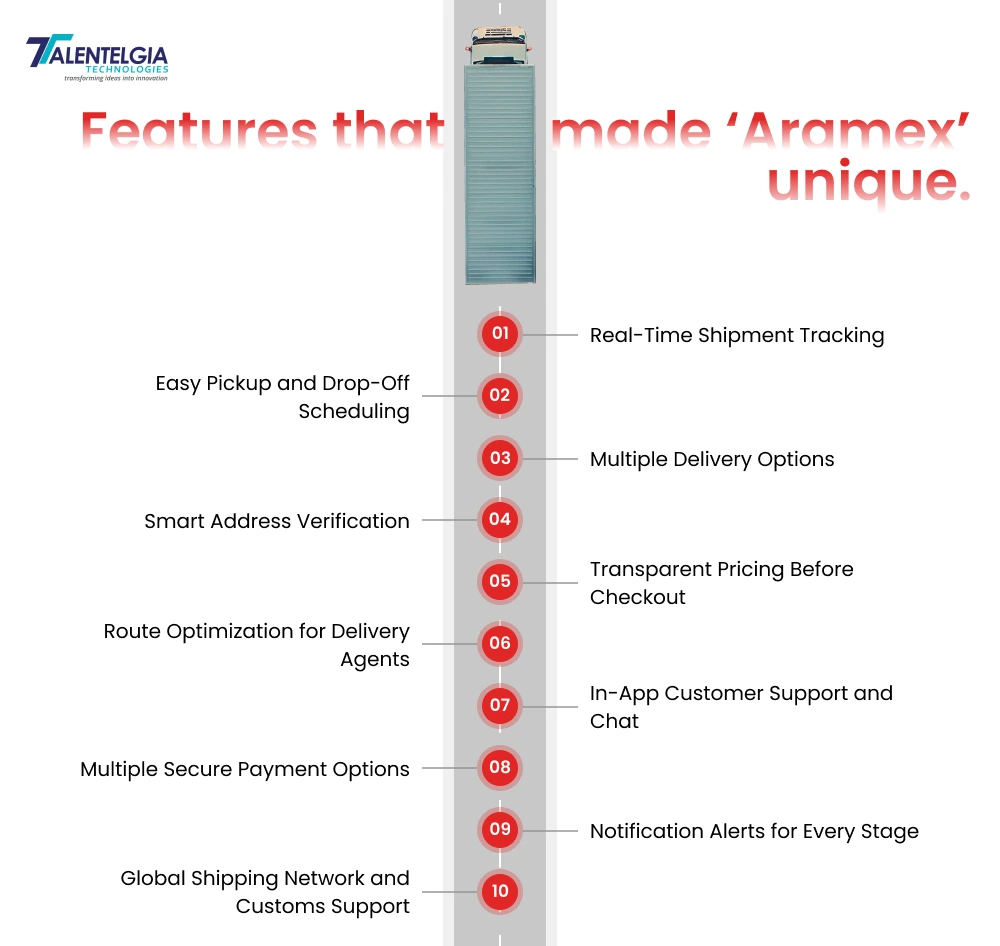
Aramex didn’t rise to global recognition by chance. The app has been carefully designed to offer fast, accurate, and reliable logistics experiences. Below are the key features that make Aramex stand out, along with real-time examples to show how each feature performs in real-world scenarios.
1. Real-Time Shipment Tracking
Real-time tracking is one of the core reasons users trust Aramex. Customers can see exactly where their shipment is at any moment without relying on guesswork.
Real-time example:
If someone orders a product from Dubai, they can follow every update in the app, including when the parcel leaves the warehouse, when it reaches the hub, and when the driver is on the way. The live map feature shows the delivery vehicle’s movement, offering complete visibility throughout the process.
2. Easy Pickup and Drop-Off Scheduling
Aramex simplifies sending packages with on-demand pickups and flexible drop-off options.
Real-time example:
A customer in Abu Dhabi who needs to send urgent documents to Riyadh can schedule a pickup directly from the app. A courier arrives at the selected time, eliminating the need to visit a physical office or wait in long queues.
3. Multiple Delivery Options
Aramex provides varied delivery modes such as same-day delivery, next-day delivery, and economical options. This helps customers choose based on urgency and budget.
Real-time example:
An eCommerce store in Saudi Arabia can offer customers the ability to choose same-day delivery for urgent purchases, next-day delivery for regular orders, and budget-friendly delivery for those who prefer lower costs.
4. Smart Address Verification
Address issues are common in many regions, and Aramex resolves this with intelligent address validation.
Real-time example:
When a user enters “Al Nahda Street, Sharjah,” the app suggests verified landmarks, building names, or alternative delivery-friendly points. This reduces missed deliveries and improves accuracy.
5. Transparent Pricing Before Checkout
Aramex displays all charges upfront before the user confirms their shipment.
Real-time example:
If a customer wants to ship a 2 kg parcel from Dubai to Cairo, the app calculates the cost instantly. It includes shipping fees, fuel surcharge, and any customs-related costs. Users know exactly what they will pay before proceeding.
6. Route Optimization for Delivery Agents
Aramex helps its delivery agents complete routes more efficiently through smart optimization.
Real-time example:
A driver in Kuwait gets an optimized route showing the best sequence for deliveries, including traffic updates and road conditions. This helps reduce delays, fuel usage, and operational expenses.
7. In-App Customer Support and Chat
Aramex’s in-app customer support system allows users to quickly access help without calling support centers.
Real-time example:
If a package seems delayed, the user can open the chat feature and immediately speak with a support agent. The agent provides real-time updates and clarifies concerns on the spot.
8. Multiple Secure Payment Options
Aramex supports several payment methods to make transactions smooth for all users.
Real-time example:
A customer in Bahrain sending a shipment can pay through credit card, debit card, Apple Pay, wallet balance, or cash on delivery. The wide range of options makes the process convenient and reliable.
9. Notification Alerts for Every Stage
Aramex keeps customers informed with timely notifications throughout the shipping process.
Real-time example:
Users receive alerts such as “Package picked up,” “Arrived at sorting center,” “Out for delivery,” and “Delivered.” These updates keep users in the loop without needing to track the order manually.
10. Global Shipping Network and Customs Support
Aramex is known for its ability to handle cross-border shipping smoothly.
Real-time example:
If a business in Oman wants to send products to Europe, Aramex manages all customs paperwork, duties, documentation, and shipping requirements. This helps businesses expand globally without facing logistical complexities.
Steps to build an App like ‘Aramex’
Creating a logistics app like Aramex isn’t just a development project—it’s about building an entire delivery ecosystem that feels smooth, reliable, and effortless for every user involved. Here’s how the process typically unfolds when you’re aiming for Aramex-level performance and trust.

1. Begin with Real Market & Competitor Research
Before you jump into development, you need to understand how the logistics world actually works. Look at how other apps like Aramex, DHL, and FedEx operate.
What do their apps do well? Where do users complain the most?
These insights help you shape your app that’s not just another delivery tool, but something that truly solves everyday logistics challenges.
2. Define Clear Features for Each User Group
A logistics app serves multiple people at the same time—customers, delivery agents, warehouse teams, and admins—and each needs different features.
For instance:
- Customers want easy bookings and real-time updates.
- Drivers want quick access to routes and delivery details.
- Admins need dashboards to monitor everything happening in the system.
Listing out these needs early prevents confusion later and keeps development aligned with real workflows.
3. Select a Tech Stack That Can Handle Scale
Aramex handles thousands of shipments daily. If you want similar performance, your tech stack should be strong enough to handle heavy loads, accurate tracking, fast syncing, and secure transactions.
This is where you decide between native and cross-platform development. Also, a clever selection of GPS and mapping APIs, cloud services, and the backend architecture that will keep everything running smoothly.
4. Design a Simple, Clean User Experience
Logistics processes can get complicated behind the scenes, but the user experience shouldn’t feel that way.
Your app should look clean, the navigation should feel natural, and each action—booking, tracking, or updating—should happen without friction.
This is where wireframes and prototypes help you fine-tune the flow before coding even begins.
5. Develop the Core Modules
Once the structure is set, the development team starts building the actual components of the app.
This usually includes:
- User registration
- Shipment creation
- Real-time tracking
- Warehouse and inventory handling
- Driver route optimization
- Push notifications
- Payment and billing
Each module should connect seamlessly with the next so the entire experience feels unified, just like Aramex.
6. Add Smart, Advanced Capabilities
To truly match what makes Aramex efficient, you’ll need modern tech integrations.
This often includes:
- AI-based route optimization
- Automatic driver assignment
- QR and barcode scanning
- Cloud syncing for real-time data
These features minimize delays, prevent manual errors, and help manage a large volume of shipments without slowing down.
7. Test in Real Delivery Conditions
Logistics apps must be tested beyond normal conditions because they’re used on different devices, networks, and environments.
Testing typically includes:
- Functional testing
- GPS and location accuracy testing
- Heavy load and stress testing
- Security checks
- Cross-device testing
The goal is simple: nothing should break when actual users rely on the app for real deliveries.
8. Roll Out the App in Phases
A controlled launch—first with a pilot region or a small user group—helps you collect real feedback. This lets you refine things like tracking accuracy, delivery flow, and performance before opening it up to a wider audience.
9. Keep Improving and Scaling
Even after launch, logistics demands keep evolving. Customer expectations rise, delivery speeds need to improve, and operations grow more complex.
Regular updates, new features, performance improvements, and security patches help your app remain reliable and competitive—just like Aramex has managed to do over the years.
Cost to Build a Logistics App
Building a logistics app, whether it’s similar to Aramex, DHL, or Delhivery, comes with different cost layers depending on the feature set, tech stack, integrations, and team structure. To give you a transparent and credible overview through this blog, the pricing ranges placed below are backed by publicly available data from top software development marketplaces and research platforms we recently used.
| Cost Component | What It Includes | Estimated Cost |
| Basic Logistics App | Signup, basic booking, status updates, simple admin panel | $25,000 – $40,000 |
| Mid-Level Logistics App | Real-time tracking, route planning, driver app, payments, warehouse tools | $50,000 – $90,000 |
| Advanced (Aramex-Level) | AI routing, automated dispatch, multi-warehouse, analytics, barcode scanning | $100,000 – $200,000+ |
| Single Platform (Android or iOS) | One OS only | $20,000 – $50,000 |
| Both Platforms | Android + iOS | $40,000 – $100,000 |
| Real-Time GPS Tracking | GPS APIs, maps, background updates | Depends on API usage |
| Route Optimization | Multi-stop routing, traffic-based suggestions | Depends on API usage |
| AI-Based Dispatching | Auto-assigning drivers using ML | Add-on cost varies |
| Warehouse/Inventory Modules | Scanning, GRN, stock sync | Feature-dependent |
| Freelancers | Independent developers | $15 – $40/hr |
| Mid-Level Agency | Full development team | $40 – $70/hr |
| Enterprise Agency | Large, high-end teams | $80 – $150+/hr |
| UI/UX Design | Customer, driver, admin flows | $5,000 – $20,000 |
| Backend Development | Shipment flow, tracking engine, routing, warehouse sync | $20,000 – $80,000+ |
| QA & Testing | Real-device, field testing | $5,000 – $25,000 |
| Maintenance (Annual) | Updates, server scaling, bug fixes | 15–25% of total cost yearly |
Market Overview
The logistics and delivery space has quickly emerged out of nowhere to become one of the fastest-growing industries on the planet, largely thanks to an explosion in e-commerce as well as on-demand expectations that have seen digital transform supply chains. In other words: more beyond-online-ordering people; shorter delivery windows; tech-centric businesses, because they’ve got nothing else left to rely on. This behaviour change has led to an enormous need for smart, app-based logistics systems, apps like Aramex, DHL, Delhivery, and FedEx.
The International logistics market has been growing steadily for several years. Cloud-based and automated real-time logistics service adoption is replacing traditional tracking and delivery businesses. Shippers — whether they are small businesses or giant corporations — today want the visibility to packages on a real-time basis with rapid routing, automatically dispatched goods, and clear lines of communication at delivery time. This has shifted logistics apps from being “good to have” tools to forming the foundation of modern supply chains.
Meanwhile, customer expectations have shifted dramatically. Consumers demand real-time tracking, same-day deliveries, and clear communication throughout the process. Logistics companies are being pushed to deliver the same experience as that of giants like Aramex or Amazon. That’s what more companies are now investing in using mobile-first logistics platforms that manage everything from booking and routing to optimising routes for delivery.
Another key trend affecting the market is the increasing use of tech such as AI, predictive analytics, IoT sensors, and automation. Whether it’s driver routing, demand prediction , or eliminating the time wastage in the delivery process, smart technology is making operations more efficient even as costs come down. As with most things logistics-related, now that the technology has come to the masses, apps are developing from basic tracking tools into comprehensive digital platforms that can power full fleets and warehouses.
Taken as a whole, the market is in a state where not only are digital logistics solutions growing — they’re becoming downright necessary. And as the number of eCommerce purchases grows, a more expansive delivery network gets established, and customer expectations keep getting higher, the need for advanced logistics apps becomes even more pronounced. Companies that invest in building a reliable, scalable, and feature-rich logistics platform today are likely to maintain a competitive edge in meanwhile highly competitive won by speed, accuracy, and transparency.
Conclusion
Building a logistics app like Aramex comes down to combining the right features, strong backend engineering, and a user experience that feels effortless for both customers and delivery teams. With the growing demand for faster deliveries and real-time visibility, businesses today need reliable, scalable logistics solutions more than ever. Whether you’re a startup or an established company, investing in a well-built logistics app can streamline operations, reduce delivery delays, and help you stay competitive in a market that’s rapidly moving toward digital-first logistics.

For businesses exploring proven digital logistics tools, solutions like Soren Logistics
offer a great example of what modern logistics platforms can achieve. Soren Logistics is a SaaS-based system that allows users to update multiple carrier fields, upload CSV files, and efficiently manage transport operations with advanced, automation-ready features.











 Sales Enquiries:
  Business queries:
  HR:
HR: 


