



 Healthcare App Development Services
 Real Estate Web Development Services
 E-Commerce App Development Services
 E-Commerce Web Development Services
 Blockchain E-commerce Development Company
 Fintech App Development Services
 Fintech Web Development
 Blockchain Fintech Development Company
 E-Learning App Development Services
 Restaurant App Development Company
 Mobile Game Development Company
 Travel App Development Company
 Automotive Web Design
 AI Traffic Management System
 AI Inventory Management Software
 AI Development Company
  ChatGPT integration services
  AI Integration Services
  Generative AI Development Services
  Natural Language Processing Company
 Machine Learning Development
  Machine learning consulting services
  Blockchain Development
  Blockchain Software Development
  Smart Contract Development Company
  NFT Marketplace Development Services
  Asset Tokenization Company
 DeFi Wallet Development Company
 Mobile App Development
  IOS App Development
  Android App Development
  Cross-Platform App Development
  Augmented Reality (AR) App Development
  Virtual Reality (VR) App Development
  Web App Development
  SaaS App Development
 Flutter
  React Native
  Swift (IOS)
  Kotlin (Android)
  Mean Stack Development
  AngularJS Development
  MongoDB Development
  Nodejs Development
  Database Development
 Ruby on Rails Development
 Expressjs Development
  Full Stack Development
  Web Development Services
  Laravel Development
  LAMP Development
  Custom PHP Development
  .Net Development
  User Experience Design Services
  User Interface Design Services
  Automated Testing
  Manual Testing
  Digital Marketing Services
 Ride-Sharing And Taxi Services
 Food Delivery Services
 Grocery Delivery Services
 Transportation And Logistics
 Car Wash App
 Home Services App
 ERP Development Services
 CMS Development Services
 LMS Development
 CRM Development
 DevOps Development Services
 AI Business Solutions
 AI Cloud Solutions
 AI Chatbot Development
 API Development
 Blockchain Product Development
 Cryptocurrency Wallet Development
 About Talentelgia
  Our Team
  Our Culture
 Healthcare App Development Services
 Real Estate Web Development Services
 E-Commerce App Development Services
 E-Commerce Web Development Services
 Blockchain E-commerce
Development Company
Blockchain E-commerce
Development Company Fintech App Development Services
 Finance Web Development
 Blockchain Fintech
Development Company
Blockchain Fintech
Development Company E-Learning App Development Services
 Restaurant App Development Company
 Mobile Game Development Company
 Travel App Development Company
 Automotive Web Design
 AI Traffic Management System
 AI Inventory Management Software
 AI Development Company
 ChatGPT integration services
 AI Integration Services
 Machine Learning Development
 Machine learning consulting services
 Blockchain Development
 Blockchain Software Development
 Smart contract development company
 NFT marketplace development services
 IOS App Development
 Android App Development
 Cross-Platform App Development
 Augmented Reality (AR) App
Development
Augmented Reality (AR) App
Development Virtual Reality (VR) App Development
 Web App Development
 Flutter
 React
Native
React
Native Swift
(IOS)
Swift
(IOS) Kotlin (Android)
 MEAN Stack Development
 AngularJS Development
 MongoDB Development
 Nodejs Development
 Database development services
 Ruby on Rails Development services
 Expressjs Development
 Full Stack Development
 Web Development Services
 Laravel Development
 LAMP
Development
LAMP
Development Custom PHP Development
 User Experience Design Services
 User Interface Design Services
 Automated Testing
 Manual
Testing
Manual
Testing About Talentelgia
 Our Team
 Our Culture
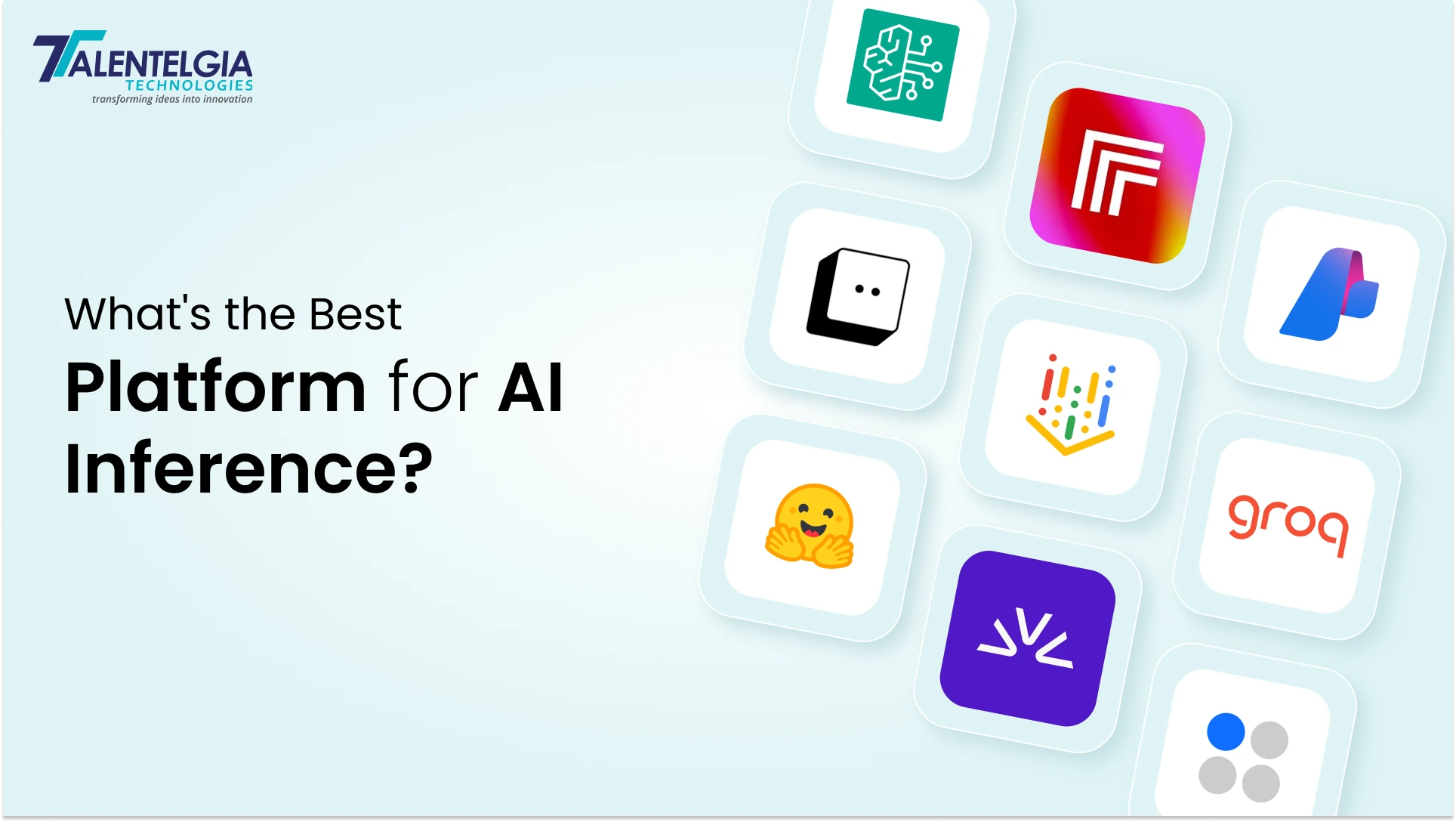
In the present world, the focus of innovation in AI has shifted from training models in a research environment to fine-tuning model retrieval. The goal is to obtain the responses from AI models much faster, more affordably, and in bulk. This is necessary for building more profitable and scalable AI-powered products to attract users, and that explains the industry’s focus shift. It is almost impossible to ignore the fact that almost all organizations experience the same challenges when trying to scale their AI initiatives: model is not the issue; it’s sustaining the costs, efficiency, and reliability of the AI model in production, which is arguably the most overlooked aspect.
As a result, businesses are taking AI inference platforms as a critical business decision within their broader AI Integration strategy. The platform you choose impacts the customer experience, and operational efficiencies, as well as the potential for compliance and the ability to scale AI deployment within the organization. One wrong choice and the costs will spike exponentially, while the correct choice integrates AI as a reliable and scalable solution in your daily business operations. In this post, we will explain the importance of such AI Inference from a business leader’s perspective, the variety of providers currently in the market, and their features.
Understanding AI Inference In 2025: An Overview
For the first time, the world is witnessing an unprecedented capability of “Artificial Intelligence”, thanks to advancements in machine learning (ML). AI has leaped from the research realm to powering production systems that facilitate millions of transactions every day. Model training may be the part that gets the most attention, but inference— which entails executing the trained model to receive predictions— makes up 80-90% of the total computing cost across all AI production applications.
For instance, large language models (LLMs) that serve customer queries can use thousands of GPU hours a month, while computer vision systems that process live video streams require consistently low latency performance. According to Grand View Research statistics, the global AI inference market was valued at $97.24 billion in 2024, which is estimated to reach $253.75 billion by 2030 with a CAGR of 17.5% during the forecast period (2025–2030).
However, the majority of teams continue to face at least 3 critical challenges. First, how to manage the exponentially increasing AI inference costs with an increase in traffic volume. Second, how to sustain low levels of latency given the unpredictable shifts in demand. Finally, how to expand the possibilities of the infrastructure without unnecessarily allocating too many resources.
What is AI Inference Platform and Why Do They Matter?
A platform designed for deploying machine learning models that offers the required resources, specialized technology, and operational methodologies for converting a trained machine learning model into a scalable and production-grade service. These platforms provide assistance with model version control, model deployment, model scaling, model performance tracking, and model integration with real-world applications, with software systems, dashboards, or end-user applications.
Despite whatever the news and mainstream media may lead you to believe, the most common challenge for AI builders after the models are trained is deploying them for use. Inference is the stage where the trained models generate outputs, i.e., make predictions, provide real-time responses, etc. Users are increasingly expecting A products to be inexpensive, dependable, quick & responsive across vast areas, which sets the bar for the AI inference layer to be extremely high.
AI inference is the engine behind modern AI products and services.
- Power production applications
- Chatbots, copilots, search assistants.
- Recommendation systems in e-commerce and streaming.
- Fraud detection, anomaly detection, risk scoring.
- Drives user experience and revenue
- Faster, more accurate inference leads to higher engagement and conversion.
- Slow or unreliable inference directly hurts trust and usage.
- Scales with demand
- Every new user and every new request triggers additional inference load.
- Platforms must handle spikes (e.g., product launches, campaigns) without degrading performance.
Key Factors to Consider For Choosing The Best AI Inference Platform
If you’re looking for an AI Inference platform, then you need to consider what serves your business best. The first step is to assess the complexity of your models. Some models are more complex and need more computing power. You need to check how fast you need the results. If your application is designed to deliver instant responses, you need to look for low latency. Performance can be improved with hardware acceleration, so consider platforms that have dedicated processors. Ensure that you prefer to deploy your solution. Security and compliance are important, particularly with sensitive information. Scalability is essential, too. The larger your data gets, the more requests your platform needs to manage without lagging.
Choosing The Right AI Inference Platform
| Factor | What It Means | Low Demand (Prototypes) | High Demand (Production) | Ultra-Critical Priority |
| Model Complexity(Parameters, modalities) | Size & type of models (simple → massive multimodal LLMs) | Lightweight CV/NLP models | 100B+ parameter monsters | Giant LLMs with vision/audio |
| Latency Requirements(ms vs. seconds) | Response time tolerance | <500ms acceptable | Sub-100ms interactions | Real-time streaming (<50ms) |
| Hardware Acceleration(GPU/TPU/specialized) | Specialized chips vs. commodity compute | CPU/GPU sufficient | NVIDIA GPUs + accelerators | Custom LPUs/optimized kernels |
| Deployment Environment(Cloud/Edge/Hybrid) | Where it physically runs | Serverless anywhere | Cloud ecosystems (AWS/GCP/Azure) | Edge devices + on-prem |
| Scalability(Users → Millions) | Traffic growth handling | Manual scaling OK | Auto-scaling clusters | Global multi-region fleets |
Top 9 AI Inference Platforms To Consider in 2026
There is a wide variety of platforms designed for different use cases, including real-time, massive scale inference, and and no-code, simple incorporation into business flows. Below is a deep dive into 10 top choices for this year.
Top 9 AI Inference Platform Comparison Chart
1. AWS SageMaker & Bedrock (Enterprise Inference Powerhouse)
AWS has two main pillars for inference: “SageMaker” for hosting your own models and “Bedrock” for fully managed foundation models.
- SageMaker Inference supports real‑time, batch, and asynchronous endpoints with autoscaling, A/B testing, and built‑in monitoring, which is why it appears in almost every 2025 “AI model deployment platforms” guide.
- Bedrock lets you call top foundation models (including third‑party LLMs) via a managed API with guardrails, access policies, and integration into the broader AWS security stack.
Best for: Regulated or large enterprises deeply on AWS that want inference tightly integrated with VPCs, IAM, CloudWatch, and full lifecycle MLOps.
2. Google Cloud Vertex AI (Unified GCP Unit Serving)
Vertex AI is Google Cloud’s all‑in‑one ML platform, frequently compared head‑to‑head with SageMaker for training plus inference.
Standout Features:
- Offers online prediction, batch prediction, and model monitoring, plus direct access to Google’s Gemini and other managed models in the same environment.
- Often highlighted in MLOps lists for its integration with BigQuery, Dataflow, and GKE, making it easy to plug inference into existing data pipelines.
Best fit: Teams already on GCP that want a single control plane for data, training, and inference, especially when using Google’s own models.
3. Microsoft Azure AI (Inference in a Microsoft‑First Stack)
Azure’s inference story combines Azure Machine Learning (for your models) with Azure AI / Azure OpenAI Service (for hosted foundation models).
Standout Features:
- Azure ML endpoints provide managed online and batch inference with features like CI/CD integration, model versioning, and autoscaling.
- Azure AI / Azure OpenAI exposes models like GPT‑4.1 and others with enterprise‑grade security, private networking, and compliance certifications, attractive to Microsoft‑centric organizations.
Best fit: Companies that standardized on Microsoft 365, Azure AD, and Azure DevOps that want inference to sit naturally inside that ecosystem.
4. Together AI (Open‑Source LLM Workhorse)
Together AI shows up repeatedly in LLM API provider rankings for its mix of performance, price, and model variety.
Standout Features:
- Focuses on serving open‑source LLMs (Llama, Mistral, DeepSeek, etc.) via an OpenAI‑compatible API, so existing code often runs with minimal changes.
- Benchmarks and provider comparisons highlight Together as a strong performance‑per‑dollar option for large‑scale agents, copilots, and RAG systems.
Best fit: Engineering teams that want open‑source flexibility, aggressive pricing, and the ability to swap models without re‑architecting.
5. Fireworks AI (Low‑Latency, High‑Throughput Specialist)
Fireworks AI is frequently singled out as one of the fastest providers for open‑source LLMs, especially in independent performance comparisons.
Standout Features:
- Uses optimizations like FlashAttention, quantization, and advanced batching to drive down latency and increase throughput for large models.
- Aims squarely at enterprise workloads with features such as autoscaling clusters, observability, and SLAs, while still exposing simple HTTP APIs.
Best fit: High‑traffic, latency‑sensitive applications—customer support chat, coding assistants, and interactive agents—where every millisecond counts.
6. Groq (Custom Hardware for Real‑Time LLMs)
Groq stands out by running inference on its own Language Processing Unit (LPU) hardware rather than standard GPUs.
Standout Features:
- Independent provider comparisons show Groq delivering extremely high tokens‑per‑second and very low latency for Llama‑class models, often ranking at or near the top for raw speed.
- Developers interact with it as a hosted API, so they benefit from custom silicon performance without touching hardware.
Best fit: Real‑time experiences—streaming chat, live copilots, or trading‑adjacent tools—where “instant” responses are part of the product promise.
7. Hugging Face Inference Endpoints (From Hub to Production)
Hugging Face pairs its famous Model Hub with Inference Endpoints / Inference Providers, making it a central part of many 2025 AI PaaS and platform guides.
Standout Features:
- Let’s you deploy community or private models to managed endpoints with a few clicks or CLI commands, choosing CPU/GPU, scaling rules, and network isolation.
- Enterprise reviews emphasize its strengths in model cataloging, governance, and integration into broader MLOps flows, not just raw serving.
Best fit: Teams living in the Hugging Face ecosystem that want a seamless path from experimentation to secure, scalable production endpoints.
8. Replicate (The Developer’s Model Marketplace)
Replicate is often recommended to individual builders and startups as an easy way to call a wide variety of hosted models.
Standout Features:
- Offers a marketplace of models (LLMs, image, video, audio, and more) exposed via simple REST APIs, which is why it appears in many developer‑oriented “top inference” lists.
- Especially strong for creative and long‑tail models, giving quick access to new research and community creations without manual GPU setup.
Best fit: Fast prototyping, creative apps, and smaller teams that want to test many models quickly without touching infrastructure.
9. BentoML (Build‑Your‑Own Inference Platform)
BentoML is an open‑source framework for packaging and deploying models that increasingly anchor self‑hosted LLM and inference stacks.
Standout Features:
- Provides a standard way to bundle models, servers, and dependencies into “Bentos,” then deploy them to Kubernetes, VMs, or serverless environments.
- With integrations like vLLM, BentoML powers high‑performance LLM inference (continuous batching, efficient scheduling) on your own infrastructure.
Best fit: Organizations that want cloud‑agnostic control—running their own inference clusters (on‑prem or in any cloud) while still getting a modern UI and developer workflow.
Conclusion
When it comes to picking an AI inference platform, it’s not merely a technical matter anymore; it’s a decision that shapes the unit economics and operational scalability of an AI business. Finding the right balance depends on which stage of AI maturity, organizational performance, financial realism, and regulatory aspects the business is in. Practical inference in economics becomes a function of optimization techniques, workloads, latencies, and model selection. These criteria are best evaluated, in context, using an empirical approach.
As enterprises evolve on the AI continuum, it is critical to assess the infrastructure and be ready to shift between types of platforms to attain rapid growth and a sustainable competitive position in the market.











 Write us on:
  Business queries:
  HR:
HR: 


