



 Healthcare App Development Services
 Real Estate Web Development Services
 E-Commerce App Development Services
 E-Commerce Web Development Services
 Blockchain E-commerce Development Company
 Fintech App Development Services
 Fintech Web Development
 Blockchain Fintech Development Company
 E-Learning App Development Services
 Restaurant App Development Company
 Mobile Game Development Company
 Travel App Development Company
 Automotive Web Design
 AI Traffic Management System
 AI Inventory Management Software
 AI Software Development
  AI Development Company
  AI App Development Services
  ChatGPT integration services
  AI Integration Services
  Generative AI Development Services
  Natural Language Processing Company
 Machine Learning Development
  Machine learning consulting services
  Blockchain Development
  Blockchain Software Development
  Smart Contract Development Company
  NFT Marketplace Development Services
  Asset Tokenization Company
 DeFi Wallet Development Company
 Mobile App Development
  IOS App Development
  Android App Development
  Cross-Platform App Development
  Augmented Reality (AR) App Development
  Virtual Reality (VR) App Development
  Web App Development
  SaaS App Development
 Flutter
  React Native
  Swift (IOS)
  Kotlin (Android)
  Mean Stack Development
  AngularJS Development
  MongoDB Development
  Nodejs Development
  Database Development
 Ruby on Rails Development
 Expressjs Development
  Full Stack Development
  Web Development Services
  Laravel Development
  LAMP Development
  Custom PHP Development
  .Net Development
  User Experience Design Services
  User Interface Design Services
  Automated Testing
  Manual Testing
  Digital Marketing Services
 Ride-Sharing And Taxi Services
 Food Delivery Services
 Grocery Delivery Services
 Transportation And Logistics
 Car Wash App
 Home Services App
 ERP Development Services
 CMS Development Services
 LMS Development
 CRM Development
 DevOps Development Services
 AI Business Solutions
 AI Cloud Solutions
 AI Chatbot Development
 API Development
 Blockchain Product Development
 Cryptocurrency Wallet Development
 About Talentelgia
  Our Team
  Our Culture
 Healthcare App Development Services
 Real Estate Web Development Services
 E-Commerce App Development Services
 E-Commerce Web Development Services
 Blockchain E-commerce
Development Company
Blockchain E-commerce
Development Company Fintech App Development Services
 Finance Web Development
 Blockchain Fintech
Development Company
Blockchain Fintech
Development Company E-Learning App Development Services
 Restaurant App Development Company
 Mobile Game Development Company
 Travel App Development Company
 Automotive Web Design
 AI Traffic Management System
 AI Inventory Management Software
 AI Software Development
 AI Development Company
 ChatGPT integration services
 AI Integration Services
 Machine Learning Development
 Machine learning consulting services
 Blockchain Development
 Blockchain Software Development
 Smart contract development company
 NFT marketplace development services
 IOS App Development
 Android App Development
 Cross-Platform App Development
 Augmented Reality (AR) App
Development
Augmented Reality (AR) App
Development Virtual Reality (VR) App Development
 Web App Development
 Flutter
 React
Native
React
Native Swift
(IOS)
Swift
(IOS) Kotlin (Android)
 MEAN Stack Development
 AngularJS Development
 MongoDB Development
 Nodejs Development
 Database development services
 Ruby on Rails Development services
 Expressjs Development
 Full Stack Development
 Web Development Services
 Laravel Development
 LAMP
Development
LAMP
Development Custom PHP Development
 User Experience Design Services
 User Interface Design Services
 Automated Testing
 Manual
Testing
Manual
Testing About Talentelgia
 Our Team
 Our Culture

In general, businesses can be perceived as complex puzzles, where every piece represents a separate department. For business managers to acquire a certain perspective, every piece, such as sales, marketing, manufacturing, finance, customer service, and human resources, must fit together perfectly. With that in mind, ERP Development are one of the most specialised methods for establishing seamless connections, often natively incorporating all these pieces, plus additional ones, into a consolidated database that enables business processes, workflows, and insights to be unified.
Moreover, ERP integrations are an ideal means for the future, extending the efficiency and productivity benefits of ERP system integration to additional applications, whether those are independent applications or homegrown proprietary solutions, through ERP software integrations. Integrations can be tricky, however. Linking various systems together, such as in the case of some multi-system setups, can lead to a degree of interdependence that results in a chain reaction if one system fails. Thus, understanding their Do’s and Don’ts and how to implement them can help companies understand their landscape.
Understanding ERP Integration: An Overview
Enterprise Resource Planning (ERP) systems are the backbone of modern business, integrating core functions like finance, HR, supply chain, and sales into a unified platform. ERP integration connects this central platform with other critical business applications CRM, eCommerce, or payroll, creating seamless data flows and automating processes for greater accuracy and efficiency.
All types of companies from various industries have begun to adopt ERP software. Some of the key benefits of ERP integration are:
- Operational efficiency: Decreases time from administrative processes in responding to queries, streamlining business operations across systems, automating processes, eliminating manual data entry, and creating datasets.
- Data Accuracy: Provides a singular, synchronized, and cohesive unified data across systems and data sources to ensure there are no discrepancies and to retain data integrity in systems.
- Reporting & Analytics: Enhances and streamlines operational data and reports from analytics by standardizing processes to cut costs, combining with other processes, and by single-entry consolidation of data.
- Adaptability: Assists in business continuity and operational flexibility in the organization by being disruption-free with no major operational changes, even when there are technology mergers, acquisitions, divestitures, or changes.
- Service Delivery: Improves response time and provides more accessible data to customer service representatives by integrating the transactional back-office system with the customer-facing system to offer tailored and more active services.
- Supply Chain Integration: Supports supply chain operations by integrating and interconnecting the ERP to available supplier portal systems, user transportation systems, and warehousing operations, such as providing.
How Does ERP Integration Work?
ERP integration functions by creating communication pathways and data exchange frameworks between the ERP system and other software applications. This involves linking the ERP’s
application programming interfaces (APIs) with those of external systems to facilitate smooth and uninterrupted data transfer.
Technically, this integration often depends on middleware or integration platforms that act as bridges between the ERP and other applications. These middleware tools handle data format translations and transformations, ensuring that information remains compatible and consistent across different systems.
A vital part of the process is aligning data fields between the ERP and the connected applications. This mapping guarantees that data is properly synchronized and accurately matched, preventing issues like duplication or misinterpretation.
Once successfully connected, the systems can exchange data in both directions, enabling real-time updates and seamless information sharing. This integration supports core business areas such as finance, sales, inventory, and HR by providing timely access to precise and current data from multiple sources.
Major ERP Integration Methods of Managing APIs
The enterprise resource planning integration landscape is multifaceted. There are over 800 different free open-source API management tools to advanced iPaaS products. More primitive approaches include point-to-point (P2P) and enterprise service bus (ESB) models, of which some companies are still reliant upon. However, the industry standard is now cloud-hosted, scalable, iPaaS integration solutions.
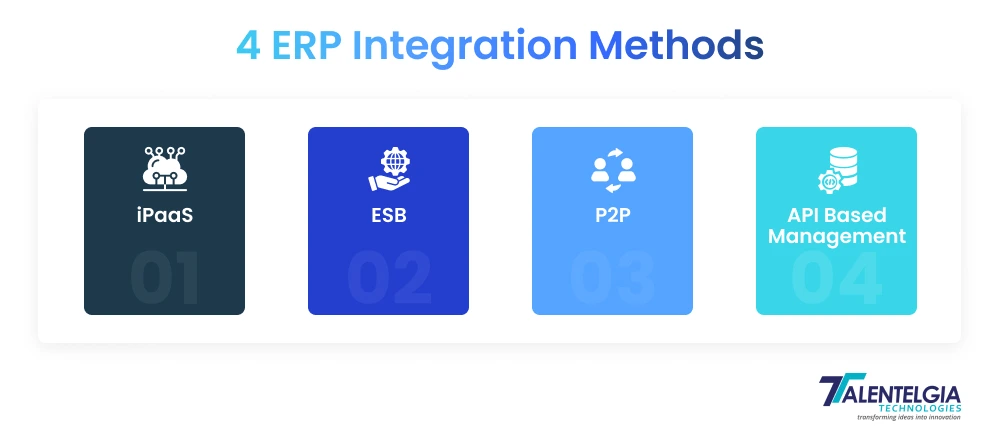
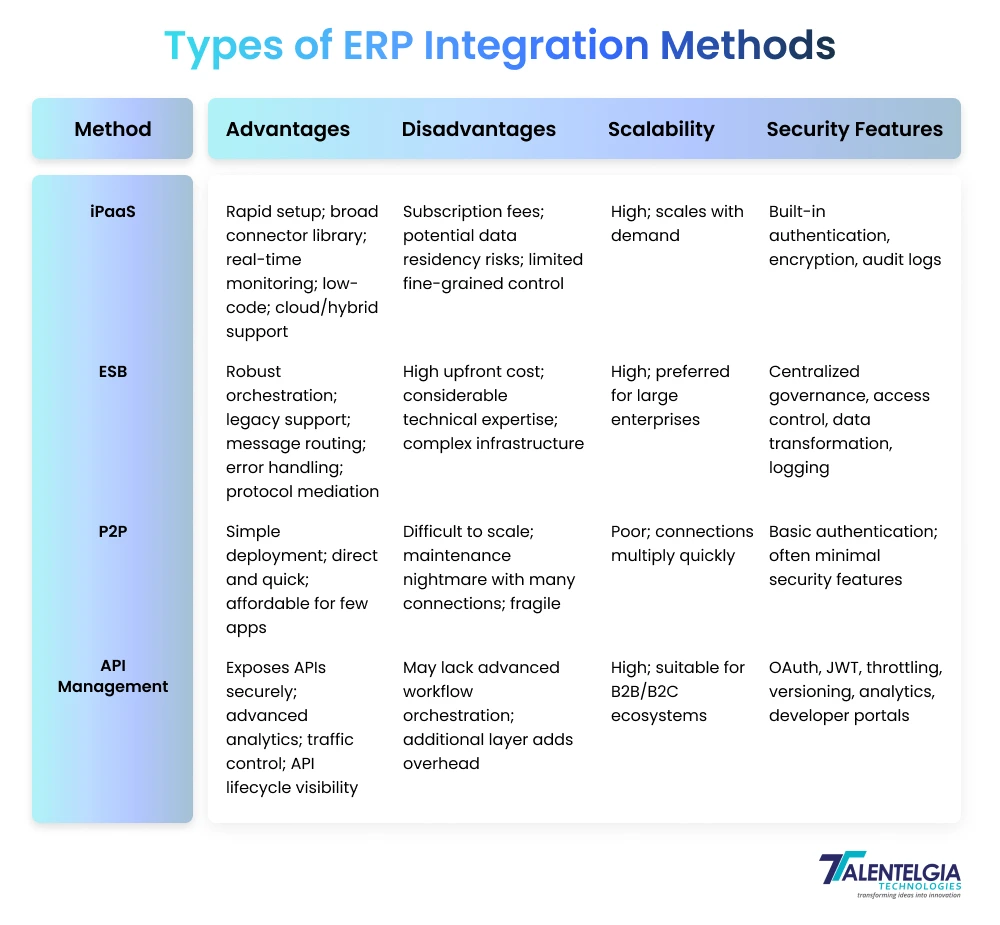
The following outlines some of the more popular methods of ERP integration – their advantages and disadvantages.
1. iPaaS (Integration Platform as a Service)
iPaaS is a cloud-native platform that connects applications through pre-built connectors, low-code workflow tools, and automated scaling. It handles both cloud and on-premises data sources, making it ideal for businesses seeking rapid implementation and minimal technical overhead. iPaaS manages data mapping, transformation, and orchestration out-of-the-box while providing real-time monitoring, error handling, and integration lifecycle management. Popular examples: Boomi, MuleSoft, Zapier.
2. ESB (Enterprise Service Bus)
ESB acts as a centralised middleware layer, connecting legacy and modern applications while handling message routing, data transformation, protocol mediation, and security. ESBs decouple applications, allowing flexible and reusable integration without modifying individual endpoints. ESB is preferred for complex multi-system architectures requiring robust orchestration of asynchronous processes and transaction management. Examples: IBM Integration Bus, TIBCO ActiveMatrix.
3. Point-to-Point (P2P) Integration
P2P integration directly connects two applications using native plugins or custom API code. While simple and cost-effective for limited scenarios, P2P becomes challenging as the number of connections grows, leading to tangled networks and maintenance headaches. Still, it works well for small teams or single-purpose integrations with clear relationships.
4. API-Based Management
API Management platforms govern published APIs, ensuring secure, scalable, and monitored access. They power both internal and external connectivity, enable partner integrations, and manage lifecycle operations like authentication, rate limiting, analytics, and versioning. API-based management excels at exposing data reliably to mobile, web, or third-party developer ecosystems—examples include Apigee, Azure API Management, and Kong.
Read More: Which ERP System is Best
Typical Use Cases of ERP Software Integration
There are as many ERP integration methods as there are types available. Some ERP systems offer comprehensive integrations with other applications to automate data transfers and process integrations across the different modules. However, companies sometimes prefer third-party applications, including custom software for the relevant ones, due to better familiarity and desirable functionality. Below are the most common ERP integrations.
- Customer Relationship Management (CRM) Integration
Imagine a sales team with instant access to real-time customer data—orders, preferences, support tickets—without switching between systems. CRM and ERP integration creates a unified view of customer interactions, enabling personalised service and proactive engagement. For instance, when a customer service query arises, agents can immediately see order history, delivery status, and payment details, leading to faster resolution and enhanced loyalty.
- eCommerce Platform Integration
Envision a company selling online and in stores, having synchronised stock levels across all channels. When ERP integrates with eCommerce platforms like Shopify or Magento, product availability, pricing, and promotions update automatically. This eliminates overselling, reduces stockouts, and provides customers with accurate, instant information—transforming the shopping experience into a hassle-free, omnichannel journey.
- Customer Service Software Integration
Customer support is more impactful when service tickets, product data, and order history are interconnected. Integration ensures support agents have complete visibility—tracking an issue from complaint to resolution—without manual data entry. This results in faster, more accurate responses, and builds trust as customers feel valued and understood.
- Accounts Payable (AP) Automation Software Integration
Imagine eliminating manual invoice entry and speeding up approvals. When ERP connects with AP automation tools, incoming invoices are automatically matched with purchase orders, dates, and vendor data. Payments are scheduled in real time, reducing delays and errors, and freeing finance teams to focus on strategic financial planning rather than routine work.
- Human Resources (HR) Systems Integration
HR and ERP integration transforms employee data management. It ensures that onboarding, payroll, time tracking, and benefits are consistent and accurate across platforms. For example, new hire info entered into HR systems flows seamlessly into payroll and compliance modules, minimising manual errors and speeding up onboarding.
- Product Lifecycle Management (PLM)
In manufacturing and product development, integrating ERP with PLM solutions synchronises design, engineering changes, and production schedules. This leads to faster product launches, better quality control, and cost savings, as teams collaborate more effectively across the entire product journey—from conception to market.
- Project Management Software Integration
When project timelines, budgets, and resource plans are linked to ERP data, organisations gain insight into project costs, procurement, and staffing needs. For instance, real-time inventory data linked with project management tools prevents delays due to stock shortages, enabling smarter planning and timely delivery.
- Business Intelligence (BI) Software Integration
Integrating ERP with BI tools like Power BI or Tableau aggregates data across functions, creating dynamic dashboards and predictive reports. Imagine management making strategic decisions based on real-time sales trends, supply chain performance, and customer feedback—driving growth with confidence.
- Electronic Data Interchange (EDI)
EDI automates the exchange of purchase orders, invoices, and shipment notices with suppliers and logistics partners. This reduces manual entry, accelerates transaction cycles, and enhances supply chain transparency—crucial in industries like retail and manufacturing with high transaction volumes.
- Enterprise Asset Management (EAM)
ERP integration with EAM solutions enables organisations to monitor, maintain, and optimise their physical assets. For example, real-time data on machinery health informs predictive maintenance, reducing downtime and extending asset life—a vital component in manufacturing, utilities, and transportation sectors.
Also Read: Benefits of ERP Inventory Management System
Conclusion
If there is one thing to understand about ERP integration across a business, it is about appearing in perfect balance. Each business has its needs, problems, issues, and challenges. But successful ERP software integrations continue to follow a similar path, and it is the companies that estimate needs, build strong teams, and construct visions, communicating these visions to involve all stakeholders—while also justifying the cost of implementing an ERP system that create a true masterpiece.












 Write us on:
  Business queries:
  HR:
HR: 


