



 Healthcare App Development Services
 Real Estate Web Development Services
 E-Commerce App Development Services
 E-Commerce Web Development Services
 Blockchain E-commerce Development Company
 Fintech App Development Services
 Fintech Web Development
 Blockchain Fintech Development Company
 E-Learning App Development Services
 Restaurant App Development Company
 Mobile Game Development Company
 Travel App Development Company
 Automotive Web Design
 AI Traffic Management System
 AI Inventory Management Software
 AI Software Development
  AI Development Company
  AI App Development Services
  ChatGPT integration services
  AI Integration Services
  Generative AI Development Services
  Natural Language Processing Company
 Machine Learning Development
  Machine learning consulting services
  Blockchain Development
  Blockchain Software Development
  Smart Contract Development Company
  NFT Marketplace Development Services
  Asset Tokenization Company
 DeFi Wallet Development Company
 Mobile App Development
  IOS App Development
  Android App Development
  Cross-Platform App Development
  Augmented Reality (AR) App Development
  Virtual Reality (VR) App Development
  Web App Development
  SaaS App Development
 Flutter
  React Native
  Swift (IOS)
  Kotlin (Android)
  Mean Stack Development
  AngularJS Development
  MongoDB Development
  Nodejs Development
  Database Development
 Ruby on Rails Development
 Expressjs Development
  Full Stack Development
  Web Development Services
  Laravel Development
  LAMP Development
  Custom PHP Development
  .Net Development
  User Experience Design Services
  User Interface Design Services
  Automated Testing
  Manual Testing
  Digital Marketing Services
 Ride-Sharing And Taxi Services
 Food Delivery Services
 Grocery Delivery Services
 Transportation And Logistics
 Car Wash App
 Home Services App
 ERP Development Services
 CMS Development Services
 LMS Development
 CRM Development
 DevOps Development Services
 AI Business Solutions
 AI Cloud Solutions
 AI Chatbot Development
 API Development
 Blockchain Product Development
 Cryptocurrency Wallet Development
 About Talentelgia
  Our Team
  Our Culture
 Healthcare App Development Services
 Real Estate Web Development Services
 E-Commerce App Development Services
 E-Commerce Web Development Services
 Blockchain E-commerce
Development Company
Blockchain E-commerce
Development Company Fintech App Development Services
 Finance Web Development
 Blockchain Fintech
Development Company
Blockchain Fintech
Development Company E-Learning App Development Services
 Restaurant App Development Company
 Mobile Game Development Company
 Travel App Development Company
 Automotive Web Design
 AI Traffic Management System
 AI Inventory Management Software
 AI Software Development
 AI Development Company
 ChatGPT integration services
 AI Integration Services
 Machine Learning Development
 Machine learning consulting services
 Blockchain Development
 Blockchain Software Development
 Smart contract development company
 NFT marketplace development services
 IOS App Development
 Android App Development
 Cross-Platform App Development
 Augmented Reality (AR) App
Development
Augmented Reality (AR) App
Development Virtual Reality (VR) App Development
 Web App Development
 Flutter
 React
Native
React
Native Swift
(IOS)
Swift
(IOS) Kotlin (Android)
 MEAN Stack Development
 AngularJS Development
 MongoDB Development
 Nodejs Development
 Database development services
 Ruby on Rails Development services
 Expressjs Development
 Full Stack Development
 Web Development Services
 Laravel Development
 LAMP
Development
LAMP
Development Custom PHP Development
 User Experience Design Services
 User Interface Design Services
 Automated Testing
 Manual
Testing
Manual
Testing About Talentelgia
 Our Team
 Our Culture
Healthcare is changing fast, and technology has become central to the delivery, management , and improvement of medical services. Whether it’s patient records or monitoring of health on the go, digital solutions have transformed and are continuing to evolve to ensure accuracy, immediacy, and a positive outcome in care. As healthcare becomes more and more fragmented, software platforms can turn systems of providers into patients and of patients into clinics.
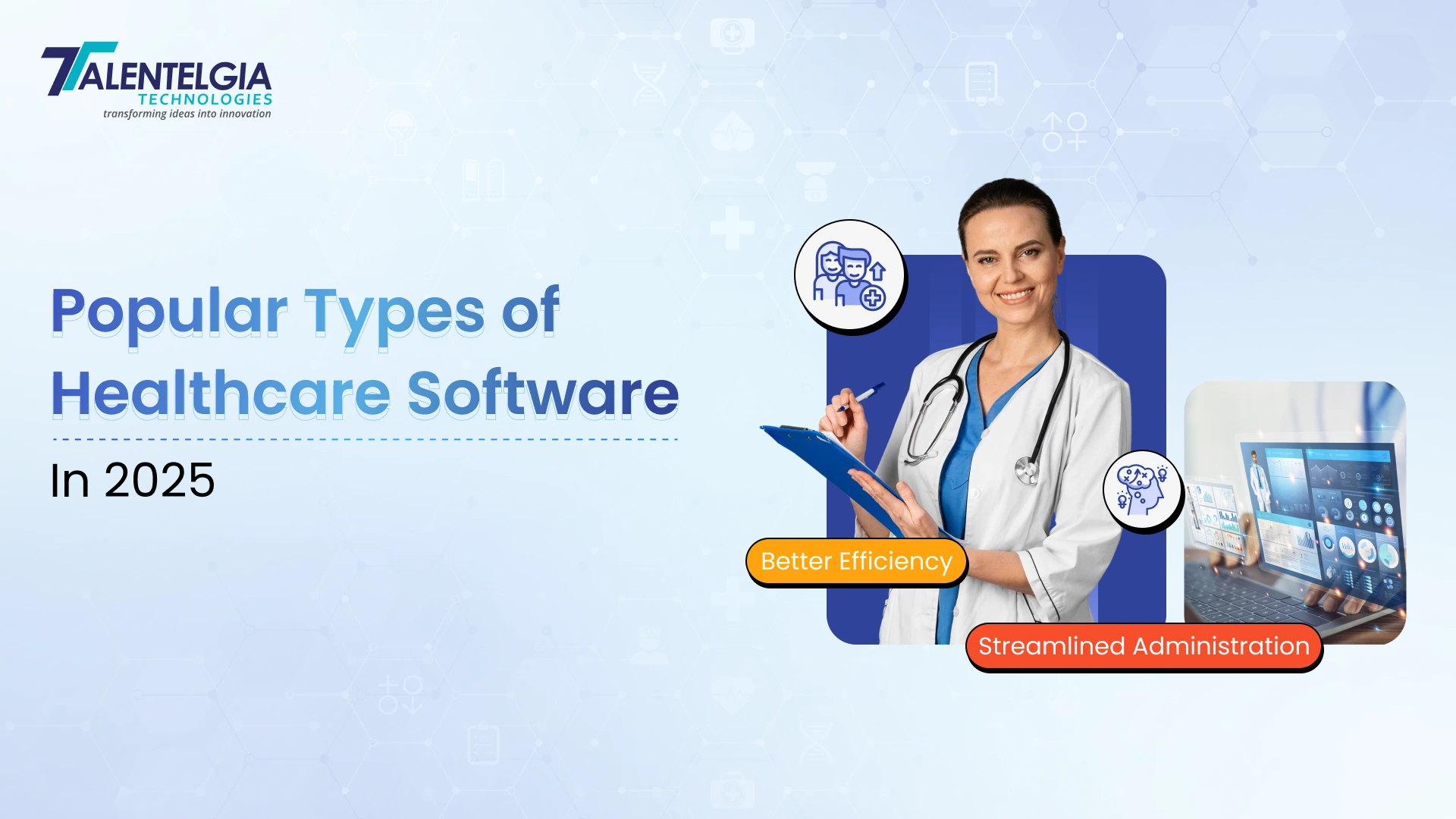
Popular Types of Healthcare Software In 2026
Now in 2026, healthcare software doesn’t just do simple data storage or scheduling. Next-gen solutions enable analytics, remote care, interoperability, and personalized care plans, enabling organizations to respond quickly to patient needs while still addressing compliance mandates through advanced healthcare app development initiatives.
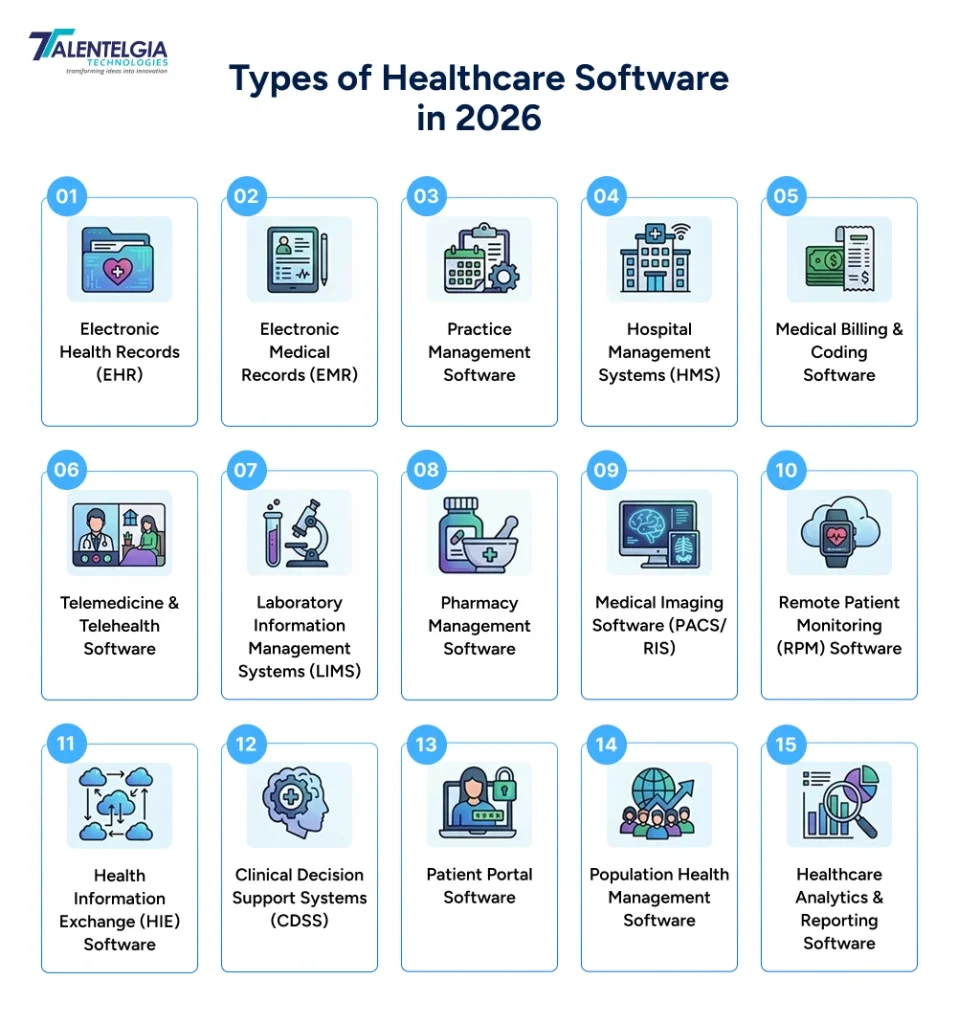
Knowing the different types of healthcare software available enables providers and hospitals, in addition to health-tech companies, to pick out the most effective tools that increase operational efficiency while maximizing the patient experience.
1. Electronic Health Records (EHR)
The term EHR refers to a digital tool where any information that pertains to health and care can be stored, managed, and used, often integrating with CRM platforms to improve patient engagement and communication. They enable authorized health professionals to get real-time information about their patients, save time on paperwork, and prevent medication errors.
Real-life example: If a patient goes to a hospital for the first time, doctors can immediately look up past lab reports, prescriptions, or allergy information through an EHR system, regardless of where that data was created — even if it’s in another clinic. This assists doctors in making smarter decisions and with safer, quicker treatment.
Also Read: EHR Implementation Cost Breakdown
2. Electronic Medical Records (EMR)
An electronic medical record (EMR) is an electronic version of a paper chart that contains the patient’s medical history and is created in a single organization. They store details of patient history, diagnoses, treatment plans, medications the person is taking – in fact, everything to do with the patient and their health that a doctor needs to make decisions about care.
Real-life use case: A family clinic adopts an EMR system to keep up with records of patient visits, treatment notes, and prescription management. When a patient returns for a follow-up appointment, the doctor can quickly review previous diagnoses and treatments recorded in the clinic’s EMR system.
3. Practice Management Software
Practice Management Software supports healthcare practices in all of their daily tasks by providing services for appointment scheduling, patient registration, billing, and insurance claims. It standardizes workflow methods, minimizes manual work, and maximizes efficiency in the clinic and the physician’s office.
Example in real life: A dental clinic that uses practice management software for scheduling appointments, sending automatic reminders, creating invoices, and filling out insurance claims forms enables employees to concentrate more on patient care and less on handling paperwork.
4. Hospital Management Systems (HMS)
HMS software refers to a series of comprehensive software specifically designed for use in the day-to-day running of a hospital, and is built to control materials such as patient details, appointments, records on admission (inpatient or outpatient), billing process, and inventory management. They streamline the operation of hospitals by linking together different departments in a single system.
Example in real life: A multi-specialty hospital adopts an HMS to manage patient admission, monitor availability of beds, provide pharmacy and laboratory services, and bill for the care delivered to enable coordinated patient care delivery as well as smooth hospital operations.
5. Medical Billing & Coding Software
Medical Billing & Coding Software assists in transforming medical services into standardized codes to create and send flawless bills, as well as ensuring timely payment of insurance claims.
Example: A healthcare clinic relies on medical billing and coding software to file insurance claims electronically following patient visits, cutting down claim errors and expediting payment.
6. Telemedicine & Telehealth Software
Telemedicine & Telehealth Software allows healthcare professionals to conduct medical consultations and follow-ups remotely through video calls, voice calls, or secure messages. It makes care more accessible, particularly for patients who may not be able to go to the hospital.
Example : A patient sees a doctor via video call as part of a routine check-up, reports symptoms online and receives a digital prescription without visiting the clinic.
7. Laboratory Information Management Systems (LIMS)
Laboratory Information Management Systems (LIMS) are automation software employed in managing laboratory operations and storage units, such as multimedia content, for tracking samples, test orders, and results (processing and analysis), etc. They enable laboratories to keep their instruments running at peak performance, increase operational efficiency, and ensure consistent data.
Example: A diagnostic lab, which uses a LIMS to trace blood samples from collection to results readouts, gets technicians processing tests more rapidly — and doctors receiving reports digitally.
Read More: Generative AI in Healthcare
8. Pharmacy Management Software
Pharmacy Management is software to aid in the day-to-day operations of a pharmacy. It minimizes the chances of human errors, maintains the stock level, and increases accuracy in terms of medicine dispersal.
Real-life example: A retail pharmacy uses the pharmacy management software to fill digital prescriptions, monitor stock levels of medicine, and create bills; at the end of the day, patients go home with their appropriate medications on schedule.
9. Medical Imaging Software (PACS/RIS)
Medical Imaging Software like PACS (Picture Archiving and Communication System) and RIS (Radiology Information System) is utilized to store, manage, and share medical images that can be anything from X-rays and CT scans to MRIs, ultrasounds, and more. It enables the medical staff to review high-resolution images directly on a computer and can be stored within the computer by a file format of .jpg, avoiding unnecessary X-ray film.
Example: A hospital’s radiology department uses PACS/RIS to upload MRI and x-ray images, allowing doctors to see scans immediately from other departments for quicker diagnosis.
10. Remote Patient Monitoring (RPM) Software
Remote Patient Monitoring (RPM) Software RPM software enables care providers to monitor patients’ health data outside of a clinical setting via connected devices. It gathers data, including heart rate, blood pressure, glucose levels, and oxygen saturation, to allow doctors to track patient conditions in real time.
Example in real life: A heart patient is paired with a wearable tech device that sends health data daily to the physician via RPM software, thereby enabling intervention at an early stage, if there are unusual readings.
11. Health Information Exchange (HIE) Software
The Health Information Exchange (HIE) Software facilitates a safe transfer of patient health records across various healthcare providers. It aids doctors, hospitals, labs, and pharmacies in finding a patient’s accurate medical information in real time, which leads to better care coordination and less unnecessary duplication of tests.
Real-life example: One such system can make it easy for doctors to access all of a patient’s previous medical history, lab results, and prescriptions when the patient has moved to a new hospital or other health care facility, so the same tests don’t have to be repeated.
12. Clinical Decision Support Systems (CDSS)
CDSS are computerized tools that assist healthcare providers in the process of making decisions, based on patient data. They process patient data, guidelines, and historical examples to minimize possible errors and increase the precision of treatments.
Real-world analogy: A CDSS notifies a physician of an interaction between two drugs before they are prescribed, assisting in avoiding adverse events and providing safer patient care.
13. Patient Portal Software
It provides access to appointment schedules, lab results, and medical records online. With secure interaction between healthcare providers, it is the evolution of patient engagement, communication, and ease.
Real-life scenario: A patient logs on to a hospital’s patient portal, looks at test results, schedules a follow-up appointment, and sends direct messages to the physician, cutting down on phone calls or in-person visits.
14. Population Health Management Software
Population health management (PHM) software enables healthcare providers to monitor and improve the quality of care provided to specific patient populations. It recognizes patterns, monitors diseases, and promotes preventive care to better the overall health of communities.
Example: A health system is employing PHM software to track diabetic patients, issuing reminders for check-ups and providing tailored lifestyle advice that can prevent complications and hospitalizations.
15. Healthcare Analytics & Reporting Software
Healthcare Analytics & Reporting Software gathers and analyzes information from different healthcare applications to offer valuable insights. It enables organisations to measure performance, assess patient outcomes, improve operations, and make evidence-informed decisions.
Example in real life: A hospital may use analytic software to evaluate patient-admission rates, effectiveness of treatment, and performance of staff numbers, allowing for management strategies to be developed that enhance care quality and resource allocation.
Also Read:- Cost of Implementing AI in Healthcare
Conclusion
Healthcare software plays a vital role in modern medical care by improving efficiency, accuracy, and patient outcomes. From managing electronic records and billing to enabling remote consultations and advanced analytics, these solutions streamline operations and enhance decision-making across healthcare organizations.
By adopting the right combination of healthcare software, hospitals, clinics, and medical practices can provide better care, reduce errors, and stay ahead in a rapidly evolving healthcare environment. Investing in these technologies ultimately benefits both healthcare providers and patients, ensuring safer, faster, and more connected care.











 Write us on:
  Business queries:
  HR:
HR: 


