


 Healthcare App Development Services
 Real Estate Web Development Services
 E-Commerce App Development Services
 E-Commerce Web Development Services
 Blockchain E-commerce Development Company
 Fintech App Development Services
 Fintech Web Development
 Blockchain Fintech Development Company
 E-Learning App Development Services
 Restaurant App Development Company
 Mobile Game Development Company
 Travel App Development Company
 Automotive Web Design
 AI Traffic Management System
 AI Inventory Management Software
 AI Software Development
  AI Development Company
  AI App Development Services
  ChatGPT integration services
  AI Integration Services
  Generative AI Development Services
  Natural Language Processing Company
 Machine Learning Development
  Machine learning consulting services
  Blockchain Development
  Blockchain Software Development
  Smart Contract Development Company
  NFT Marketplace Development Services
  Asset Tokenization Company
 DeFi Wallet Development Company
 Mobile App Development
  IOS App Development
  Android App Development
  Cross-Platform App Development
  Augmented Reality (AR) App Development
  Virtual Reality (VR) App Development
  Web App Development
  SaaS App Development
 Flutter
  React Native
  Swift (IOS)
  Kotlin (Android)
  Mean Stack Development
  AngularJS Development
  MongoDB Development
  Nodejs Development
  Database Development
 Ruby on Rails Development
 Expressjs Development
  Full Stack Development
  Web Development Services
  Laravel Development
  LAMP Development
  Custom PHP Development
  .Net Development
  User Experience Design Services
  User Interface Design Services
  Automated Testing
  Manual Testing
  Digital Marketing Services
 Ride-Sharing And Taxi Services
 Food Delivery Services
 Grocery Delivery Services
 Transportation And Logistics
 Car Wash App
 Home Services App
 ERP Development Services
 CMS Development Services
 LMS Development
 CRM Development
 DevOps Development Services
 AI Business Solutions
 AI Cloud Solutions
 AI Chatbot Development
 API Development
 Blockchain Product Development
 Cryptocurrency Wallet Development
 About Talentelgia
  Our Team
  Our Culture
 Healthcare App Development Services
 Real Estate Web Development Services
 E-Commerce App Development Services
 E-Commerce Web Development Services
 Blockchain E-commerce
Development Company
Blockchain E-commerce
Development Company Fintech App Development Services
 Finance Web Development
 Blockchain Fintech
Development Company
Blockchain Fintech
Development Company E-Learning App Development Services
 Restaurant App Development Company
 Mobile Game Development Company
 Travel App Development Company
 Automotive Web Design
 AI Traffic Management System
 AI Inventory Management Software
 AI Software Development
 AI Development Company
 ChatGPT integration services
 AI Integration Services
 Machine Learning Development
 Machine learning consulting services
 Blockchain Development
 Blockchain Software Development
 Smart contract development company
 NFT marketplace development services
 IOS App Development
 Android App Development
 Cross-Platform App Development
 Augmented Reality (AR) App
Development
Augmented Reality (AR) App
Development Virtual Reality (VR) App Development
 Web App Development
 Flutter
 React
Native
React
Native Swift
(IOS)
Swift
(IOS) Kotlin (Android)
 MEAN Stack Development
 AngularJS Development
 MongoDB Development
 Nodejs Development
 Database development services
 Ruby on Rails Development services
 Expressjs Development
 Full Stack Development
 Web Development Services
 Laravel Development
 LAMP
Development
LAMP
Development Custom PHP Development
 User Experience Design Services
 User Interface Design Services
 Automated Testing
 Manual
Testing
Manual
Testing About Talentelgia
 Our Team
 Our Culture
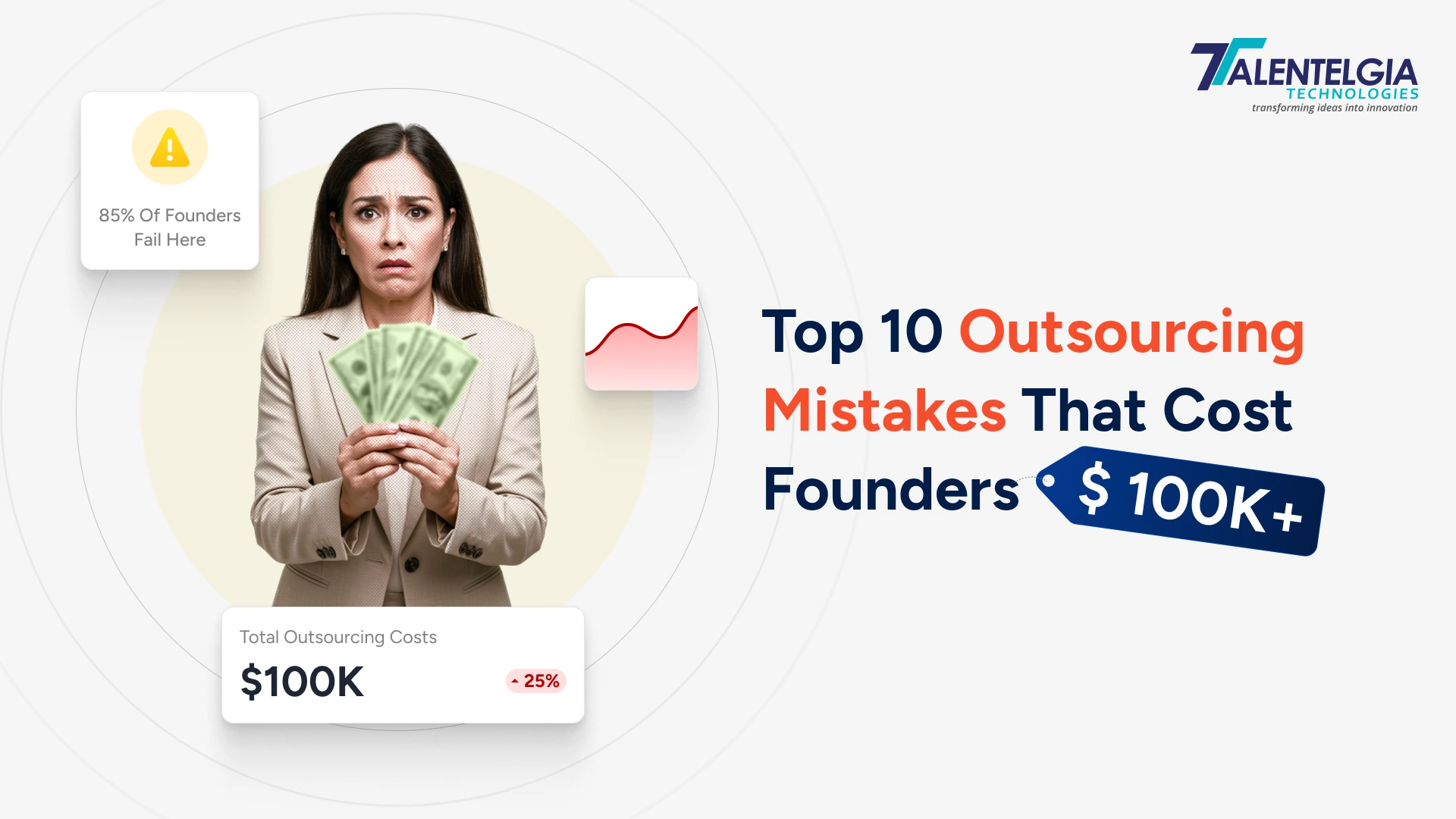
The most common strategy to achieve high-quality content production while enabling cost savings and increases in operational throughput is “focused outsourcing”. When the content production outsourcing is done correctly, the internal team can focus on the most crucial elements, they gain access to expert and specialized resources, and they’re able to enhance high-quality content production. If focused and effective analysis & strategies are not applied, outsourcing leads to wasted resources, delayed timelines, and unanticipated costs.
As per Research & Market statistics, the global market for IT outsourcing is projected to reach 410.2 billion in 2027. This shows that the future lies in software development outsourcing. You could choose to ignore this trend, but that would be a big mistake, as you’d be missing out on a huge competitive advantage. However, you could take advantage of outsourcing only if it’s done correctly. If not, you may never see the value from your investment. To prevent that, you’ll have to steer clear of a few classic outsourcing mistakes businesses face.
What Is IT Outsourcing?
IT outsourcing means hiring external experts to handle your tech work instead of building an in-house team. Think of it as renting a specialized construction crew—you define what house you want, and they bring the tools, skills, and manpower. So, instead of depending on only the in-house team, companies partner with outsourcing firms to get specific tasks done for their IT work, including Software Development, DevOps, QA & Testing.
The outsourcing approach lets companies access a broader range of skills and expertise that might not be available within their organization. Outsourcing software development agencies allows businesses to concentrate on their primary business and at the same time take advantage of their expertise and skills of their outsourcing partners.
For this reason, good project management is of utmost importance, reducing time and budget overruns and ensuring that the scope of work delivered meets the organization’s objectives. Additionally, good project management is fundamental to increasing productivity by streamlining processes and removing roadblocks.
Types of IT Outsourcing
Before we dive into the “what-not-to-do,” you need to know which flavor of outsourcing fits your business. We generally categorize them by location and partnership model.
1. By Location:
- Onshore (Domestic): Hiring a team in your own country. Best for high-compliance projects where you need the same time zone and legal framework.
✅ Same timezone/culture
✅ Easy face-to-face meetings
✅ Best communication❌ Highest cost: $80-150/hr
❌ Limited niche expertise
- Nearshore (Nearby): Outsourcing to a neighboring country (e.g., a U.S. firm hiring in Mexico or Colombia). This is the “sweet spot” for many—minimal time zone lag but lower costs.
✅ 2-6hr timezone overlap
✅ Similar work culture
✅ $30-60/hr rates❌ Still some cultural gaps
❌ Travel costs for meetings
- Offshore (Far away): Partnering with a provider in a distant country (e.g., India, Eastern Europe, or Southeast Asia). This offers the highest cost savings and access to a massive global talent pool.
✅ Lowest cost: $15-35/hour
✅ Massive talent pools
✅ 24/7 work cycles❌ 8-12hr timezones
❌ Language/cultural gaps
2. By Partnership Model:
- Staff Augmentation: You “rent” developers to join your existing team. You manage them; they provide the muscle.
✅ You control daily tasks
✅ Works like internal employees
✅ $25-$60/hr per developer❌ You manage everything
- Managed Services: You hand over an entire function (like cybersecurity or cloud infrastructure) to the provider. They manage the “how,” and you focus on the results.
✅ Zero tech management needed
✅ $15K-$100K/month
✅ Enterprise-grade reliability❌ Expensive long-term
- Project-Based: A one-and-done deal. You give them a specific brief, and they deliver the final product.
✅ Predictable budget
✅ They manage everything
✅ $20K-$500K per project❌ Scope changes cost extra
- Dedicated Team: A long-term setup where the provider builds a team that works exclusively for you, essentially acting as a remote branch of your office.
✅ They handle coordination
✅ Fixed monthly cost ($8K-$25K)
✅ Scale team up/down easily❌ Less direct control
Why Do Companies Need Outsourcing?
In the current landscape, outsourcing has shifted from a “luxury for the big players” to a “necessity for the agile.” Smart founders partner with outsourcing agencies to beat competition without burning cash. So in this article, we will focus on identifying risks and rewards to the content production outsourcing process.
1. Bridging the “Senior Talent Gap”
The global talent war is no longer about finding anyone who can code; it’s about finding the top 1% who understand AI orchestration, cybersecurity for outsourced teams, and cloud-native architecture. Agencies spend millions on talent acquisition and retention so you don’t have to. You get instant access to senior-level architects without the six-month recruitment cycle.
2. Radical Scalability (The “Elastic” Team)
Business in 2026 moves in waves. You might need 15 developers for a massive product launch in Q1, but only 3 for maintenance in Q3.
Partnering with an agency allows you to scale your workforce up or down with a simple contract amendment. You avoid the “hire and fire” cycle that destroys company culture and attracts negative Glassdoor reviews.
3. Turning Fixed Costs into Variable Expenses
Building an in-house department is a heavy “fixed” commitment: office space, hardware, benefits, and insurance.
Outsourcing converts these into variable costs. You pay for the output and the expertise, not the overhead. This keeps your balance sheet lean and makes your company much more attractive to investors who value agility.
4. Laser Focus on “Core” Innovation
Every hour your internal team spends on server maintenance or basic manual testing is an hour they aren’t spending on your unique value proposition. Outsourcing the “heavy lifting” to an agency frees your best minds to focus on what actually makes your brand special.
5. Instant Access to Advanced Tech Stacks
Most companies can’t afford to experiment with every new enterprise-grade AI tool or security framework. Outsourcing agencies, however, use these tools across dozens of clients. When you partner with them, you aren’t just “buying hours”; you’re inheriting their entire technological infrastructure and the lessons they’ve learned from other high-stakes projects.
6. Compliance and Risk Mitigation
With regulations like GDPR 2.0 and the latest AI Ethics Acts, staying compliant is a full-time job. A reputable agency takes on the burden of professional indemnity and regulatory compliance. They ensure that the code being written today won’t become a legal liability tomorrow.
Top 10 Most Common Mistakes of Outsourcing & How To Avoid Them?
Businesses need to build products faster, save on operational costs, and reach global talent, making software development outsourcing crucial for a business’s growth. Nonetheless, while there are many benefits of outsourcing, potential pitfalls, primarily due to typical mistakes, present a significant downside to outsourcing
As we move into 2026, the ability to remain competitive and provide quality digital solutions will be lost without avoiding the mistakes associated with outsourcing.
1. Falling Into the “Lowest Bidder” Trap
It is the most seductive mistake in the book. Choosing a partner based solely on a rock-bottom hourly rate often leads to “technical debt”—buggy code, poor security, and missed deadlines that end up costing 3x the original quote to fix.
How to Avoid: Pivot your focus from Cost to Value. Evaluate vendors based on their “Engineering Maturity,” portfolio, and client retention. A team that costs 20% more but delivers a clean, scalable product on the first try is actually the cheaper option in the long run.
2. Operating in the “Vague Scope” Void
If your requirements are for Mobile App Development, “build me an AI app that’s like Uber but for pets,” you are inviting disaster. Vague project scopes lead to “scope creep,” where the project grows out of control while the budget evaporates.
How to Avoid: Document a rigorous Statement of Work (SOW). Define a “Definition of Done” for every milestone. Use visual prototypes and wireframes to ensure both teams are seeing the same final product before a single line of code is written.
3. Ignoring Cultural and Time-Zone Synchronicity
Communication isn’t just about language; it’s about “working rhythm.” If your outsourced team has a “yes-man” culture (where they won’t tell you if a deadline is impossible), or if you have zero overlapping working hours, friction is inevitable.
How to Avoid: Establish “Golden Hours”—at least 2–3 hours of overlap for real-time syncs. During the vetting process, talk to the actual developers, not just the sales rep, to gauge their communication style and willingness to challenge bad ideas.
4. The “Shadow AI” and Security Oversight
In 2026, many developers use unauthorized AI tools to speed up their work. If your vendor isn’t monitoring this, your proprietary data could be leaked into public AI models, or you could inherit code with massive security vulnerabilities.
How to Avoid: Enforce a strict AI Usage Policy and data security audit. Ensure your contract includes a “Right to Audit” clause and that the vendor holds certifications like SOC 2 or ISO 27001. Treat their security as an extension of your own.
5. Skipping the “Pilot Project” Phase
Handing over your entire core product to a new partner on day one is a massive gamble. Many companies realize too late that the “technical fit” just isn’t there.
How to Avoid: Start with a 2–4 week Paid Pilot. Give them a non-critical but meaningful task. This acts as a stress test for their communication, speed, and quality. If they fail the pilot, you’ve saved yourself a million-dollar headache.
6. Poor Internal Governance (The “Set It and Forget It” Fallacy)
Outsourcing is a management function, not a magic wand. Companies often throw work “over the wall” and expect it to come back perfect without internal oversight.
How to Avoid: Assign a dedicated Internal Product Owner. This person should attend the outsourced team’s daily stand-ups and be the bridge between your business goals and their technical execution. Constant feedback prevents “standard drift.”
7. Falling for “AI-Washing”
In 2026, every agency claims to be an “AI-first” powerhouse. Some are just rebranding traditional manual labor as “AI-driven” to charge a premium (this is called AI-washing).
How to Avoid: Ask for Technical Proof of Concept. Don’t just look at case studies; ask to see their automated workflows, their AI governance frameworks, and how they use “Human-in-the-Loop” to verify AI-generated outputs.
8. No Clear IP Ownership or Exit Strategy
What happens if you want to switch vendors or bring the work in-house? If your contract doesn’t explicitly state you own every line of code and the associated documentation, you are essentially a hostage to your vendor.
How to Avoid: Ensure your contract specifies that all Intellectual Property (IP) belongs to you from the moment of creation. Mandate that all code must be pushed daily to your private repository (like GitHub or GitLab), not theirs.
9. Hiring a “Human-Only” Team
The world has moved on. If you hire a team that does everything manually—from ticket categorization to QA testing—you are paying for inefficiency.
How to Avoid: Prioritize partners who demonstrate Automation Maturity. Look for vendors who use AI for predictive analytics, automated testing, and CI/CD pipelines. This ensures your project scales without your costs scaling linearly.
10. Treating the Vendor as a “Task-Taker” Instead of a Partner
When you treat a vendor like a vending machine, you lose out on their greatest asset: their experience. They’ve likely worked on dozens of projects similar to yours and know the shortcuts you haven’t discovered yet.
How to Avoid: Build a Partnership Mindset. Invite them to strategic planning sessions. Encourage them to challenge your roadmap if they see a more efficient way to achieve the outcome. When they are invested in your success, they will go the extra mile.
Conclusion
IT outsourcing gives businesses an opportunity to utilize external talent to improve productivity. While planning outsourcing projects, careful planning to avoid mistakes that could lead to project failure is essential.
Outsourcing can be done successfully by balancing risk and benefit under the factors of cost, requirement, communication, expectations, culture, trust, protection, etc. When it comes to web development and other development services, an outsourcing engagement done professionally contributes to success.
As a leading outsourcing partner, Talentelgia offers a high level of customized software development services and manages client projects with full transparency and efficient communication.












 Write us on:
  Business queries:
  HR:
HR: 


