



 Healthcare App Development Services
 Real Estate Web Development Services
 E-Commerce App Development Services
 E-Commerce Web Development Services
 Blockchain E-commerce Development Company
 Fintech App Development Services
 Fintech Web Development
 Blockchain Fintech Development Company
 E-Learning App Development Services
 Restaurant App Development Company
 Mobile Game Development Company
 Travel App Development Company
 Automotive Web Design
 AI Traffic Management System
 AI Inventory Management Software
 AI Software Development
  AI Development Company
  AI App Development Services
  ChatGPT integration services
  AI Integration Services
  Generative AI Development Services
  Natural Language Processing Company
 Machine Learning Development
  Machine learning consulting services
  Blockchain Development
  Blockchain Software Development
  Smart Contract Development Company
  NFT Marketplace Development Services
  Asset Tokenization Company
 DeFi Wallet Development Company
 Mobile App Development
  IOS App Development
  Android App Development
  Cross-Platform App Development
  Augmented Reality (AR) App Development
  Virtual Reality (VR) App Development
  Web App Development
  SaaS App Development
 Flutter
  React Native
  Swift (IOS)
  Kotlin (Android)
  Mean Stack Development
  AngularJS Development
  MongoDB Development
  Nodejs Development
  Database Development
 Ruby on Rails Development
 Expressjs Development
  Full Stack Development
  Web Development Services
  Laravel Development
  LAMP Development
  Custom PHP Development
  .Net Development
  User Experience Design Services
  User Interface Design Services
  Automated Testing
  Manual Testing
  Digital Marketing Services
 Ride-Sharing And Taxi Services
 Food Delivery Services
 Grocery Delivery Services
 Transportation And Logistics
 Car Wash App
 Home Services App
 ERP Development Services
 CMS Development Services
 LMS Development
 CRM Development
 DevOps Development Services
 AI Business Solutions
 AI Cloud Solutions
 AI Chatbot Development
 API Development
 Blockchain Product Development
 Cryptocurrency Wallet Development
 About Talentelgia
  Our Team
  Our Culture
 Healthcare App Development Services
 Real Estate Web Development Services
 E-Commerce App Development Services
 E-Commerce Web Development Services
 Blockchain E-commerce
Development Company
Blockchain E-commerce
Development Company Fintech App Development Services
 Finance Web Development
 Blockchain Fintech
Development Company
Blockchain Fintech
Development Company E-Learning App Development Services
 Restaurant App Development Company
 Mobile Game Development Company
 Travel App Development Company
 Automotive Web Design
 AI Traffic Management System
 AI Inventory Management Software
 AI Software Development
 AI Development Company
 ChatGPT integration services
 AI Integration Services
 Machine Learning Development
 Machine learning consulting services
 Blockchain Development
 Blockchain Software Development
 Smart contract development company
 NFT marketplace development services
 IOS App Development
 Android App Development
 Cross-Platform App Development
 Augmented Reality (AR) App
Development
Augmented Reality (AR) App
Development Virtual Reality (VR) App Development
 Web App Development
 Flutter
 React
Native
React
Native Swift
(IOS)
Swift
(IOS) Kotlin (Android)
 MEAN Stack Development
 AngularJS Development
 MongoDB Development
 Nodejs Development
 Database development services
 Ruby on Rails Development services
 Expressjs Development
 Full Stack Development
 Web Development Services
 Laravel Development
 LAMP
Development
LAMP
Development Custom PHP Development
 User Experience Design Services
 User Interface Design Services
 Automated Testing
 Manual
Testing
Manual
Testing About Talentelgia
 Our Team
 Our Culture
By 2026, we will no longer have the luxury to rely on visual appeal alone with just visually pleasing mobile and web applications; whatever product or service your company is going to design will nowadays need to be fast, easy to use, visually optimized, accessible and personalized. In a crowded digital environment, UI/UX design plays an important role in driving app retention or abandonment. Users can be turned off by a single bad experience and end up going to competitors who provide more seamless, meaningful experiences.
Through putting actual users at the centre of every design decision, user-centered design makes certain that products revolve around their behaviours, preferences, and needs—a principle that forms the foundation of effective User Experience Design Services. As technology continues to advance in the form of AI (artificial intelligence), automation, and cross-platform frameworks, organisations have no other option but to take a second look at how they create digital experiences, including how they approach User Interface Design Services for consistency and usability.
This blog examines the increasing significance of UI/UX in 2026, demonstrating why user-centered design is crucial for building flourishing mobile and web apps today’s experience-led digital world.
What is User Centred Design?
User-Centered Design (UCD) is a design process where you design products (websites, mobile applications, software) based on the user and their needs, behaviors and expectations. Rather than designing mobile and web apps solely on business requirements or technical capabilities, UCD means every design choice is informed by how users will actually use the app.
In this method, designers first learn as much as they can about the user through research, feedback, and testing to understand their problems and solutions. And these inspirations are applied to things like navigation, content structure, and interaction design. This design is all about the ongoing testing and development process to ensure the best real-world usability, accessibility, and performance.
Importance of UI/UX for Mobile & Web Apps
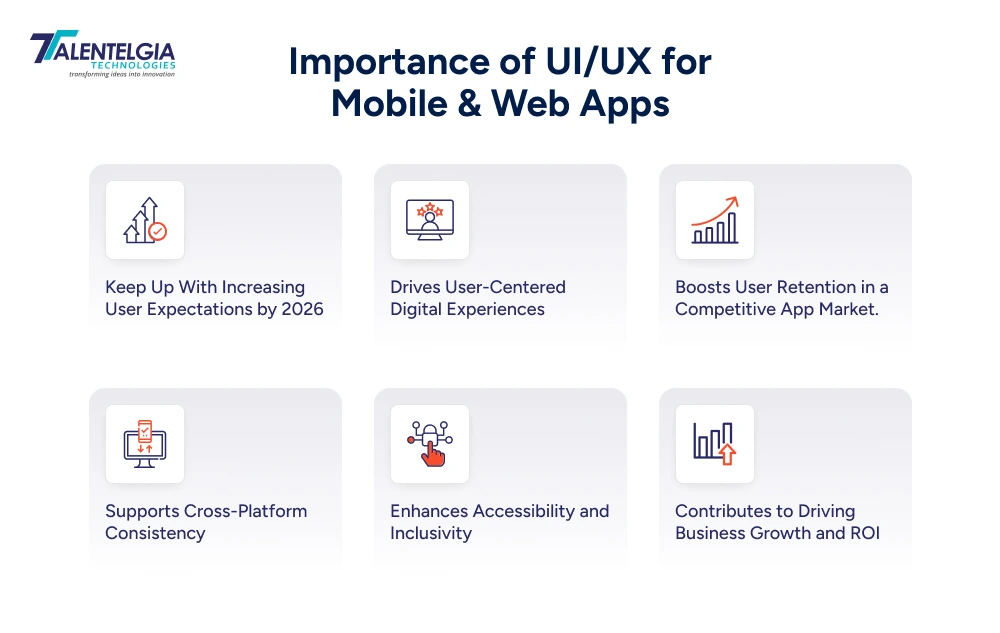
In 2026, the popularity of mobile and web apps is determined by the user experience. UI/UX design is a critical aspect to influence user loyalty, engagement, and retention, emphasizing on intuitive and user-centric interaction. Increasing online competition means that businesses need to focus on UI/UX in order to meet changing user needs, and to dome so with a long-term view.
Read More : Web App Development Cost: A Comprehensive Breakdown
1. Keep Up With Increasing User Expectations by 2026
In 2026, consumers demand instant responses, intuitive navigation and personalized experiences both in mobile and web apps.By designing UI/UX with the users in mind, we can predict such expectations and pave a clear path in their digital journey.Apps that don’t adhere to these standards will lose users after a few seconds of usage.
2. Drives User-Centered Digital Experiences
User-centered design based UI/UX enables businesses to build apps that resolve actual user concerns.This method means features, styles and interactions are created with the user in mind rather than as guesses.Users then feel like a human on the other side, which can lead to greater satisfaction.
3. Boosts User Retention in a Competitive App Market
With so many apps vying for your attention, the UI/UX in mobile and web apps is a differentiator. A natural, seamless journey prevents user churn and promotes lasting interaction. Keep users are those you can convert to evangelists and loyal customers.
4. Supports Cross-Platform Consistency
Users can switch between devices and will get the same UI/UX experience on mobile, tablet and desktop. This regularity serialises the app and inspires trust, thus making apps consistent between different touchpoints easier to use. It also reinforces brand awareness in a multi-device digital world.
5. Enhances Accessibility and Inclusivity
User-centric UI/UX Design 2026. By 2026, user-centred design will focus on accessibility as a key element for different user segments. Design for All is about enabling apps to be accessible and usable by everyone, not excluding larger audiences.Also A11Y-focused UI/UX that allows you to stay compliant with various global digital accessibility laws.
6. Contributes to Driving Business Growth and ROI
Good UI/UX increases conversions, decreases bounce rates, and makes people happy. This translates for businesses to measurable income increases, retention improvement,s and increased brand value.
"The year is 2026, and UI/UX is no longer a privilege but the keystone of sustainable digital growth."
Key UI/UX Trends Shaping 2026
Due to the fast growth of digital experiences, some UI/UX trends are gaining a must-use status for mobile and web apps in 2026. These are the result of shifts in user behavior, new technologies, and the popularity of user-focused design.
1. AI-Driven Personalization
Interfaces that learn: building interfaces that adapt content, layout and behaviour based on user preferences. Artificial Intelligence [AI] is making it possible to build a new generation of interfaces. This touch of personalisation ensures apps are intuitive and relevant to everyone.
Read More : How to Use AI for UX Research Tools?
2. Voice & Conversational Interfaces
Voice UI and conversation design are more mainstream today as users interact with apps through speech. This behavior boosts accessibility and opens up new options for users to make their way around and get things done without having to use standard taps or clicks.
3. Micro-Interactions & Motion Design
Charming micro-animations, subtle feedback responses , and intentional movement are leading to delightful engagement. Micro-interactions help users accomplish and understand a task by giving instant visual feedback that feels natural and engaging.
4. Immersive & AR Experiences
Augmented Reality(AR) and immersive interfaces are going beyond gaming and shopping to regular apps, ensuring users have rich contextually aware experiences that sit at the crossroads of digital and physical worlds.
5. Minimalism with Meaning
Sleek and minimalist designs with lots of attention to the ‘bare necessities’ are growing in popularity. This direction is about being clear and fast, so users can quickly discover answers without suffering from cognitive strain.
6. Accessibility & Inclusive Design
UI/UX in 2026 is not something tacked on at the end but a feature in its own right. Designers are being more inclusive and making sure that apps can be used by people with a range of abilities, which helps make usability better for everyone.
Best Practices for Implementing User-Centred Design
User-centered design means more than just following guidelines — it’s about maintaining real users at the center of every decision. It is possible to design mobile and web apps that are simple, useful, engaging, and beautiful by putting customer needs first.
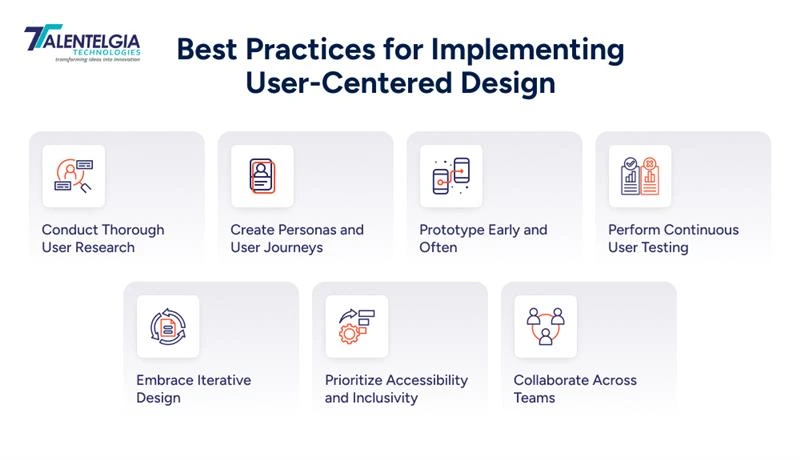
The following guiding principles serve as a guide toward creating experiences that will resonate with users into 2026 and beyond.
1. Conduct Thorough User Research
Begin by understanding the goals, behaviors, and pain points of your users through surveys, interview,s and analytics. Six years from now, the AI-powered tools will make themselves available to process massive datasets for greater insights.
2. Create Personas and User Journeys
Build out thorough user personas and map user journeys to see how users engage with your app. This way, designers make sure agents’ design is reflected in real user expectations and how they perform their workflows.
3. Prototype Early and Often
Create interactive prototypes in order to test assumptions before you build the real thing. With rapid prototyping, teams can get feedback, see how it works, and make changes faster.
4. Perform Continuous User Testing
Frequent usability testing with real users keeps the app simple and efficient. By 2026, analytics and remote testing can deliver real-time feedback to refine the user experience.
5. Embrace Iterative Design
Design for users is an iterative effort. Iteratively improve and adjust your UI/UX according to user feedback, performance data, and customer trends so that your app stays up-to-date and interesting.
6. Prioritize Accessibility and Inclusivity
You should be sure your designs are compliant and account for a range of user requirements. Inclusive design improves usability for everyone in your audience and extends the reach of your app.
7. Collaborate Across Teams
The successful practice of UCD involves the participation of all team members, including engineers, designers, product managers, and marketers. It helps to share ideas and align on goals so that the end product you’re working towards is consistent and optimized from a user perspective.
FAQ
Why is user-centered design important in 2026?
It ensures apps meet user needs, boosting engagement, retention, and loyalty.
How can AI influence UI/UX design?
AI personalizes experiences and provides insights to improve app design.
What are the key trends shaping UI/UX in 2026?
Trends include AI personalization, voice interfaces, micro-interactions, AR, and accessibility.
How can businesses measure the effectiveness of UI/UX?
Through engagement, retention, conversions, task completion, and user feedback.
What are best practices for implementing user-centered design?
Conduct research, prototype, test continuously, iterate, ensure accessibility, and collaborate.
Conclusion
It’s 2026 and UI/UX design is not just about looking pretty – it has become a strategic to-do for mobile & web applications. User-centric design results in apps that are intuitive, compelling, and meet real user needs leading to satisfaction, retention and long-term loyalty. Adapting to emerging trends, best practices and facilitating ever-increasing accessibility and inclusivity can allow businesses to craft digital experiences that not only live up to user expectations but also drive tangible growth and brand success. The investment you make in UI/UX today is the investment you are making in sustainable digital future tomorrow.













 Write us on:
  Business queries:
  HR:
HR: 


