



 Healthcare App Development Services
 Real Estate Web Development Services
 E-Commerce App Development Services
 E-Commerce Web Development Services
 Blockchain E-commerce Development Company
 Fintech App Development Services
 Fintech Web Development
 Blockchain Fintech Development Company
 E-Learning App Development Services
 Restaurant App Development Company
 Mobile Game Development Company
 Travel App Development Company
 Automotive Web Design
 AI Traffic Management System
 AI Inventory Management Software
 AI Development Company
  ChatGPT integration services
  AI Integration Services
  Generative AI Development Services
  Natural Language Processing Company
 Machine Learning Development
  Machine learning consulting services
  Blockchain Development
  Blockchain Software Development
  Smart Contract Development Company
  NFT Marketplace Development Services
  Asset Tokenization Company
 DeFi Wallet Development Company
 Mobile App Development
  IOS App Development
  Android App Development
  Cross-Platform App Development
  Augmented Reality (AR) App Development
  Virtual Reality (VR) App Development
  Web App Development
  SaaS App Development
 Flutter
  React Native
  Swift (IOS)
  Kotlin (Android)
  Mean Stack Development
  AngularJS Development
  MongoDB Development
  Nodejs Development
  Database Development
 Ruby on Rails Development
 Expressjs Development
  Full Stack Development
  Web Development Services
  Laravel Development
  LAMP Development
  Custom PHP Development
  .Net Development
  User Experience Design Services
  User Interface Design Services
  Automated Testing
  Manual Testing
  Digital Marketing Services
 Ride-Sharing And Taxi Services
 Food Delivery Services
 Grocery Delivery Services
 Transportation And Logistics
 Car Wash App
 Home Services App
 ERP Development Services
 CMS Development Services
 LMS Development
 CRM Development
 DevOps Development Services
 AI Business Solutions
 AI Cloud Solutions
 AI Chatbot Development
 API Development
 Blockchain Product Development
 Cryptocurrency Wallet Development
 About Talentelgia
  Our Team
  Our Culture
 Healthcare App Development Services
 Real Estate Web Development Services
 E-Commerce App Development Services
 E-Commerce Web Development Services
 Blockchain E-commerce
Development Company
Blockchain E-commerce
Development Company Fintech App Development Services
 Finance Web Development
 Blockchain Fintech
Development Company
Blockchain Fintech
Development Company E-Learning App Development Services
 Restaurant App Development Company
 Mobile Game Development Company
 Travel App Development Company
 Automotive Web Design
 AI Traffic Management System
 AI Inventory Management Software
 AI Development Company
 ChatGPT integration services
 AI Integration Services
 Machine Learning Development
 Machine learning consulting services
 Blockchain Development
 Blockchain Software Development
 Smart contract development company
 NFT marketplace development services
 IOS App Development
 Android App Development
 Cross-Platform App Development
 Augmented Reality (AR) App
Development
Augmented Reality (AR) App
Development Virtual Reality (VR) App Development
 Web App Development
 Flutter
 React
Native
React
Native Swift
(IOS)
Swift
(IOS) Kotlin (Android)
 MEAN Stack Development
 AngularJS Development
 MongoDB Development
 Nodejs Development
 Database development services
 Ruby on Rails Development services
 Expressjs Development
 Full Stack Development
 Web Development Services
 Laravel Development
 LAMP
Development
LAMP
Development Custom PHP Development
 User Experience Design Services
 User Interface Design Services
 Automated Testing
 Manual
Testing
Manual
Testing About Talentelgia
 Our Team
 Our Culture
Enterprise apps are what keep companies running businesses from employee-facing tools to customer-centric digital experiences. Strong enterprise application security is increasingly critical as complex web and mobile platforms become the norm for expanding organizations. These applications process sensitive data, link to multiple systems, and run for many users, making them attractive targets for cyberattacks.
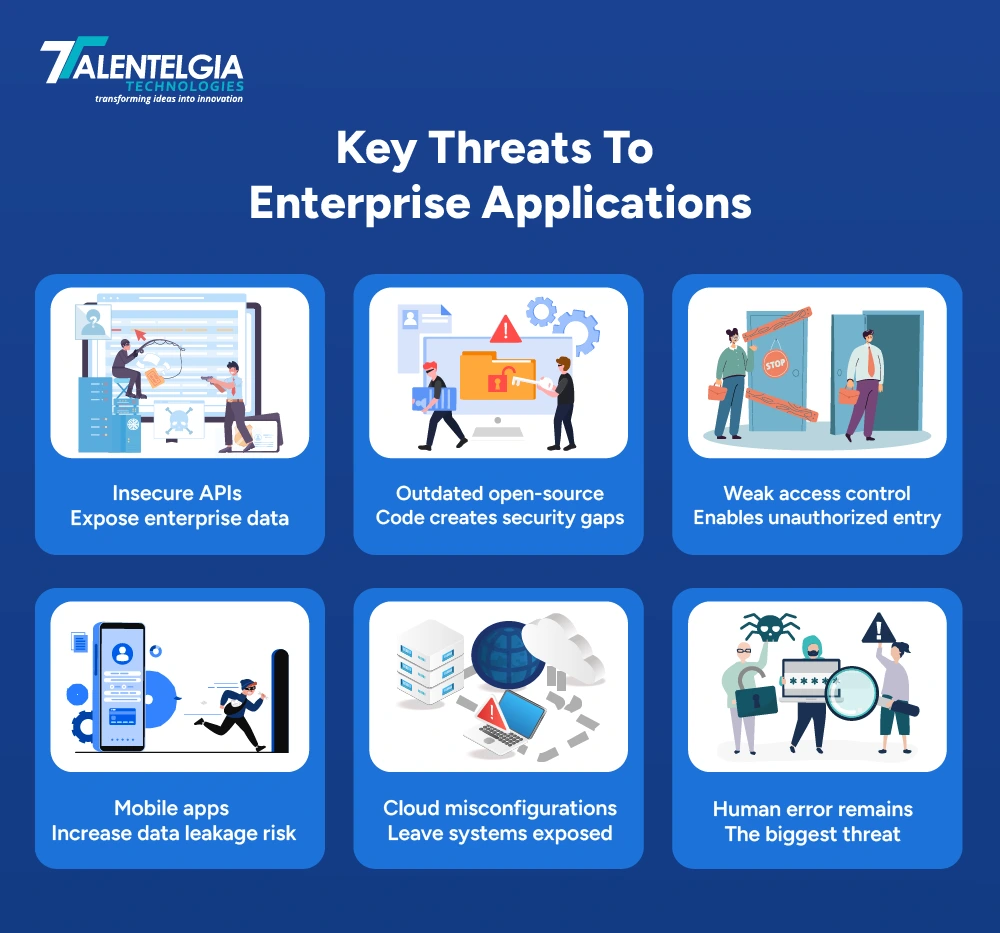
Organizations are hitting on the following security pain points that impact today’s modern enterprise – from open-source components putting you at risk, to insecure integrations and mobility taking over. Lack of a defined enterprise app security strategy exposes enterprises to data breaches, compliance concerns, and business outages. Developing for the Enterprise. Secure development of enterprise software is about engineering security into our software lifecycle, not just as a final gate.
As more mobile-first offerings and connected enterprise ecosystems enter the market, it’s also important that businesses give serious attention to enterprise mobile app security, as well as security around system integrations. Whether working with an internal team or a trusted Cross Platform App Development Company, organizations must ensure that security standards are consistently applied across web, mobile, and backend systems. A clear enterprise application strategy helps balance protection needs with collaboration, scalability, and long-term sustainability. This guide explains how to develop secure enterprise apps that meet both modern business and security requirements.
Understanding Enterprise App Security Fundamentals
Enterprise app security targets the protection of applications that underpin significant commercial activity, personal data, and intricate business processes. Enterprise applications, unlike consumer apps, interface with many systems, users, and third-party services – which widens their attack surface. Enterprise app security ensures the confidentiality, integrity, and availability of web, mobile, and backend systems.
At its core, enterprise application security involves protecting application code, APIs, backend datastores, user access, and third-party integrations. Typical challenges include weak authentication, insecure access controls, unpatched vulnerabilities in third-party open-source libraries, and misconfigurations of cloud-hosting services. Without a business-grade level of defence, these vulnerabilities can result in a breach or loss of data, financial implications, or regulatory sanctions.
If you build enterprise software, the only way to be secure is to have a proactive security program integrated into your development lifecycle. It should go without saying that the above-mentioned factors include secure coding practices, frequent vulnerability testing, dependency management of open-source components, and ongoing monitoring. These security basics enable businesses to build reliable solutions that can scale and grow, while managing risk effectively
Example:- Imagine it’s an enterprise HR app that includes payroll, attendance, and a mobile employee app. In the case that an obsolete authentication library is utilized, for example, an open-source one, and it is not maintained/patched over time, attackers could exploit its weaknesses to access confidential data. This one weakness could have led to the exposure of employee records, salary information, and internal systems. With secure coding practices, up-to-date dependencies, and strong access controls in place, the organization can avoid these breaches while holding on to its secure enterprise software.
Read More:- Cybersecurity for Outsourced & Remote Software Teams
Enterprise Application Strategy for Security-First Design
A security-first enterprise application strategy puts security into every step of the software development process, rather than trying to tack it on afterward. The following are the steps enterprises should take to ensure their applications are built to be secure, scalable, and resilient.
Key Steps in a Security-First Enterprise Application Strategy
1. Define security requirements early
Identify sensitivity of data, compliance requirements, and risk exposure upfront to inform architecture/design decisions.
2. Choose a secure enterprise app platform
Choose holders that incorporate security features like encryption, role-based access control, and audit logging.
3. Implement centralized identity and access management
Reduce the discrepancy in access between web, mobile, and internal applications by delegating all logic to a single system for authentication and authorization.
4. Embed security into the development lifecycle
Employ coding guidelines for secure coding practices, security scanning tools, and follow data privacy standards to ensure the product is safe from security threats; also, maintain zero vulnerabilities throughout development by cross-verifying against national vulnerability databases.
5. Enable secure enterprise security and collaboration
Secure all data sharing between teams and systems with secure APIs, encryption, and controlled access policies.
6. Continuously monitor and improve security posture
Monitor the state of application security, and evolve security controls to fend off new threats as enterprise essential services change.
By conducting the above, companies can create secure enterprise software that combines innovation and collaboration with enterprise-grade security.
Enterprise Mobile Application Security Best Practices
Enterprise mobile apps are no longer just “nice to have.” They’re how employees check data, approve work, and stay productive when they’re not at a desk. Because these apps handle real business information, enterprise mobile application security has to work quietly in the background—without slowing people down or getting in the way.
What actually works in real-world enterprise mobile security?
- Make access simple but strict
Don’t rely on passwords alone. Multi-factor authentication and role-based access make sure the right people get in, even if a device ends up in the wrong hands. - Assume devices will get lost
Phones go missing. It happens. Encrypting data and limiting what’s stored on the device reduces damage when it does. - Treat APIs like front doors, not back doors
Mobile apps constantly talk to enterprise systems. Securing APIs with proper authentication and monitoring prevents silent data leaks. - Don’t ignore open-source shortcuts
Open-source libraries save time—but outdated ones create risk. Regular updates and scans close gaps that attackers often exploit first. - Give IT control without micromanaging users
Mobile app and device management tools help enforce security policies without disrupting daily work. - Keep checking, even after launch
Security isn’t “done” once the app is live. Continuous testing and monitoring catch problems before users or attackers do.
When these practices are followed consistently, enterprises can support flexible work and mobile productivity while maintaining strong enterprise app security—without making security feel like a burden.
Read More:- Why Does Your Business Need Enterprise Application …
Integrating Application Security Solutions with Enterprise Systems
In real enterprise environments, applications are always connected to something else—login systems, databases, cloud tools, mobile apps, or third-party platforms. That’s why security integration isn’t just about adding another tool. It’s about making sure security fits naturally into the systems teams already depend on, without slowing anyone down.
What smooth security integration looks like in practice?
- Work with what’s already there
The best security solutions plug into existing systems like identity management, CRM, ERP, and cloud platforms. If security forces are forced to change everything overnight, it usually gets bypassed. - Keep access rules consistent everywhere
Using one centralized identity and access system helps avoid confusion. People shouldn’t have different permissions for every app—they should have one clear, controlled access experience. - Pay attention to the connections, not just the apps
A lot of security issues happen where systems talk to each other. Securing APIs, data flows, and third-party integrations is just as important as securing the application itself. - Don’t treat mobile apps as an exception
Mobile apps should follow the same security rules as core enterprise systems. This keeps enterprise application integration security consistent across web, mobile, and backend platforms. - Let automation do the heavy lifting
Integrating security checks into existing DevOps and monitoring tools reduces manual effort and helps teams catch issues early—without extra meetings or checklists. - Make security visible, not noisy
Centralized logs and alerts give security teams clarity without overwhelming developers or operations teams with constant warnings.
When application security solutions blend naturally into enterprise systems, security stops feeling like a blocker. Instead, it becomes part of how the organization works, quietly protecting data, users, and integrations while enabling collaboration and scale.
Conclusion
Creating secure enterprise applications is not about adopting every new security tool available, but about making intelligent, well-planned decisions from the start. By integrating security into application strategy, mobile experiences, and system integrations, enterprises can reduce risk while continuing to innovate and collaborate effectively.
A security-led approach enables businesses to protect valuable data, manage open-source and integration risks, and support modern workflows across web and mobile platforms. Many organizations also choose to work with a trusted Cybersecurity Service Provider to strengthen governance, risk management, and ongoing threat monitoring across enterprise environments.

Ultimately, secure enterprise apps uphold more than just security standards they are more stable, easier to manage, and better prepared for future growth and evolving digital threats.












 Write us on:
  Business queries:
  HR:
HR: 


