


 Healthcare App Development Services
 Real Estate Web Development Services
 E-Commerce App Development Services
 E-Commerce Web Development Services
 Blockchain E-commerce Development Company
 Fintech App Development Services
 Fintech Web Development
 Blockchain Fintech Development Company
 E-Learning App Development Services
 Restaurant App Development Company
 Mobile Game Development Company
 Travel App Development Company
 Automotive Web Design
 AI Traffic Management System
 AI Inventory Management Software
 AI Software Development
  AI Development Company
  AI App Development Services
  ChatGPT integration services
  AI Integration Services
  Generative AI Development Services
  Natural Language Processing Company
 Machine Learning Development
  Machine learning consulting services
  Blockchain Development
  Blockchain Software Development
  Smart Contract Development Company
  NFT Marketplace Development Services
  Asset Tokenization Company
 DeFi Wallet Development Company
 Mobile App Development
  IOS App Development
  Android App Development
  Cross-Platform App Development
  Augmented Reality (AR) App Development
  Virtual Reality (VR) App Development
  Web App Development
  SaaS App Development
 Flutter
  React Native
  Swift (IOS)
  Kotlin (Android)
  Mean Stack Development
  AngularJS Development
  MongoDB Development
  Nodejs Development
  Database Development
 Ruby on Rails Development
 Expressjs Development
  Full Stack Development
  Web Development Services
  Laravel Development
  LAMP Development
  Custom PHP Development
  .Net Development
  User Experience Design Services
  User Interface Design Services
  Automated Testing
  Manual Testing
  Digital Marketing Services
 Ride-Sharing And Taxi Services
 Food Delivery Services
 Grocery Delivery Services
 Transportation And Logistics
 Car Wash App
 Home Services App
 ERP Development Services
 CMS Development Services
 LMS Development
 CRM Development
 DevOps Development Services
 AI Business Solutions
 AI Cloud Solutions
 AI Chatbot Development
 API Development
 Blockchain Product Development
 Cryptocurrency Wallet Development
 About Talentelgia
  Our Team
  Our Culture
 Healthcare App Development Services
 Real Estate Web Development Services
 E-Commerce App Development Services
 E-Commerce Web Development Services
 Blockchain E-commerce
Development Company
Blockchain E-commerce
Development Company Fintech App Development Services
 Finance Web Development
 Blockchain Fintech
Development Company
Blockchain Fintech
Development Company E-Learning App Development Services
 Restaurant App Development Company
 Mobile Game Development Company
 Travel App Development Company
 Automotive Web Design
 AI Traffic Management System
 AI Inventory Management Software
 AI Software Development
 AI Development Company
 ChatGPT integration services
 AI Integration Services
 Machine Learning Development
 Machine learning consulting services
 Blockchain Development
 Blockchain Software Development
 Smart contract development company
 NFT marketplace development services
 IOS App Development
 Android App Development
 Cross-Platform App Development
 Augmented Reality (AR) App
Development
Augmented Reality (AR) App
Development Virtual Reality (VR) App Development
 Web App Development
 Flutter
 React
Native
React
Native Swift
(IOS)
Swift
(IOS) Kotlin (Android)
 MEAN Stack Development
 AngularJS Development
 MongoDB Development
 Nodejs Development
 Database development services
 Ruby on Rails Development services
 Expressjs Development
 Full Stack Development
 Web Development Services
 Laravel Development
 LAMP
Development
LAMP
Development Custom PHP Development
 User Experience Design Services
 User Interface Design Services
 Automated Testing
 Manual
Testing
Manual
Testing About Talentelgia
 Our Team
 Our Culture
Cyber threats are increasing day by day, and businesses require robust tools to secure their systems. This is where SIEM (Security Information and Event Management) and SOAR (Security Orchestration, Automation, and Response) get involved. They’re both meant to aid security teams in identifying, processing, and responding to attacks more quickly — but they function differently. When it comes down to SIEM vs SOAR, what they are and which one is best makes many confused.
SIEM is about getting security data in one place and analyzing it; SOAR is all about automating actions to take on threats, helping security teams organize their operations. Taken together, they can construct an effective shield against contemporary cyber threats. If you’re working with a cybersecurity service provider, they can also help you understand which solution fits your needs best.
In this blog, we’ll dissect some of these tools and explain the features to compare when instance analyzers, cloud service maps, or tagging solutions are considered for solving your business problems.
What is SIEM?
SIEM, Security Information and Event Management, is like the central command center of security for your business. Instead of sifting through logs and alerts from various tools one after another, SIEM collects it all in a single place. It keeps an eye on your servers, applications, firewalls and networks to help security teams identify threats faster and see what’s really happening behind each warning. Consider it as your cybersecurity “eyes and ears” throughout your entire system.
Key Features of SIEM
- Log Collection: SIEM gathers logs from all your tools so nothing slips through the cracks.
- Real-Time Monitoring: It keeps an eye on your systems 24/7 to catch unusual activities.
- Threat Detection: SIEM can identify patterns that may signal an attack or a security risk.
- Instant Alerts: When something looks suspicious, it sends an alert right away.
- Compliance Support: Need to meet security rules or industry standards? SIEM creates the reports you need.
How SIEM Works in Cybersecurity
SIEM takes all that data from your systems and processes it, raising a red flag if something looks suspicious. For instance, multiple failed login attempts or unusual network traffic could indicate that a threat is brewing. When SIEM sees these flags, it notifies the security team so that they can investigate and respond. It functions as an early-warning service, and it provides enough visibility for teams to take action before cyberattacks can take root.
Limitations of SIEM Tools
While SIEM is a great resource for security, there are also some cons that businesses should keep an eye on.
One, SIEM tools throw a lot of alerts. Sometimes, it seems, everything is an alert — even things that don’t truly imperil you. This can drown security teams and smother their efforts to concentrate on the issues that are truly important.
One issue is that SIEM still suffers from the problem of manual investigation. It can warn you that something is wrong, but it will not magically make the problem go away. Your team still needs to roll up its sleeves and get dirty, dig into the logs, and determine what we’re going to do.
The process of implementing SIEM can also be something of a heavy lift. It takes time, skill, and careful tuning to make the device work properly. Unfocused SIEM won’t give you the clarity you’re looking for.
And lastly, even though SIEM is adept at identifying threats, its response capabilities are restricted. It isn’t going to answer for itself. So when an alert goes off, your team can’t just let it ride and figure the response out on their own.
Simply put, SIEM is a valuable tool “when” you already have the right resources and setup and processes in place around it.
What is SOAR?
SOAR stands for Security Orchestration, Automation, and Response, and it’s basically the “action hero” of cybersecurity tools. While SIEM focuses on collecting and analyzing data, SOAR takes things a step further by helping teams respond to threats faster — and in many cases, automatically.
Think of SOAR as the system that helps your security team work smarter, not harder, by cutting down manual tasks and speeding up the response cycle.
Key Features of SIEM
- Automation: SOAR can automatically handle repetitive security tasks so your team doesn’t have to.
- Playbooks: It uses predefined workflows to guide how different types of threats should be handled.
- Case Management: Everything related to an incident — alerts, logs, actions — is organized in one place.
- Integration: SOAR connects with multiple security tools so they all work together smoothly.
- Faster Response: With automation and smarter workflows, threats are handled much more quickly.
How SIEM Works in Cybersecurity
Here’s where SOAR really shines: when a threat is detected, SOAR steps in and helps coordinate the entire response. For example, if a suspicious login attempt is flagged, SOAR can automatically block the user, alert the security team, and log the incident — all without someone having to jump in right away.
It acts like a digital assistant for your security team, taking care of time-consuming tasks, organizing everything neatly, and ensuring the response process follows best practices every time.
Limitations of SIEM Tools
While SOAR is incredibly helpful, it’s not a magic solution.
For starters, SOAR works best when you already have strong security tools in place — like SIEM. If your data is messy or incomplete, SOAR won’t perform as well because it relies on accurate information to take action.
There’s also the initial setup and customization. SOAR needs well-designed playbooks, clear workflows, and proper integration with your existing tools. This can take time and requires expertise.
And finally, automation isn’t perfect. If playbooks aren’t designed well, SOAR might respond incorrectly or take an action you didn’t intend. So your team still needs to monitor, update, and refine it regularly.
In short, SOAR is powerful, but it needs the right environment and careful setup to work at its best.
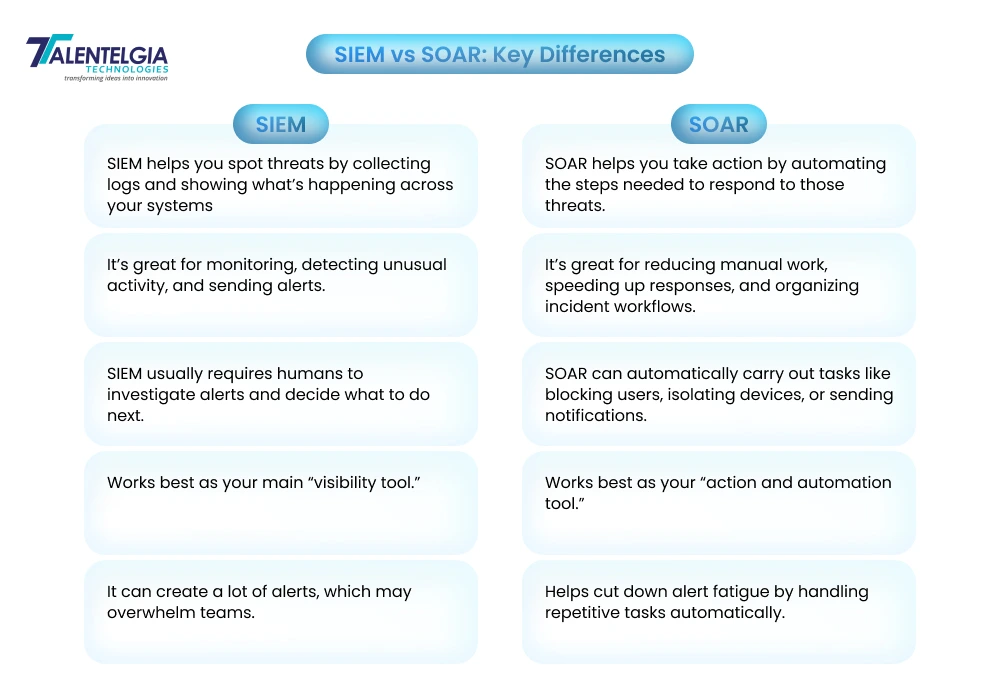
SIEM vs SOAR: Key Differences
SIEM and SOAR Together
SIEM and SOAR are great tools on their own, but they become a real game-changer when you use them together. You can think of SIEM as the tool that spots the problem and SOAR as the tool that helps you fix it—quickly and with less effort.
SIEM gathers all the logs, alerts, and security data from across your systems. Once it detects something suspicious, SOAR steps in to handle the next part. It can automatically block a user, isolate a device, or notify the right team members—saving a lot of time.
When they work as a team, you get a smoother and stronger security setup:
- You see what’s happening across your entire environment.
- You respond to threats much faster.
- Your team spends less time doing repetitive tasks.
- And you reduce the chances of missing critical alerts.
In short, SIEM gives you the visibility you need, and SOAR gives you the power to act quickly and consistently. Together, they help create a smarter and more reliable defense against modern cyber threats.
Also read: Best Cybersecurity Practices for Small and Medium …
Choosing the Right Solution
Choosing between SIEM and SOAR doesn’t have to feel complicated. It really comes down to what your security team needs the most right now.
If your main goal is to see what’s happening across your systems, catch unusual behavior, and stay on top of alerts, then SIEM is the tool you should start with. It gives you visibility, insights, and a clear picture of potential threats.
But if you’re already drowning in alerts and your team is spending too much time doing the same security tasks over and over, SOAR can be a huge help. It automates responses, handles routine actions, and speeds up the entire incident-handling process.
In many cases, the best choice isn’t “SIEM or SOAR” — it’s actually both. SIEM detects the problem, and SOAR helps you respond to it. When they work together, your security becomes faster, smarter, and more efficient.
So think about your biggest pain points:
- Need better visibility? Go for SIEM.
- Need faster response and less manual work? Go for SOAR.
- Need both? Use them together for the strongest defense.
Conclusion
In the modern era of ceaseless cyberthreats, simply having the proper security tools has become a necessity rather than an option. SIEM and SOAR offer strong capabilities, but they’re not really interchangeable. SIEM lets you see what’s happening across your systems, while SOAR allows you to act on those problems rapidly and at scale.
In combination, they offer a significantly stronger defense: the SIEM alerts on an issue and SOAR takes action. This not only enhances your security posture but also liberates your team from monotonous manual tasks.

In the end, it depends on your use case for which option is better. If visibility is most important to you, SIEM is your answer. If you handle more alerts than you know what to do with and dread manually handling so many of them, SOAR is where it’s at. And if you’re looking to build a state-of-the-art cybersecurity infrastructure, the best decision is simply using both tools.

You can create a security strategy that’s faster, more intelligent, and able to handle today’s dynamic threats when you know how SIEM and SOAR are different — and how they work together.










 Write us on:
  Business queries:
  HR:
HR: 


