



 Healthcare App Development Services
 Real Estate Web Development Services
 E-Commerce App Development Services
 E-Commerce Web Development Services
 Blockchain E-commerce Development Company
 Fintech App Development Services
 Fintech Web Development
 Blockchain Fintech Development Company
 E-Learning App Development Services
 Restaurant App Development Company
 Mobile Game Development Company
 Travel App Development Company
 Automotive Web Design
 AI Traffic Management System
 AI Inventory Management Software
 AI Software Development
  AI Development Company
  AI App Development Services
  ChatGPT integration services
  AI Integration Services
  Generative AI Development Services
  Natural Language Processing Company
 Machine Learning Development
  Machine learning consulting services
  Blockchain Development
  Blockchain Software Development
  Smart Contract Development Company
  NFT Marketplace Development Services
  Asset Tokenization Company
 DeFi Wallet Development Company
 Mobile App Development
  IOS App Development
  Android App Development
  Cross-Platform App Development
  Augmented Reality (AR) App Development
  Virtual Reality (VR) App Development
  Web App Development
  SaaS App Development
 Flutter
  React Native
  Swift (IOS)
  Kotlin (Android)
  Mean Stack Development
  AngularJS Development
  MongoDB Development
  Nodejs Development
  Database Development
 Ruby on Rails Development
 Expressjs Development
  Full Stack Development
  Web Development Services
  Laravel Development
  LAMP Development
  Custom PHP Development
  .Net Development
  User Experience Design Services
  User Interface Design Services
  Automated Testing
  Manual Testing
  Digital Marketing Services
 Ride-Sharing And Taxi Services
 Food Delivery Services
 Grocery Delivery Services
 Transportation And Logistics
 Car Wash App
 Home Services App
 ERP Development Services
 CMS Development Services
 LMS Development
 CRM Development
 DevOps Development Services
 AI Business Solutions
 AI Cloud Solutions
 AI Chatbot Development
 API Development
 Blockchain Product Development
 Cryptocurrency Wallet Development
 About Talentelgia
  Our Team
  Our Culture
 Healthcare App Development Services
 Real Estate Web Development Services
 E-Commerce App Development Services
 E-Commerce Web Development Services
 Blockchain E-commerce
Development Company
Blockchain E-commerce
Development Company Fintech App Development Services
 Finance Web Development
 Blockchain Fintech
Development Company
Blockchain Fintech
Development Company E-Learning App Development Services
 Restaurant App Development Company
 Mobile Game Development Company
 Travel App Development Company
 Automotive Web Design
 AI Traffic Management System
 AI Inventory Management Software
 AI Software Development
 AI Development Company
 ChatGPT integration services
 AI Integration Services
 Machine Learning Development
 Machine learning consulting services
 Blockchain Development
 Blockchain Software Development
 Smart contract development company
 NFT marketplace development services
 IOS App Development
 Android App Development
 Cross-Platform App Development
 Augmented Reality (AR) App
Development
Augmented Reality (AR) App
Development Virtual Reality (VR) App Development
 Web App Development
 Flutter
 React
Native
React
Native Swift
(IOS)
Swift
(IOS) Kotlin (Android)
 MEAN Stack Development
 AngularJS Development
 MongoDB Development
 Nodejs Development
 Database development services
 Ruby on Rails Development services
 Expressjs Development
 Full Stack Development
 Web Development Services
 Laravel Development
 LAMP
Development
LAMP
Development Custom PHP Development
 User Experience Design Services
 User Interface Design Services
 Automated Testing
 Manual
Testing
Manual
Testing About Talentelgia
 Our Team
 Our Culture
To be honest, tech projects don’t always go as per the plan. A feature takes longer than expected, a new update breaks something, the budget starts getting stretched, or client requirements suddenly change. This is simply part of the tech job. This is where risk management strategies for tech projects become critical.
All technology projects create uncertainty, from developing a new mobile app and launching a SaaS platform to upgrading systems or migrating to the cloud. Technical challenges, delays, cost issues, security threats, or lack of team communication can be the real obstacles. Neglecting these risks can result in small issues escalating to big problems in no time.
Strong risk management strategies don’t mean to expect the worst. They mean being prepared. This helps teams identify potential problems early on, recognize their severity, and take intelligent measures to mitigate them. Teams can push ahead with focus and assurance, instead of continuing to respond to issues.
In this guide, we’ll cover practical and easily actionable risk management strategies for tech projects to help you get more comfortable with uncertainty, whether at the beginning or throughout a project’s life cycle.
Risk Management Strategies
Risk management strategies are simple plans that help teams prepare for what could go wrong on a project. Rather than waiting for problems to arise, teams seek to identify potential risks early — such as technical challenges, delays, or budget issues — and prepare responses. By planning and preparing ahead of time, teams can reduce the severity of these issues and maintain forward progress on the project. On the whole, risk management strategies make projects more systematic, resilient, and manageable.
Why Risk Management Strategies for Tech Projects Are Important
Below are some key reasons why risk management strategies for tech projects are important:
1. Helps identify potential problems early
Risk management strategies allow teams to identify potential problems like tech breakdowns, delays, and budget issues before they can escalate.
2. Reduces project delays
By prepping teams to handle challenges in advance, risks can be mitigated and handled more quickly, keeping the project on track.
3. Controls project costs
Unexpected problems can increase expenses. A good strategy for risk management avoids overspending and ensures the budget is managed responsibly.
4. Improves decision-making
The project managers will be able to make informed decisions and better decisions for the deciding parts during its lifecycle with clear risk plans.
5. Enhances team coordination
Teams communicate more effectively and remain aligned when everyone knows there’s potential risk involved, as well as a plan to mitigate it.
6. Increases project success rate
Companies are better equipped to finish tech projects on time and within budget by preparing for uncertainties.
Types of Risks in Tech Projects
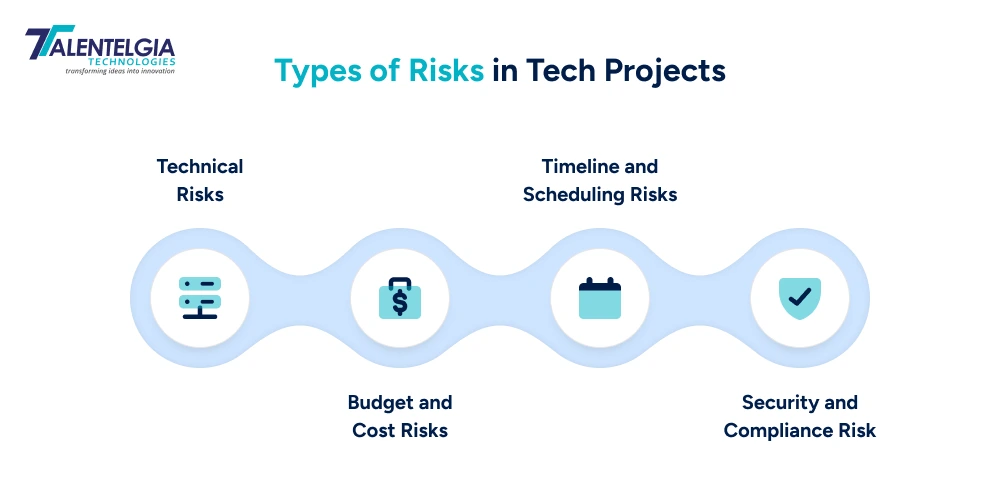
Technology projects involve multiple stages such as planning, development, testing, and deployment. During these stages, different types of risks can arise that may affect the project’s timeline, budget, or overall success. Understanding these risks helps teams prepare better and manage challenges effectively.
Below are some common types of risks in tech projects:
| Technical Risks | Budget and Cost Risks |
| Issues related to software performance, system failures, integration problems, bugs, or outdated technologies that can impact the functionality of the project. | These risks occur when the project exceeds the planned budget due to poor cost estimation, unexpected challenges, or additional project requirements. |
| Timeline and Scheduling Risks | Security and Compliance Risks |
| Delays occur when tasks take longer than expected because of unclear requirements, limited resources, or technical challenges during development. | Risks related to data breaches, cyber threats, or failure to follow legal regulations and industry compliance standards. |
Read more:- How to Set Realistic Timelines for Software Projects?
Best Risk Management Strategies Used by Successful Tech Teams
The best tech teams know that risks will always be a natural part of any project. They cannot afford to bury their heads in the sand; instead, they implement well-defined strategies to identify, control, and minimize potential problems before those issues get a chance to dance with the project. Ensuring teams are organized with effective decision-making and managing tech project risk keeps development on track. Here are some of the top risk management strategies that successful tech teams use:
1. Early Risk Identification
Successful teams are even adept at identifying risks early on in a project. By analyzing requirements, technologies, and resources up front, they can forecast potential challenges and develop solutions in advance.
2. Regular Risk Assessment
Tech teams continuously perform risk assessments throughout the project lifecycle. Regular reviews provide insight for teams on how serious a risk is and if new risks have arisen during development.
3. Clear Communication and Collaboration
Silo-free communication between team members, project managers, and stakeholders ensures that risks are highlighted during the collaboration and mitigated quickly. Transparency decreases confusion and increases decision-making.
4. Creating Risk Mitigation Plans
The top teams had contingency plans to limit the effects of potential risks. These plans include contingencies, reallocating resources, and timeline adjustments in the event of a problem.
5. Continuous Monitoring and Adaptation
Successful teams regularly keep track of project progress and modify their strategies as necessary. This enables them to react quickly to unplanned changes and ensure the continuing progress of the project.
Also Read:- Why Many Software Projects Fail?
How to Create a Risk Management Plan for Tech Projects (Step-by-Step)
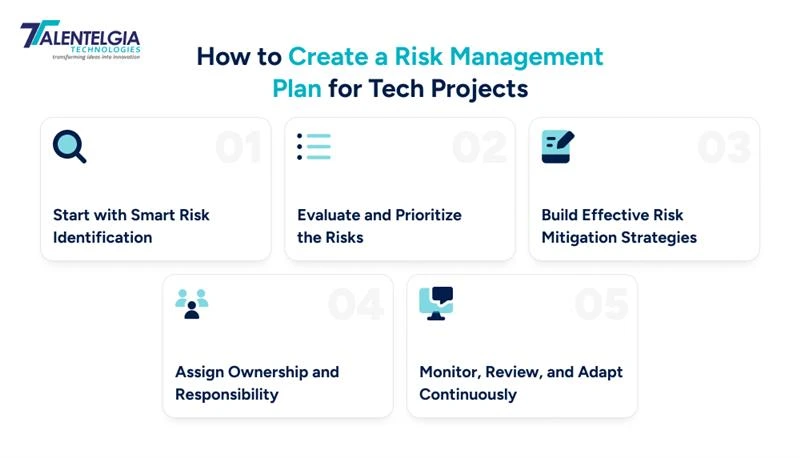
This type of strong risk management plan for tech projects helps a team stay prepared to respond properly in case the forecast goes wrong. Rather than being reactive when problems arise, a structured first principles approach allows teams to proactively identify, evaluate, and manage risks early. Here are the key steps that successful tech teams take to create an effective risk management plan.
1. Start with Smart Risk Identification
The first thing in any risk management strategy for tech projects is to identify potential risks. Reviewing project requirements, technology stacks, timelines, and resources would help teams identify possible roadblocks. Identifying risk early helps to stop small problems from becoming big roadblocks for a project.
2. Evaluate and Prioritize the Risks
Step 2: Assess Probability and Impact of Risks. After you identify risks Not all risks are equally grave. Ranking risks as High Impact, High Probability helps teams to invest their precious time more wisely.
3. Build Effective Risk Mitigation Strategies
After evaluating the risks, teams should create concise risk mitigation strategies. This could involve building contingency plans, enhancing test procedures, deploying more resources, or modifying timelines. The mitigation plan aims to minimize disruption throughout the project lifecycle.
4. Assign Ownership and Responsibility
There must be a person/team responsible for each of the identified risks. Ownership ensures accountability and streamlines the process of responding quickly to risks hitting the project.
5. Monitor, Review, and Adapt Continuously
Risk management does not stop at planning. Effective tech teams monitor project progress on an ongoing basis, track existing risks within the project as well as discover new ones when needed throughout the course of the project. Frequent reviews allow teams to adjust risk management approaches for tech projects and ensure the project stays on schedule.
Conclusion
Technology projects can add uncertainty in all manner from technical challenges to budget and timeline issues. Hence, tech project risk management strategies are essential for successful project execution. When teams proactively assess their environment for potential obstacles, they can better plan, make more informed choices, and minimize disruptions as everything unfolds over the lifecycle of the project.

Effective risk management strategies can prevent drastically reduced revenues, but they also enhance team cohesion and the stability of your project. A proactive approach to risk management increases the likelihood of successful, good-quality technology projects being completed on time and to budget.












 Write us on:
  Business queries:
  HR:
HR: 


