



 Healthcare App Development Services
 Real Estate Web Development Services
 E-Commerce App Development Services
 E-Commerce Web Development Services
 Blockchain E-commerce Development Company
 Fintech App Development Services
 Fintech Web Development
 Blockchain Fintech Development Company
 E-Learning App Development Services
 Restaurant App Development Company
 Mobile Game Development Company
 Travel App Development Company
 Automotive Web Design
 AI Traffic Management System
 AI Inventory Management Software
 AI Software Development
  AI Development Company
  AI App Development Services
  ChatGPT integration services
  AI Integration Services
  Generative AI Development Services
  Natural Language Processing Company
 Machine Learning Development
  Machine learning consulting services
  Blockchain Development
  Blockchain Software Development
  Smart Contract Development Company
  NFT Marketplace Development Services
  Asset Tokenization Company
 DeFi Wallet Development Company
 Mobile App Development
  IOS App Development
  Android App Development
  Cross-Platform App Development
  Augmented Reality (AR) App Development
  Virtual Reality (VR) App Development
  Web App Development
  SaaS App Development
 Flutter
  React Native
  Swift (IOS)
  Kotlin (Android)
  Mean Stack Development
  AngularJS Development
  MongoDB Development
  Nodejs Development
  Database Development
 Ruby on Rails Development
 Expressjs Development
  Full Stack Development
  Web Development Services
  Laravel Development
  LAMP Development
  Custom PHP Development
  .Net Development
  User Experience Design Services
  User Interface Design Services
  Automated Testing
  Manual Testing
  Digital Marketing Services
 Ride-Sharing And Taxi Services
 Food Delivery Services
 Grocery Delivery Services
 Transportation And Logistics
 Car Wash App
 Home Services App
 ERP Development Services
 CMS Development Services
 LMS Development
 CRM Development
 DevOps Development Services
 AI Business Solutions
 AI Cloud Solutions
 AI Chatbot Development
 API Development
 Blockchain Product Development
 Cryptocurrency Wallet Development
 About Talentelgia
  Our Team
  Our Culture
 Healthcare App Development Services
 Real Estate Web Development Services
 E-Commerce App Development Services
 E-Commerce Web Development Services
 Blockchain E-commerce
Development Company
Blockchain E-commerce
Development Company Fintech App Development Services
 Finance Web Development
 Blockchain Fintech
Development Company
Blockchain Fintech
Development Company E-Learning App Development Services
 Restaurant App Development Company
 Mobile Game Development Company
 Travel App Development Company
 Automotive Web Design
 AI Traffic Management System
 AI Inventory Management Software
 AI Software Development
 AI Development Company
 ChatGPT integration services
 AI Integration Services
 Machine Learning Development
 Machine learning consulting services
 Blockchain Development
 Blockchain Software Development
 Smart contract development company
 NFT marketplace development services
 IOS App Development
 Android App Development
 Cross-Platform App Development
 Augmented Reality (AR) App
Development
Augmented Reality (AR) App
Development Virtual Reality (VR) App Development
 Web App Development
 Flutter
 React
Native
React
Native Swift
(IOS)
Swift
(IOS) Kotlin (Android)
 MEAN Stack Development
 AngularJS Development
 MongoDB Development
 Nodejs Development
 Database development services
 Ruby on Rails Development services
 Expressjs Development
 Full Stack Development
 Web Development Services
 Laravel Development
 LAMP
Development
LAMP
Development Custom PHP Development
 User Experience Design Services
 User Interface Design Services
 Automated Testing
 Manual
Testing
Manual
Testing About Talentelgia
 Our Team
 Our Culture
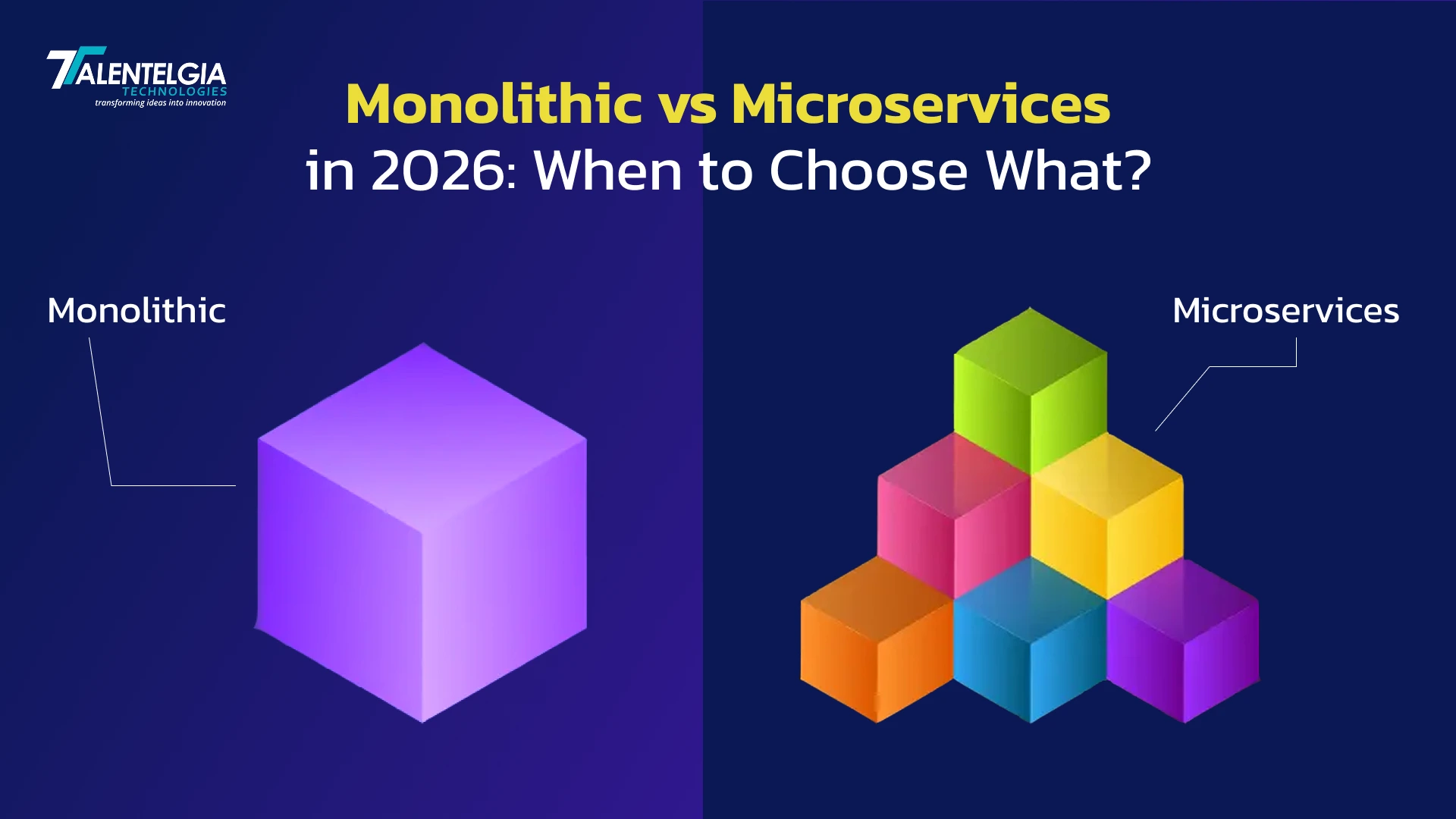
In 2026, software architecture is a critical factor in delivering applications that are stable and scalable. With the increasing complexity of digital systems, companies need an architecture that will support performance, reliability, and growth over time. The good decision upfront will cut down technical complications and benefit app development, website development, or any software development productivity.
Monolithic and microservices are two of the most popular architectural styles. Monolithic system, in which all components are integrated into one single system; and Microservices architecture, where applications are decomposed into small independent services. Each method has its own unique development and deployment model.
In today’s blog, we’ll cover the main differences between monolithic and microservices architectures, and then get into a discussion on why you’d choose one over the other in 2026.
What is Monolithic Architecture?
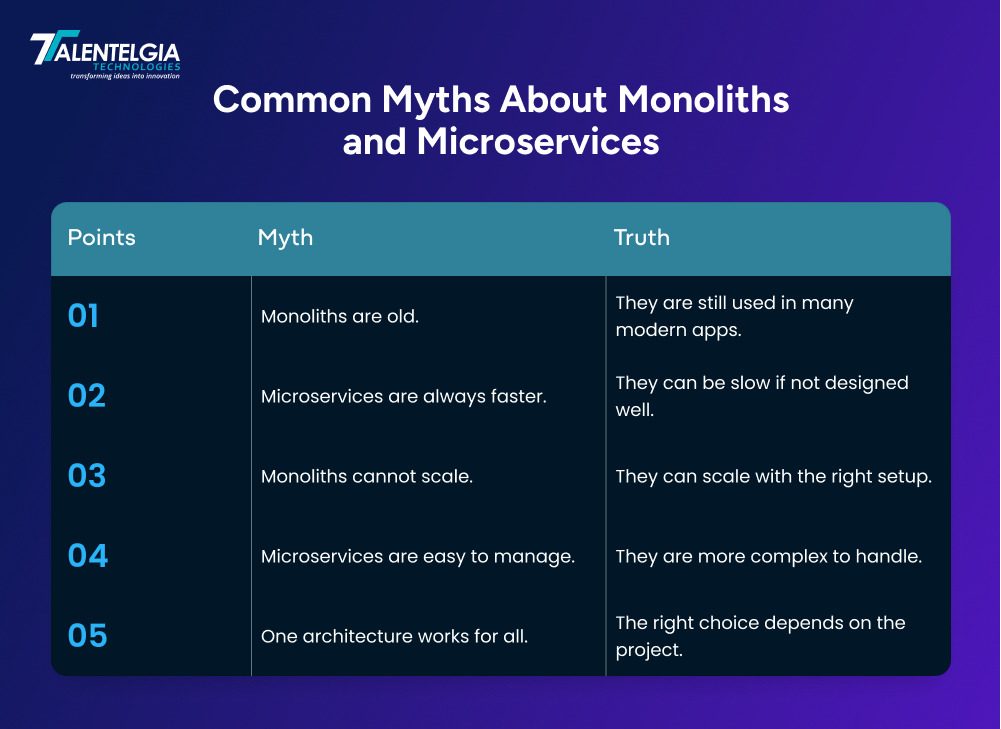
Monolithic architecture is an old way of designing software where the entire application is developed as one single system. User Interface, business logic, and data access are tightly coupled and run as a single unit.
In monolithic architecture, updating or making a change normally means redeploying the entire application. This simply makes the development easier and quicker during the introduction phases of the project, espeically small teams or low complexity projects.
Small apps, startups from the seed stage, or an early-phase product may occasionally prefer monolithic architecture as it is simpler to write, test, and maintain. But with the app growing larger, there can be difficulties in scaling and maintaining it.
Key Characteristics of Monolithic Systems
Below are the key characteristics that define how monolithic systems are structured and how they function.
- Everything lives in one place: The entire app is built as a single entity, so all features, logic, and even data handling reside in one codebase.
- Parts depend on each other: Deleting a component or updating one feature can impact other parts of the system because everything is closely connected.
- Deployed all at once: Even for small changes, the entire application usually needs to be redeployed, which can become slower as the app grows.
- Easy to get started: Monolithic systems are easy to understand, making them a suitable choice when starting new projects.
- Debugging is simpler: Since everything runs together, it becomes easier to identify and fix issues.
- One shared database: All components usually share a common database, which simplifies data handling.
- Scaling is more difficult: When one part needs more power, the entire application must be scaled.
- Ideal for smaller teams: This approach works well for small to medium projects where speed and simplicity matter more than flexibility.
Understanding Microservices Architecture
Microservices architecture is another way of application development where you build applications with small, independently functioning services rather than as one large system. Each service is dedicated to doing one thing, such as managing users or payment processing of notifications, and the services communicate with one another through APIs.
Services are decoupled, so teams can develop, deploy, and scale them individually. This makes microservices a strong contender for applications that require frequent updates or serve many users. If one service has problems, others can continue to function, so the system is overall more reliable.
Microservices are typically integrated into cloud-native ecosystems and complement containers, DevOps methodologies, and automation frameworks. Nonetheless, they also bring additional operational concerns like monitoring of services, propagation of communication, and consistency of data that need professional teams and the right tooling.
Core Principles of Microservices
- Services are fine-grained and limited in scope: Every microservice is built by design to cater to one clear business capability, making responsibilities easy to contain and properly understood.
- Decoupled development: Updates to a single service can be deployed without updating the whole application.
- Service decoupling: Services are implemented with APIs and interact via services to minimize dependency, resulting in simplified refactoring.
- Decentralized data ownership: Each service might have its own database, resulting in better flexibility and removing any concerns about the shared model.
- Designed for scalability: Users can scale out individual services according to traffic and load.
Monolithic vs Microservices
Monolithic and microservices are two fundamentally different architectural styles of software application design. Whereas monolith simplifies the system and has a single composite structure, microservices are simplified for the sake of independence. Having a good understanding of how they differ can help teams to pick the appropriate architecture that suits the context of the project, the scalability needs, and team capabilities.
The table below summarizes the differences between monolithic and microservices based on the important factors:
| Aspect | Monolithic Architecture | Microservices Architecture |
| Application structure | Built as one single, unified system | Built as multiple small, independent services |
| Codebase | One shared codebase | Separate codebases for each service |
| Deployment | The entire application is deployed together | Each service can be deployed independently |
| Scalability | The whole application must be scaled | Individual services can be scaled |
| Development speed | Faster to build initially | Slower at start, faster over time |
| Maintenance | Easier in the early stages | Requires advanced monitoring and management |
| Failure impact | One failure can affect the whole system | Failures are isolated to specific services |
| Best suited for | Small to medium projects, small teams | Large, complex applications, bigger teams |
When to Choose a Monolithic Architecture
If simplicity, speed, and ease of development were top of your requirement list, then monolithic architecture would be a good candidate. It is most effective in use cases where requirements are well defined, and the system is not supposed to become overly complex in the near future.
Monoliths make sense if you’re leading an early-stage start-up and building a new product, and you’re looking to iterate quickly and validate ideas fast. One codebase and easier deployment mean you spend less time developing and testing, getting to market faster.
This architecture is also good for small development teams that have few resources. Under this approach, when all parts are developing collaboratively, the need for sophisticated DevOps tools and deep monitoring and service management becomes mostly obsolete.
When monolithic systems are a good fit You should particularly consider monolithic architectures if:
- The app is large to medium-sized
- Faster time to market matters more than long-term scalability
- The team values easy debugging and testing above all else
- The running costs of infrastructure must be minimized
Often, you have a monolith as a sound basis of your application that enables you to transition to microservices later, if required.
When to Choose Microservices Architecture
The microservices architecture is ideal for an application that must evolve and scale while handling complexity over time. For many systems that need to be updated often, high availability and low friction for growing without restructuring your entire app are pretty great.
This is particularly useful for large or fast-growing applications and when different features have different workloads. Because every service is scalable independently, teams can use their resources more effectively and not overload the entire system.
Microservices work well even for larger teams or remote teams building the same product. Decouples services that enable teams to iterate, test, and deploy features without impeding one another’s progress, thus making them more productive.
Microservices are well-suited when:
- It is a big, complex application.
- High scalability and availability are needed
- Each feature involves many teams
- Frequent deployments are needed
- Cloud-native and DevOps practices are already in place
While microservices can provide flexibility and resilience, they also need strong planning, monitoring, and operational maturity to handle the increased complexity.
Conclusion
Monoliths or Microservices, the decision in 2026 depends on what your application needs are, your team, and future business plans. Each approach has its inherent strengths, and neither is universally applicable.
Simple systems that have little complexity will consider using monolithic as it allows for fast initial development and a basic way to manage our things -- a good choice for smaller applications or early-stage projects. Microservices architecture , however, offers the capabilities that are more suited to large and evolving systems, such as flexibility, scalability, and resiliency.

What You Can Do: Plan for future needs.
The right architectural decision can enhance performance, reduce technical issues, and support the development of a sustainable application.












 Write us on:
  Business queries:
  HR:
HR: 


