


 Healthcare App Development Services
 Real Estate Web Development Services
 E-Commerce App Development Services
 E-Commerce Web Development Services
 Blockchain E-commerce Development Company
 Fintech App Development Services
 Fintech Web Development
 Blockchain Fintech Development Company
 E-Learning App Development Services
 Restaurant App Development Company
 Mobile Game Development Company
 Travel App Development Company
 Automotive Web Design
 AI Traffic Management System
 AI Inventory Management Software
 AI Software Development
  AI Development Company
  AI App Development Services
  ChatGPT integration services
  AI Integration Services
  Generative AI Development Services
  Natural Language Processing Company
 Machine Learning Development
  Machine learning consulting services
  Blockchain Development
  Blockchain Software Development
  Smart Contract Development Company
  NFT Marketplace Development Services
  Asset Tokenization Company
 DeFi Wallet Development Company
 Mobile App Development
  IOS App Development
  Android App Development
  Cross-Platform App Development
  Augmented Reality (AR) App Development
  Virtual Reality (VR) App Development
  Web App Development
  SaaS App Development
 Flutter
  React Native
  Swift (IOS)
  Kotlin (Android)
  Mean Stack Development
  AngularJS Development
  MongoDB Development
  Nodejs Development
  Database Development
 Ruby on Rails Development
 Expressjs Development
  Full Stack Development
  Web Development Services
  Laravel Development
  LAMP Development
  Custom PHP Development
  .Net Development
  User Experience Design Services
  User Interface Design Services
  Automated Testing
  Manual Testing
  Digital Marketing Services
 Ride-Sharing And Taxi Services
 Food Delivery Services
 Grocery Delivery Services
 Transportation And Logistics
 Car Wash App
 Home Services App
 ERP Development Services
 CMS Development Services
 LMS Development
 CRM Development
 DevOps Development Services
 AI Business Solutions
 AI Cloud Solutions
 AI Chatbot Development
 API Development
 Blockchain Product Development
 Cryptocurrency Wallet Development
 About Talentelgia
  Our Team
  Our Culture
 Healthcare App Development Services
 Real Estate Web Development Services
 E-Commerce App Development Services
 E-Commerce Web Development Services
 Blockchain E-commerce
Development Company
Blockchain E-commerce
Development Company Fintech App Development Services
 Finance Web Development
 Blockchain Fintech
Development Company
Blockchain Fintech
Development Company E-Learning App Development Services
 Restaurant App Development Company
 Mobile Game Development Company
 Travel App Development Company
 Automotive Web Design
 AI Traffic Management System
 AI Inventory Management Software
 AI Software Development
 AI Development Company
 ChatGPT integration services
 AI Integration Services
 Machine Learning Development
 Machine learning consulting services
 Blockchain Development
 Blockchain Software Development
 Smart contract development company
 NFT marketplace development services
 IOS App Development
 Android App Development
 Cross-Platform App Development
 Augmented Reality (AR) App
Development
Augmented Reality (AR) App
Development Virtual Reality (VR) App Development
 Web App Development
 Flutter
 React
Native
React
Native Swift
(IOS)
Swift
(IOS) Kotlin (Android)
 MEAN Stack Development
 AngularJS Development
 MongoDB Development
 Nodejs Development
 Database development services
 Ruby on Rails Development services
 Expressjs Development
 Full Stack Development
 Web Development Services
 Laravel Development
 LAMP
Development
LAMP
Development Custom PHP Development
 User Experience Design Services
 User Interface Design Services
 Automated Testing
 Manual
Testing
Manual
Testing About Talentelgia
 Our Team
 Our Culture
Over the last five years, contract lifecycle management software has witnessed significant advancements in the digital product space. What started as basic digital contract storage has transformed into something much more advanced—now it is a way for organizations to strategically manage their risk, revenue, and compliance. Many organizations now partner with a Smart Contract Management Company to streamline contract processes, improve visibility, and ensure better compliance across departments. “Contract Lifecycle Management” (CLM) software is no longer a ‘nice-to-have’; it’s a necessity.
Teams are pushed to increase their speed while supporting revenue growth, maintaining audit readiness, and identifying trends within thousands of contracts. With the introduction of AI, automation of contract review, clause extraction, renewal forecasting, and executive reporting has become the norm. These capabilities are increasingly powered by advanced AI business solutions that help organizations streamline contract management and extract insights more efficiently.Contracts govern the revenue made by businesses and are essential to run any business. According to B2B Reviews, 60% to 80% of all B2B transactions are governed by contracts, and over 60% of agreements are undergoing negotiation.
It is very complex to manage contracts in a business. The manual and tedious nature of the job creates delays in the cycle of contracts and makes errors and risks associated with contracts more likely. Contract lifecycle management systems help to improve speed, consistency, and accessibility in business. There are a multitude of CLM software solutions available in the market. This guide highlights the top contract lifecycle management software solutions to help you find the best fit for your business needs
Understanding CLM Software: Key Features, Vendor Comparison & Its Importance
The range of relationships that contracts manage, from vendors to employees, is endless. However, as an organization experiences growth in its contracts, it will become increasingly difficult and unsustainable to manage contracts through spreadsheets, shared drives, or email threads. Therefore, to stay in control, many businesses choose CLM tools to manage contracts through every stage of the contract lifecycle and to handle an increased volume of contracts.
With modern CLM systems, the enterprise can also focus on the automation of its manual processes and use workflows to accelerate contract drafting and contract approval processes.
What Exactly is CLM Software?
Contract lifecycle management software is usually cloud-based and manages a company’s contract portfolio at each stage of the contract lifecycle. CLM software allows a business’s contract workflow (including the contracts of the business’s legal team and the contracts of the business’s commercial team) to be automated and streamlined. The best CLM software optimizes the contract process and enhances the productivity of the whole business.
Think of it as a “GPS for your agreements.” Instead of a contract getting lost in a desk drawer or a “Final_v2_REVISED” email thread, CLM software provides a centralized, automated platform where every version, every clause, and every deadline is tracked in real-time. In 2026, high-performing organizations have broken down the silos. Here are the core teams that use CLM platform:
- Legal & Compliance: They are the “Architects.” Legal uses CLM to build standardized clause libraries and templates. This ensures that every contract follows company policy without a lawyer needing to hand-read every single page. It’s about maintaining control while increasing speed.
- Sales & Revenue Operations: For Sales, CLM is a “Deal Accelerator.” Instead of waiting days for Legal to approve a contract, they can generate pre-vetted agreements directly within their CRM (like Salesforce). In 2026, the faster the contract, the higher the win rate.
- Procurement & Supply Chain: These teams use CLM to manage vendor relationships. They track whether a supplier is meeting their obligations and get automated alerts for renewals or price adjustments, ensuring the company never pays for a service they aren’t receiving.
- Finance & Accounting: Finance relies on CLM for “Revenue Integrity.” They use it to track payment milestones and avoid “Zombie Contracts”—those pesky auto-renewals that drain budgets because nobody remembered to cancel them.
- HR & Talent Acquisition: From offer letters to non-disclosure agreements (NDAs), HR uses CLM to streamline the hiring process, ensuring a smooth, professional onboarding experience for new talent.
Why CLM Matters More Than Ever in 2026?
The CLM market has attracted many new businesses, each pitching its unique approach to contract management. While the multitude of features may elicit a desire to acquire a broad range of functionalities, it may not be practical or useful to your team. To help, we have distilled the options down to the most important three game-changing features that will enable smarter digital contracting:
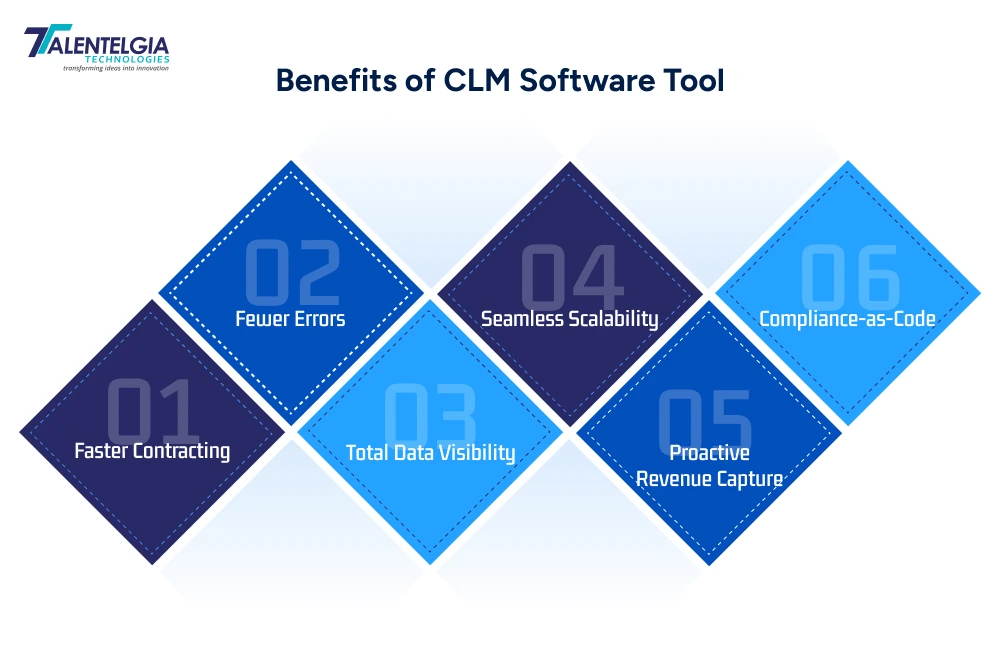
- Faster Contracting: Business moves at the speed of AI. CLM slashes cycle times by up to 80% through automated routing and pre-approved templates, turning weeks of negotiation into hours.
- Fewer Errors: “Guardrail Governance” ensures only vetted clauses are used. AI assistants catch risky deviations in real-time, eliminating the human errors that lead to costly litigation.
- Total Data Visibility: Stop digging through folders. CLM turns “Dark Data” into a searchable dashboard, giving you instant insights into spend, risk, and supplier performance across thousands of agreements.
- Seamless Scalability: Grow your business without doubling your legal headcount. Self-service portals allow departments like Sales and HR to generate low-risk agreements independently.
- Proactive Revenue Capture: Never miss a renewal or a price escalation again. The system tracks milestones and sends automated alerts, ensuring you capture every dollar and renegotiate underperforming deals.
- Compliance-as-Code: With global regulations like the EU AI Act evolving rapidly, CLM can scan your entire library in minutes to flag agreements that need updates, shielding you from massive fines.
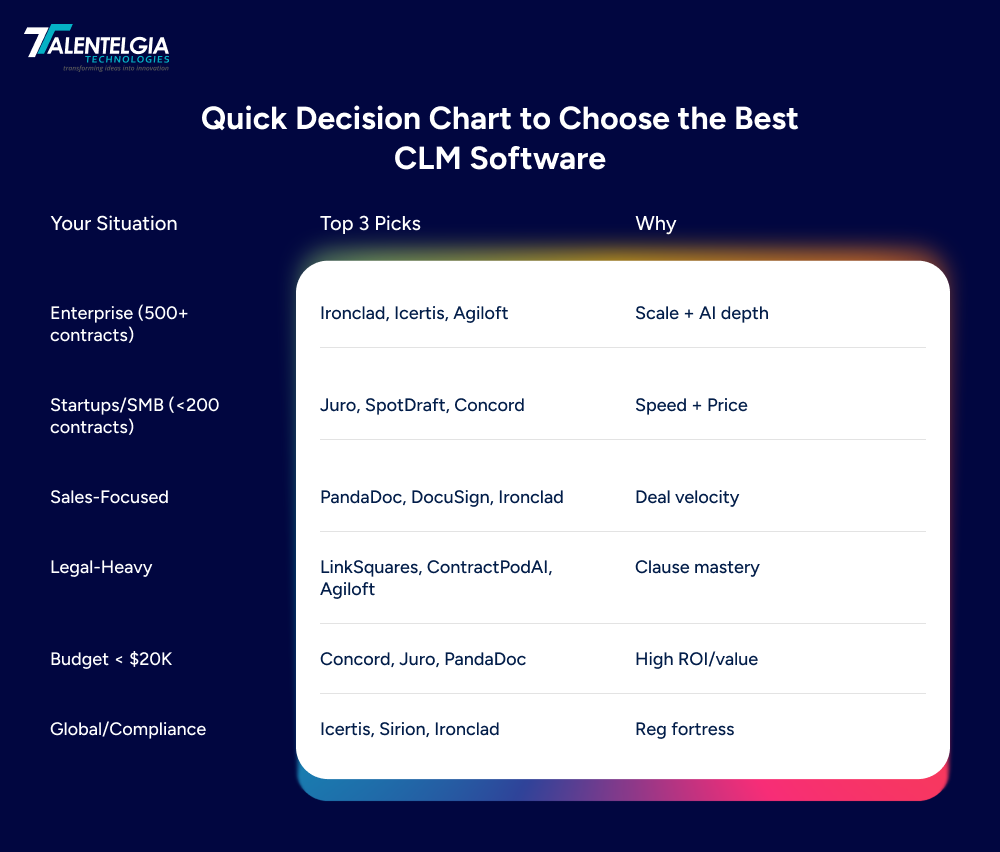
Top 11 Contract Lifecycle Management Software Tools In 2026
The best contract management software should combine strong automation, sophisticated analytics, and user-friendly design, allowing organizations to streamline their contract workflows, maintain compliance, and manage risk effectively.
Below are some of the best contract management tools available for IT teams, and their features, to help you make the best selection.
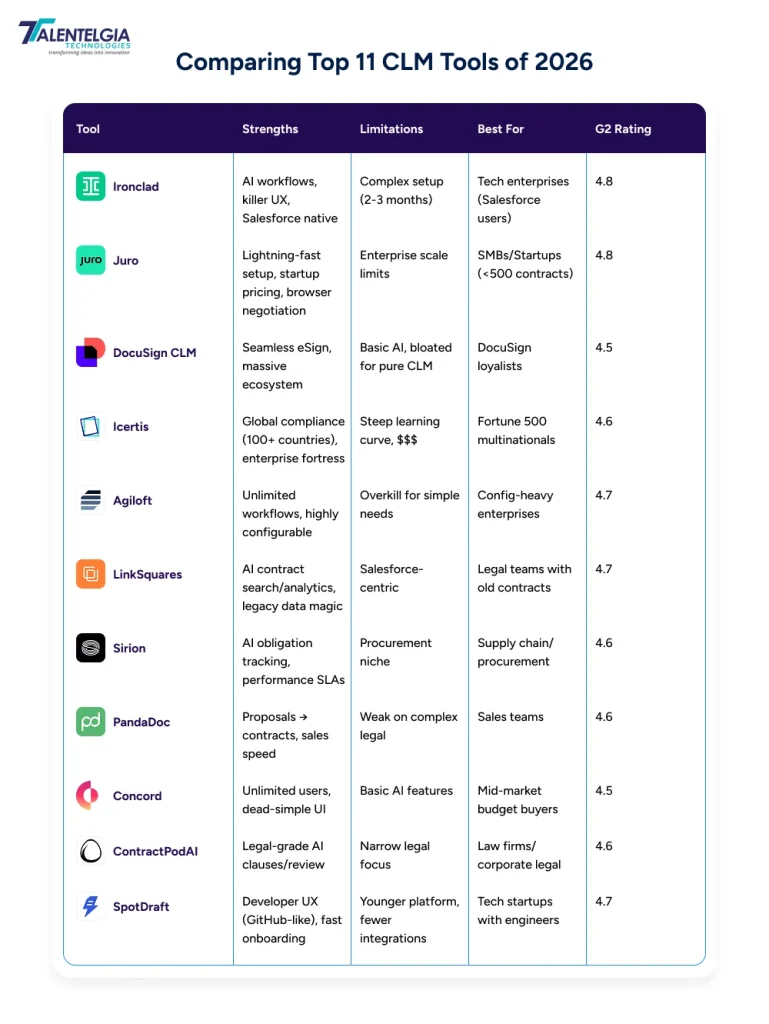
1. Ironclad (The Enterprise Favorite)
Known for its “Workflow Designer,” Ironclad is the gold standard for mid-to-large companies. Its Ironclad AI handles the heavy lifting of redlining, while its legendary Salesforce integration keeps sales and legal on the same page.
Key Features:
- Ironclad AI: Automatically extracts metadata and detects high-risk clauses during the intake process.
- Workflow Designer: A drag-and-drop tool that lets you build complex approval paths without writing a single line of code.
- Smart Import: One-click bulk uploading that uses AI to “read” and tag your old legacy contracts.
Pros: Ironclad is famously “sales-friendly.” Its deep integration with Salesforce means your sales reps can close deals without ever leaving their CRM.
2. Juro (The Speed Demon)
If you hate downloading Word docs, Juro is for you. It’s entirely browser-based, meaning you can negotiate and sign right in your tab. It’s famously the fastest to set up—perfect for high-growth companies that need to move now.
Key Features:
- Browser-Based Redlining: Real-time negotiation where all parties can see edits in real time.
- Negotiation Guardrails: You can set “no-go” zones (e.g., “Never agree to liability over $500k”) and the AI will flag any deviations.
- Native eSignature: No need for third-party signing tools; everything is built-in.
Pros: Juro is built for velocity. It’s the fastest platform to implement, often getting teams up and running in days rather than months.
3. DocuSign CLM (The Ecosystem Choice)
If you’re already using DocuSign for e-signatures, this is the natural next step. In 2026, it features Iris AI, which can “read” your contracts to find hidden risks and automate your post-signature tasks. DocuSign has evolved far beyond just “the signature company.” Their CLM is now a massive intelligence engine.
Key Features:
- DocuSign Iris: An advanced AI engine that “understands” the intent behind your contracts to suggest smarter routing and risk scoring.
- Pre-Built Connectors: Over 100 integrations with tools like SAP, Oracle, and Workday.
- AI-Assisted Review: Automatically flags non-compliant language based on your company’s specific playbooks.
Pros: If you already use DocuSign for signing, the “ecosystem synergy” makes this a no-brainer for a seamless user experience.
4. Icertis (The Enterprise Titan)
Icertis is a heavy hitter for Fortune 500 companies. It excels at managing millions of complex, multi-language contracts across different countries and integrating them with massive systems like SAP or Oracle.
Key Features:
- IICP (Icertis Intelligence Platform): Uses generative AI to create executive summaries of 150-page contracts in seconds.
- Global Compliance Engine: Automatically updates your contract templates when new laws (like GDPR 3.0) are passed in different regions.
- Dynamic Clause Control: Ensures the right legal language is used based on the jurisdiction of the contract.
Pros: Governance. Icertis is unbeatable when it comes to audit trails and regulatory safety for massive, high-stakes organizations.
5. Agiloft (The “No-Code” Master)
Agiloft is the most flexible tool on this list. Using their “no-code” builder, you can customize almost every field and rule without ever calling a programmer. It’s perfect for teams with highly specific or unusual processes.
Key Features:
- Data-first Agreement Platform (DAP): Treats every sentence in a contract as a data point that can be tracked and reported.
- AI-Enhanced Obligation Management: Automatically extracts and assigns tasks (like “Pay vendor by Oct 12”) to the right people.
- Screens Run Action (SRA): One-click analysis that sends a contract through an AI “health check” before you sign it.
Pros: Flexibility. If your company has a unique way of doing things, Agiloft is the only tool that will bend to your will without breaking.
6. LinkSquares (The Data Miner)
If you have thousands of old PDFs and no idea what’s in them, LinkSquares is your best friend. Its AI specializes in “digital archaeology,” scanning your entire history to pull out expiration dates and hidden clauses in minutes.
Key Features:
- LinkSquares Cloud: A unified suite that handles both pre-signature drafting and post-signature analysis.
- Rapid Metadata Tagging: AI that identifies and tags everything from “Indemnity” to “Auto-Renewal” dates instantly.
- Executive Reporting: Beautiful dashboards that show your leadership exactly where the bottlenecks are in your deal cycle.
Pros: Visibility. It’s the best at taking a giant pile of “Dark Data” (unorganized contracts) and turning it into clear, actionable insights.
7. Sirion (The AI-Native Specialist)
Sirion stands out in 2026 for its Agentic AI architecture. It doesn’t just store contracts; it uses “AI agents” to actively track if vendors are actually doing what they promised in the contract. It excels at managing relationships after the ink is dry.
Key Features:
- Agentic AI Architecture: Uses “AI Agents” to proactively monitor vendor performance and service levels.
- Conversational Search: You can ask the platform, “Show me all contracts where we have a right to audit,” and get a list instantly.
- Real-time Risk Scoring: Assigns a “Danger Score” to contracts based on how far they deviate from your standard terms.
Pros: Accountability. If you lose sleep over whether your vendors are overcharging you or missing deadlines, Sirion is your watchdog.
8. PandaDoc: The Sales Favorite
PandaDoc is a favorite for SMEs and it’s is all about the “look and feel.” It’s designed to help sales teams create stunning proposals and contracts making it incredibly easy for them to create beautiful, branded documents that get signed instantly.
Key Features:
- Interactive Quotes: Let your customers choose add-ons or adjust quantities right inside the contract.
- Integrated Payments: Collect deposits or full payments the second the document is signed.
- Intuitive UI: A drag-and-drop editor that is as easy to use as Canva or Google Docs.
Pros: User Adoption. It’s so easy to use that your team will actually want to use it, which is the biggest hurdle for any new software.
9. Concord: The Budget Powerhouse
Growing fast but watching your wallet? Concord offers a “feature-heavy, price-light” approach at a price point that makes sense for growing mid-market companies. It includes unlimited e-signatures in its basic plans, making it a great entry point for companies
Key Features:
- Horizon Platform: A conversational interface where you can manage your entire portfolio by just “talking” to the AI.
- Unlimited Everything: Most plans include unlimited documents, eSignatures, and even “free guests” for external collaborators.
- MCP Support: In 2026, Concord supports Model Context Protocol, allowing other AI tools (like Claude or ChatGPT) to securely pull data from your contracts.
Pros: Scalability. It’s perfect for the “sweet spot” company that is too big for basic eSignatures but not ready for the $100k price tag of a global enterprise tool.
10. Leah (formerly ContractPodAi): The Agentic Visionary
Recently rebranded as Leah, this platform is at the absolute cutting edge of “Agentic AI”—where the software doesn’t just suggest, it acts. You can literally “talk” to Leah to ask questions about your legal library, like “Which of our vendors have a 30-day termination clause?”
Key Features:
- Leah Agentic OS: An operating system where “Legal Agents” can handle entire workflows—from drafting to compliance checks—autonomously.
- Conversational Q&A: A feminine-voiced AI assistant designed to “listen” and help you navigate complex legal decisions.
- Leah Legal Helpdesk: A conversational interface that acts as the first line of defense for non-legal teams asking contract questions.
Pros: Innovation. Leah is the closest thing to having a junior lawyer on your team who works 24/7 and never needs coffee.
11. SpotDraft: The Compliance Hero
SpotDraft is designed for the modern legal ops team to bring structure and sanity to their ecosystem. It’s clean, intuitive, and skips the “clunkiness” of older systems. It’s particularly popular with startups that need to scale their contracting without the headache of a 6-month implementation.
Key Features:
- Automated Obligation Extraction: Instantly pulls out financial and operational “To-Dos” and assigns them to owners.
- Compliance Dashboards: Real-time “Heat Maps” that show you exactly which contracts are at risk of expiration or non-compliance.
- Audit-Ready Records: Every single edit, comment, and approval is logged in a tamper-proof audit trail.
Pros: Structure. If you need a “Single Source of Truth” that keeps your legal, finance, and operations teams perfectly aligned, SpotDraft is the glue.
Tips To Choose The Best CLM Software in 2026
When shopping for a CLM platform this year, don’t just look for a digital filing cabinet. Look for these “Future-Proof” features:
- Agentic AI Review: Your software shouldn’t just highlight text; it should “reason.” It should say, “This indemnity clause is 20% higher than our standard risk profile—would you like me to rewrite it?”
- No-Code Contract Builders: Anyone on your team should be able to build a complex agreement using simple drag-and-drop templates.
- Self-Executing Renewals: The system should automatically ping the relevant stakeholder three months before an expiration and suggest a negotiation strategy based on the current market.
- Omni-Channel Collaboration: Whether you’re on Slack, Outlook, HubSpot, MS Teams, Word, or a mobile app, you should be able to approve a contract with one click.
Final Words
The challenges businesses face in 2026 will need new approaches to contract lifecycle management that ensure the speed, intelligence, and control you need throughout the entire lifecycle of a contract. The CLM software that you choose should make contract management and the costs associated with it a non-issue and remove the chaos that comes with it.
Are you prepared to ease the burden of your contract management process and enhance your business?
Contact us to arrange your demo.











 Write us on:
  Business queries:
  HR:
HR: 


