



 Healthcare App Development Services
 Real Estate Web Development Services
 E-Commerce App Development Services
 E-Commerce Web Development Services
 Blockchain E-commerce Development Company
 Fintech App Development Services
 Fintech Web Development
 Blockchain Fintech Development Company
 E-Learning App Development Services
 Restaurant App Development Company
 Mobile Game Development Company
 Travel App Development Company
 Automotive Web Design
 AI Traffic Management System
 AI Inventory Management Software
 AI Software Development
  AI Development Company
  AI App Development Services
  ChatGPT integration services
  AI Integration Services
  Generative AI Development Services
  Natural Language Processing Company
 Machine Learning Development
  Machine learning consulting services
  Blockchain Development
  Blockchain Software Development
  Smart Contract Development Company
  NFT Marketplace Development Services
  Asset Tokenization Company
 DeFi Wallet Development Company
 Mobile App Development
  IOS App Development
  Android App Development
  Cross-Platform App Development
  Augmented Reality (AR) App Development
  Virtual Reality (VR) App Development
  Web App Development
  SaaS App Development
 Flutter
  React Native
  Swift (IOS)
  Kotlin (Android)
  Mean Stack Development
  AngularJS Development
  MongoDB Development
  Nodejs Development
  Database Development
 Ruby on Rails Development
 Expressjs Development
  Full Stack Development
  Web Development Services
  Laravel Development
  LAMP Development
  Custom PHP Development
  .Net Development
  User Experience Design Services
  User Interface Design Services
  Automated Testing
  Manual Testing
  Digital Marketing Services
 Ride-Sharing And Taxi Services
 Food Delivery Services
 Grocery Delivery Services
 Transportation And Logistics
 Car Wash App
 Home Services App
 ERP Development Services
 CMS Development Services
 LMS Development
 CRM Development
 DevOps Development Services
 AI Business Solutions
 AI Cloud Solutions
 AI Chatbot Development
 API Development
 Blockchain Product Development
 Cryptocurrency Wallet Development
 About Talentelgia
  Our Team
  Our Culture
 Healthcare App Development Services
 Real Estate Web Development Services
 E-Commerce App Development Services
 E-Commerce Web Development Services
 Blockchain E-commerce
Development Company
Blockchain E-commerce
Development Company Fintech App Development Services
 Finance Web Development
 Blockchain Fintech
Development Company
Blockchain Fintech
Development Company E-Learning App Development Services
 Restaurant App Development Company
 Mobile Game Development Company
 Travel App Development Company
 Automotive Web Design
 AI Traffic Management System
 AI Inventory Management Software
 AI Software Development
 AI Development Company
 ChatGPT integration services
 AI Integration Services
 Machine Learning Development
 Machine learning consulting services
 Blockchain Development
 Blockchain Software Development
 Smart contract development company
 NFT marketplace development services
 IOS App Development
 Android App Development
 Cross-Platform App Development
 Augmented Reality (AR) App
Development
Augmented Reality (AR) App
Development Virtual Reality (VR) App Development
 Web App Development
 Flutter
 React
Native
React
Native Swift
(IOS)
Swift
(IOS) Kotlin (Android)
 MEAN Stack Development
 AngularJS Development
 MongoDB Development
 Nodejs Development
 Database development services
 Ruby on Rails Development services
 Expressjs Development
 Full Stack Development
 Web Development Services
 Laravel Development
 LAMP
Development
LAMP
Development Custom PHP Development
 User Experience Design Services
 User Interface Design Services
 Automated Testing
 Manual
Testing
Manual
Testing About Talentelgia
 Our Team
 Our Culture
The rapid growth and unparalleled advancements in software development have led to a rapid change across the entire industry due to the tremendous growth in modern application architecture. The global market for the software development industry is projected to reach $1 trillion by 2026 because of the massive value this sector provides to businesses with regard to their digital transformation efforts. Due to this intense market growth, understanding the key scalable software architecture trends is crucial to determine where value can be captured before competitors do.
Artificial Intelligence (AI) is driving development automation through cloud-native and other tools. This industry is also witnessing the development of more low-code and no-code tools, all of which will transform the process of developing, deploying, and operating software.
In the paragraphs below, we will analyse the trends in API first development and microservices and how we expect them to revolutionise the industry.
Understanding API-First Development: Advancements in Scalable Software Architecture
Building fast, flexible, and scalable software solutions has become crucial for all businesses. An API-first microservices approach fulfils these needs by flipping the usual development process. Most development processes treat APIs as an afterthought. An API-first approach, however, treats them as the groundwork for the entire project—making API development a strategic priority rather than a secondary task.
Let’s understand why the API-first microservices approach is taking over the modern software development scene:
What is an API-First Development?
API stands for “Application Programming Interface” – think of it as a menu telling other apps exactly how to order data or services from your software (like “give me a user profile” or “process this payment”). Unlike traditional development—where you build the full application first, then awkwardly add APIs later, API-First development flips the process. You design the API contract during the initial planning stages.
This upfront focus ensures seamless integration from day one. Frontend teams, mobile developers, and third-party partners code against the contract immediately while backend implementation catches up. Everything from the user interface to mobile apps & partner systems works together perfectly because they all speak the same API language from the start.
Different types of APIs
APIs come in four main flavours, each serving different needs. Here’s what they are with real-world examples:
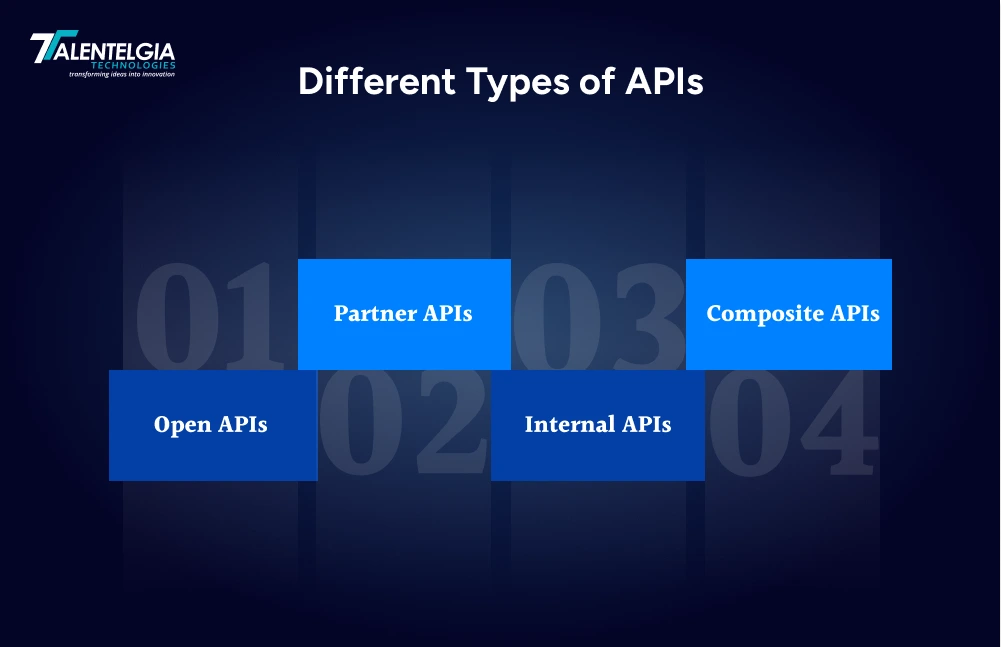
1. Open APIs (Public APIs)
Completely public—no API key required. Anyone can use them immediately. Perfect for developers building on your platform.
Examples:
- Twitter API: Fetch tweets, post updates (rate limited)
- OpenWeather API: Get weather data for any city
- REST Countries API: Country flags, currencies, population
2. Partner APIs (Partner APIs)
Shared with specific business partners under legal agreements. Require OAuth keys with usage limits and SLAs.
Examples:
- Stripe Connect: Payment platforms like Shopify use Stripe’s partner API
- Google Maps Platform: Uber, DoorDash partner access for advanced routing
- Twilio Partner: Call centres with high-volume SMS access
3. Internal APIs (Private APIs)
Only accessible within your company firewall. Power internal tools, microservices, and data sharing between teams.
Examples:
- Payment service → Inventory service (internal checkout flow)
- HR system → Finance system (employee payroll sync)
- Analytics dashboard → Raw data pipeline
4. Composite APIs
Single API call triggers multiple backend services (aka “GraphQL-style” or “Backend for Frontend”). Reduces round-trip dramatically.
Examples:
- Facebook Graph API: One call gets user posts + comments + likes
- GitHub GraphQL: Repo stats + contributors + issues in a single query
Key Principles of API-First Development Approach
The success of an API-first approach requires a consistent set of principles that guide the design, evolution, and governance of interfaces. In their absence, APIs can be documented early, but still act like tightly coupled implementation details, creating the same long-term risks the teams were hoping to mitigate.
1. Design APIs as Long-Lived Contracts
Think of APIs like restaurant menus—they work for years without changing. You create one clear menu (API specification) listing exactly what customers can order: “Add item to cart,” “Check total price,” “Process payment.” This menu stays the same forever. When you want to add fancy new items (like AI recommendations), you create Menu Version 2 while keeping Menu 1 working perfectly for everyone.
Real example: Uber’s 2015 “find driver” API still works perfectly in 2026 apps—no one had to rewrite their code.
2. Prioritise Consumer Workflows Over Internal Models
Build APIs the way customers think, not how programmers organised the database. Customers don’t care about your “UserTable123” or “OrderDatabaseField”—they want simple actions: “Show my shopping cart,” “Update my shipping address,” “See order history.” Use everyday language in API names so anyone instantly understands.
Real example: Amazon APIs say “get-cart-items” (customer thinking) instead of “retrieve-shopping-session-data-47” (tech thinking).
3. Make Versioning and Compatibility Explicit
Never break what’s already working—old apps must keep running. If you need to improve the API, create Version 2 with new features. Version 1 stays exactly the same forever. Give everyone 3 months’ notice before removing anything old. This lets companies upgrade slowly without panic.
Real example: Netflix’s original movie recommendation API (v1) still works while the newer AI-powered version (v3) runs alongside it.
4. Treat API Specifications as Source of Truth
One master document controls everything—like a blueprint for a house. This API specification automatically creates:
- User guides with working examples that everyone can test
- Ready-to-use code for websites, iPhone apps, Android apps
- Test versions that developers try before building
- Error messages explaining exactly what went wrong
Real example: Stripe’s payment API spec generates code used by Shopify, WooCommerce, and custom apps—all from one document.
5. Embed Governance Into Design and Tooling
Build safety rules right into the API from Day 1, like traffic lights on highways:
- Speed limits: Max 1,000 requests per minute (stops overload crashes)
- Security locks: Password required for private customer data
- Clear signs: “Wrong email format” instead of vague error code 500
- Usage dashboard: See exactly which apps use what, how often
- Automatic checks: Wrong data gets rejected before reaching your main system
Real example: Twitter API limits free users to 100 requests/hour, but paid apps get 10,000—fair usage built into the design.
API-First Design vs Code-First Design: What’s the Difference?
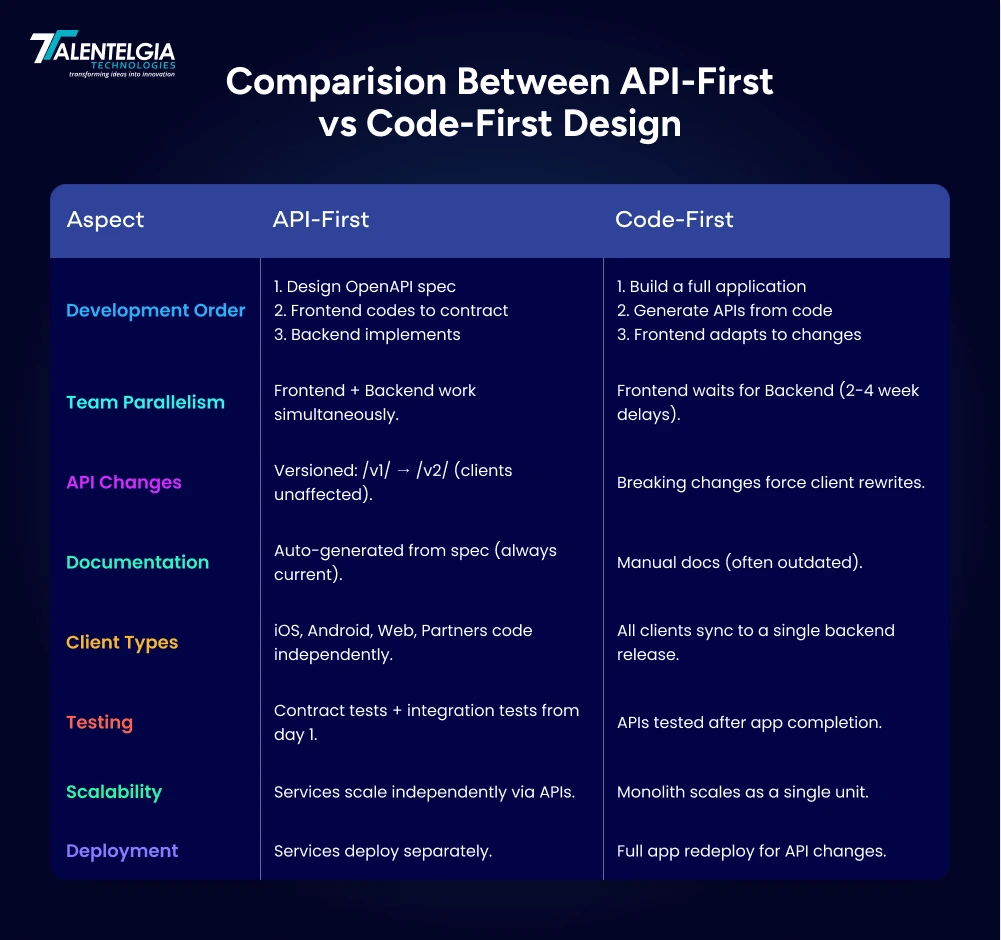
API-First designs the interface contract before coding. Code-First builds the application first, extracts APIs later.
Let’s understand their differences closely and how they compare across key aspects:
API-First Design
API-First means designing the API contract before writing any code. You start by creating a detailed specification (like OpenAPI YAML files) that defines exactly how different parts of your software will communicate. Frontend teams, mobile developers, and partner systems can immediately start building against this contract while the backend logic gets implemented later. When changes happen, you release new API versions (v1, v2, v3) so existing apps keep working perfectly. Documentation stays current automatically, and multiple client types share the same stable interface from day one.
Code-First Design
Code-First means building the complete application first, then creating APIs afterwards. Developers write the full backend logic, database models, and business rules before exposing any interfaces. APIs get generated automatically from the existing code (often through annotations or reflection). The problem? When the backend changes—like renaming a field or updating logic—every frontend app breaks until developers fix them all. Documentation becomes outdated quickly since it’s manually written. Frontend teams constantly wait for backend updates, creating frustrating delays.
Different Types of Architecture Styles In 2026
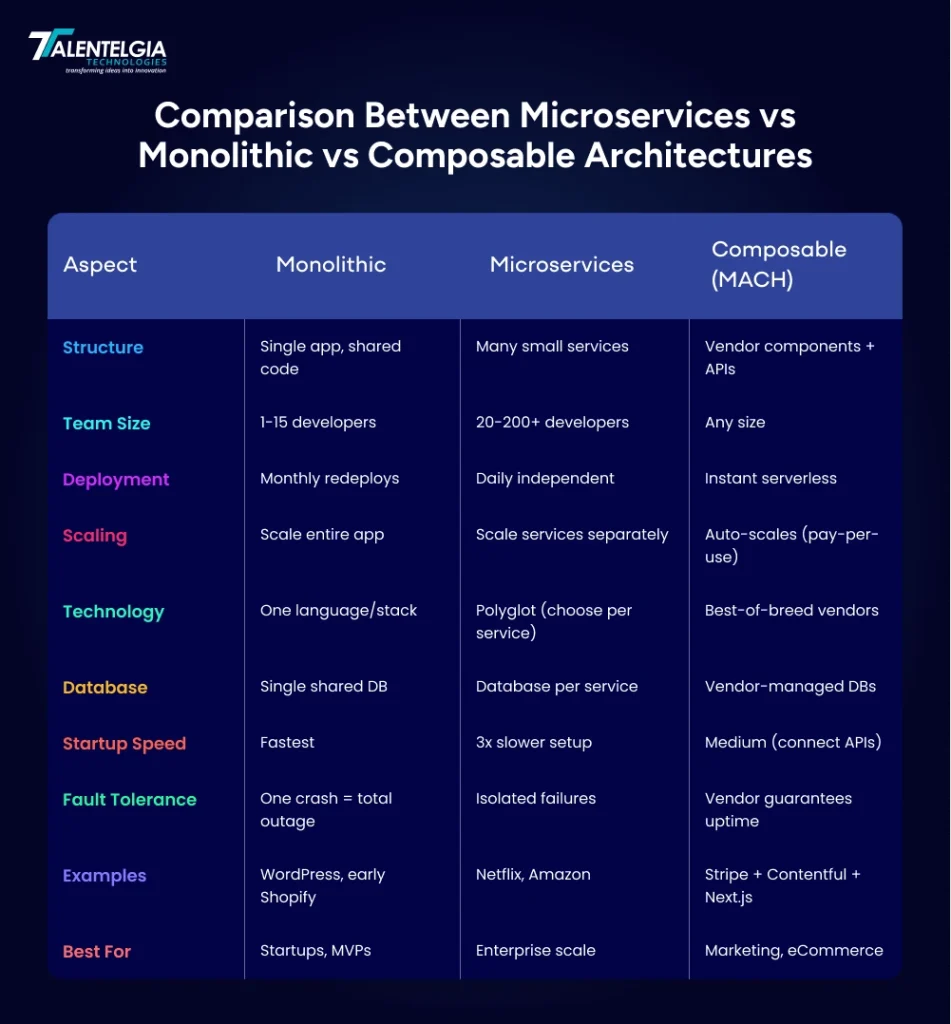
Three major architectural styles power the 2026 software. Each excels at different scales and team sizes. Here’s how they compare:
1. Monolithic Architecture
Monolithic architecture builds everything into one giant application. A single codebase contains your user interface, business logic, database access, and all features tightly interconnected. When you change anything—like fixing a login bug—you redeploy the entire application. This works great for small teams and simple apps because everything stays in one place.
However, as your team grows beyond 15 developers or traffic spikes, scaling becomes painful since you can’t scale just the payment system separately from user profiles.
2. Microservices Architecture
Microservices break your app into many small, independent services. Each service handles one specific job: one for user authentication, another for payments, another for email notifications. These services talk to each other through APIs and can use different programming languages, databases, and deployment schedules.
Need more payment processing during Black Friday?
Scale just that service to 50 servers while the user login stays on second; large companies like Netflix run 1200+ microservices, but the added complexity requires mature DevOps practices.
3. Composable Architecture (MACH)
Composable architecture (MACH: Microservices, API-first, Cloud-native, Headless) assembles software from best-in-class vendor components. Instead of building payments, search, or content management yourself, you connect proven services: Stripe for payments, Algolia for search, and Contentful for CMS, all linked through APIs. Your developers focus on unique business logic while vendors handle commodity features. Marketing sites and e-commerce platforms love composable because they launch fast using pre-built blocks that scale automatically.
Microservices vs Monolithic vs Composable Architectures: What’s Their Difference?
Three architectural styles power modern software. Monoliths keep everything simple in one app. Microservices are split into independent services. Composable (MACH) connects best-in-class vendor tools. Each fits different team sizes, scale needs, and timelines.
Core Benefits of Choosing an API-First Development Approach
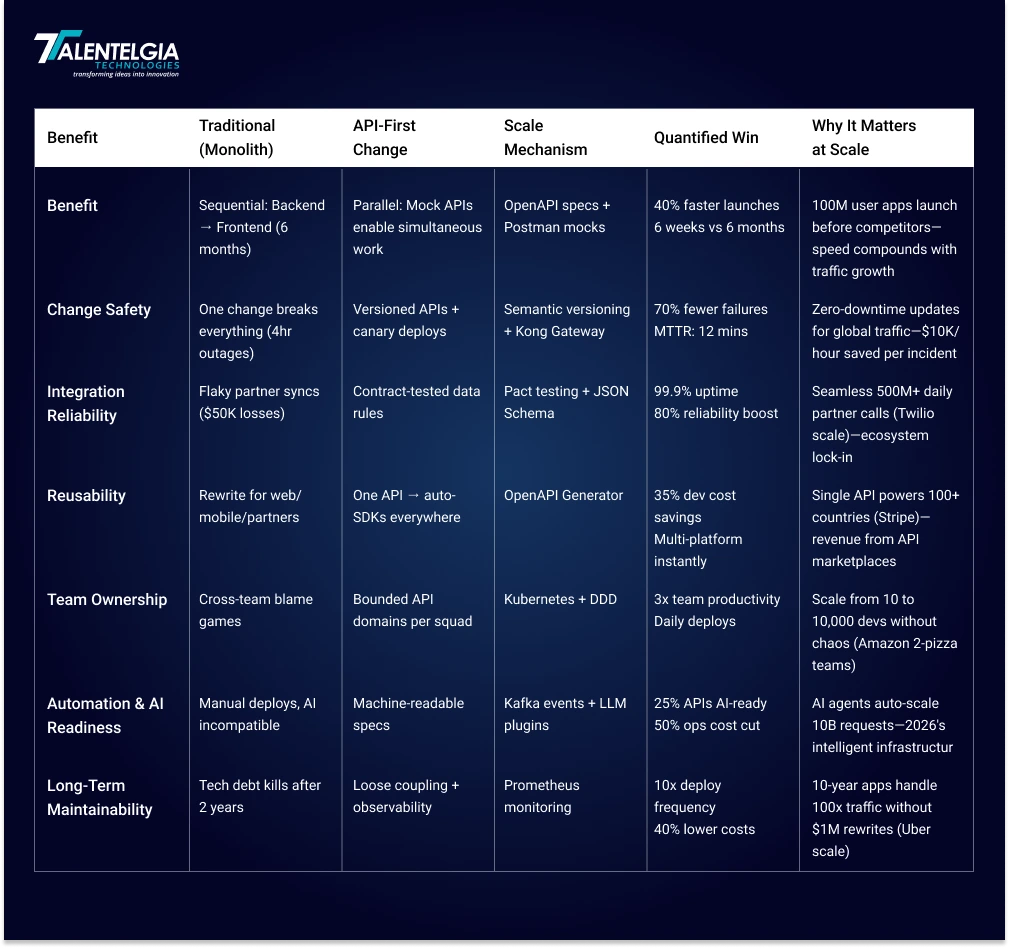
API-first development means creating the “rules of communication” (APIs) for your app before writing any code. Think of it as drawing a clear map before building a city—roads connect everything smoothly from day one. In 2026, when apps must handle AI chatbots, millions of global users, and constant updates, this approach creates software that’s easy to grow and fix.
Below are the 7 key benefits:
How Does API-First Microservices Work: Step-by-Step Guide [2026]
Transforming monoliths into API-first microservices powers Netflix-scale resilience and Stripe-level revenue growth. In 2026, with AI orchestration (KEDA), WebAssembly edge computing, and GitOps maturity, this isn’t optional—it’s survival. This detailed guide expands your 5-step outline into a production-ready roadmap with exact commands, tools, costs, timelines, pitfalls, and 2026-specific advancements.
1. Assess: Audit Monolith for Bounded Contexts
Your giant app (monolith) contains multiple business areas tangled together—like payments, users, and inventory all mixed in one codebase. We identify natural “boundaries” where each area can become its own independent service, like separating departments in a company.
Steps:
- DDD Workshops: Use EventStorming (sticky notes) to map business flows
- Dependency Analysis: jdeps Monolith.jar reveals tight coupling
- Strangler Facade: Wrap monolith: /api/v1/payments-proxy
- Scorecard: SonarQube targets (<20% coupling modules)
2. Design: Spec APIs with OpenAPI 3.1
Before writing code, we create exact “contracts” defining what each service offers—like restaurant menus listing dishes, prices, and ingredients. These machine-readable blueprints let all teams (mobile, web, and partners) work simultaneously using fake data.
Technical Execution:
openapi: 3.1.0

paths:

  /payments:

    post:

      requestBody:

        required: [amount, currency]

        schema:

          type: object

          properties:

            amount: {type: number, minimum: 0.01}

      responses: {'201': {description: Payment created}}
Steps:
- Consumer workshops: “Mobile needs WHAT payment data?”
- Mock servers: npx @stoplight/spectral-cli verify payments.yaml
- Contract tests: Pact Broker (100% coverage)
- AsyncAPI: Kafka payments/created events
3. Build: Containerise with Docker, Orchestrate via Kubernetes
Each service gets packed into its own “shipping container” (Docker) with everything needed to run anywhere. Kubernetes acts like an orchestra conductor, automatically starting/stopping containers based on demand—like self-driving traffic management for your services.
Technical Execution (Production Dockerfile):
FROM ghcr.io/chainguard/wolfi-base:latest

COPY payments /usr/local/bin/

EXPOSE 8080

ENTRYPOINT ["/usr/local/bin/payments"]
Technical Execution (Kubernetes + KEDA Autoscaling):
apiVersion: keda.sh/v2alpha1

kind: ScaledObject

spec:

  triggers:

  - type: kafka

    metadata:

      topic: payments.processed

      lagThreshold: "50"  # Scale when 50+ messages backlog
4. Secure/Test: API Mocking, Contract Testing
We test that services “speak the same language” using fake data (mocks), then add security gates preventing hacks. Contract testing ensures your payment service’s “menu” matches what the mobile app expects—no surprises at launch.
Technical Execution:
Kong Gateway (WAF + Rate Limits)
↓ Istio mTLS (mutual encryption)
OAuth2 + JWT (Keycloak)
↓ Pact Contract Tests (consumer-driven)
Chaos Engineering (LitmusChaos: 50ms latency injection)
Steps:
#1 Verify contracts match
pact-broker verify --provider=payment-service#2 Security scan
trivy image registry.io/payments:v1.2.35. Deploy/Monitor: GitOps with ArgoCD; AI Anomaly Detection (2 weeks)
What’s Happening: Git becomes your “single source of truth”—code changes automatically deploy via ArgoCD (no manual clicks). AI monitors watch for weird patterns (latency spikes, error storms) and auto-heal before users notice.
Steps:
- git commit → ArgoCD detects → Preview → Auto-deploy
↓
KEDA scales → Istio shifts traffic
↓
- Pixie + Grafana AI → Alert → Auto-rollback if needed
Closing Thoughts
The API-first development strategy prioritises scalability, flexibility, and efficiency. It allows businesses to develop more adaptable systems, reduces development time, improves security, and enhances collaboration across teams. Although adopting this approach can require an initial investment and a cultural shift, it proves to be very beneficial long-term.

For organisations aiming to simplify development and secure their software for the future, an API-first approach is the best option. Are you prepared to construct applications that are smarter, faster, and more interconnected?

Connect With Expert Developers Today!












 Write us on:
  Business queries:
  HR:
HR: 


