



 Healthcare Software Development Services
 Healthcare App Development Services
 Real Estate Web Development Services
 Real Estate App Development Company
 E-Commerce App Development Services
 E-Commerce Web Development Services
 Blockchain E-commerce Development Company
 Fintech Software Development
 Fintech App Development Services
 E-Learning App Development Services
 Restaurant App Development Company
 Mobile Game Development Company
 Travel App Development Company
 Automotive Web Design
 AI Traffic Management System
 AI Inventory Management Software
 Logistics App Development Services
 Machine Learning Development
 ChatGPT integration services
  AI Development Company
  AI Integration Services
  Natural Language Processing Company
 Mobile App Development
  IOS App Development
  Android App Development
  Cross-Platform App Development
  Augmented Reality (AR) App Development
  Virtual Reality (VR) App Development
  Web App Development
  SaaS App Development
 Custom Software Development Services
  Flutter
  React Native
  Swift (IOS)
  Kotlin (Android)
  Mean Stack Development
  AngularJS Development
  MongoDB Development
  Nodejs Development
  Database Development
 Ruby on Rails Development
 Expressjs Development
  Full Stack Development
  Web Development Services
  Laravel Development
  LAMP Development
  Custom PHP Development
  .Net Development
  User Experience Design Services
  User Interface Design Services
  Automated Testing
  Manual Testing
  Digital Marketing Services
 Ride-Sharing And Taxi Services
 Food Delivery Services
 Grocery Delivery Services
 Transportation And Logistics
 Car Wash App
 Home Services App
 ERP Development Services
 CMS Development Services
 LMS Development
 CRM Development
 DevOps Development Services
 AI Business Solutions
 AI Cloud Solutions
 AI Chatbot Development
 API Development
 Blockchain Product Development
 Cryptocurrency Wallet Development
 About Talentelgia
  Our Team
  Our Culture
 Healthcare App Development Services
 Real Estate Web Development Services
 E-Commerce App Development Services
 E-Commerce Web Development Services
 Blockchain E-commerce
Development Company
Blockchain E-commerce
Development Company Fintech App Development Services
 Blockchain Fintech
Development Company
Blockchain Fintech
Development Company E-Learning App Development Services
 Restaurant App Development Company
 Mobile Game Development Company
 Travel App Development Company
 AI Traffic Management System
 AI Inventory Management Software
 AI Development Company
 ChatGPT integration services
 AI Integration Services
 Machine Learning Development
 Machine learning consulting services
 Blockchain Development
 Blockchain Software Development
 Smart contract development company
 NFT marketplace development services
 Asset tokenization companies
 DeFi Wallet Development Company
 IOS App Development
 Android App Development
 Cross-Platform App Development
 Augmented Reality (AR) App
Development
Augmented Reality (AR) App
Development Virtual Reality (VR) App Development
 Web App Development
 Flutter
 React
Native
React
Native Swift
(IOS)
Swift
(IOS) Kotlin (Android)
 MEAN Stack Development
 AngularJS Development
 MongoDB Development
 Nodejs Development
 Database development services
 Expressjs Development
 Full Stack Development
 Web Development Services
 Laravel Development
 LAMP
Development
LAMP
Development Custom PHP Development
 User Experience Design Services
 User Interface Design Services
 Automated Testing
 Manual
Testing
Manual
Testing About Talentelgia
 Our Team
 Our Culture
The product roadmap is intended to facilitate the growth and goals of teams and transform vision into execution throughout the software development lifecycle. But when executed poorly, it becomes one of the most expensive documents a founder can prepare. Many startups don’t fail because of bad ideas they fail due to mistakes made in the product roadmap that silently compound over time. Product roadmap failures that drain capital, delay launches, and undermine market trust often stem from lost priorities, misaligned teams, and featuritis-driven decisions.
The true risk for a founder is not simply poor planning, but these hidden product roadmap risks revealing themselves at the worst time. One incorrect assumption on a roadmap can set off months of rewrite, engineering burnout, and lost money. Knowing the product roadmap mistakes to avoid most often is not only a best practice, but vital to survival. In this blog, we’ll examine 6 of these mistakes that cost product founders millions, and how you can avoid making these mistakes before they sink the future of your product.
What is a Product Roadmap?
A product roadmap is a strategic document that describes and illustrates the connected vision of where you want your product to go in the future, along with the reasons for developing it. It links business aspirations with implementation by revealing what is going to be built, why it’s important, and when it should happen — without losing itself in the technology. For founders, a clearly articulated roadmap is the single source of truth for product, engineering, design, and leadership teams.
A product roadmap is more than just a ‘timeline’ — it’s also an organizational tool full of decision-making protocols. It is a tool that allows teams to weigh trade-offs, set expectations, and adapt to change without losing sight of what they want or need. When this clarity is absent, teams are vulnerable to product roadmap risks such as feature creep, misaligned priorities, and wasted development effort. A lot of the failures in product roadmaps come from a mentality of creating a roadmap as a static checklist, rather than as something living, which will evolve with customer requirements and market changes.
A well-designed product roadmap helps to keep teams in sync and maintain visibility of progress. Constructed incorrectly, it evolves into one of the most frequent product roadmap mistakes, resulting in confusion, delay, and expensive rework.
Read More: What Makes a Great Product Roadmap in Agile Teams?
Top 6 Product Roadmap Mistakes to Avoid
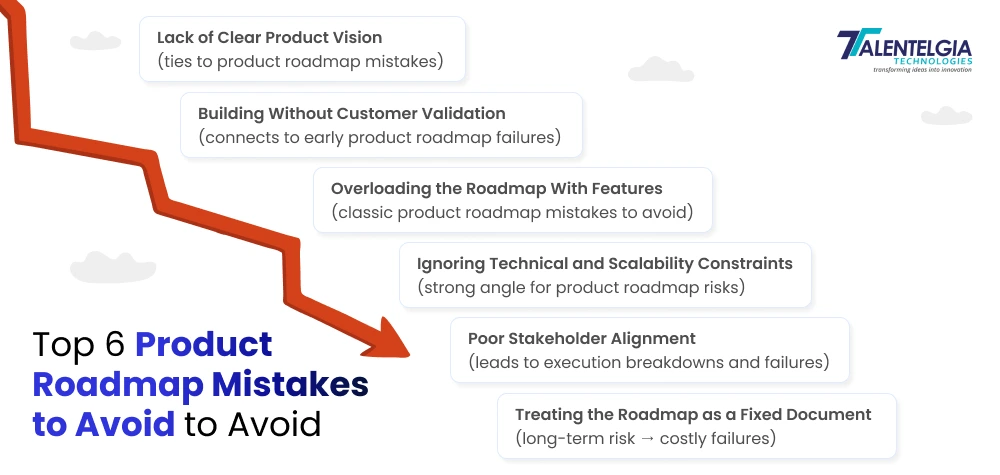
Product roadmaps often fail not because of poor execution, but because of early planning errors. These common product roadmap mistakes can introduce long-term risks, leading to wasted effort and costly failures. Understanding these mistakes early helps founders make smarter, more sustainable product decisions.
1. Building Without a Clear Product Vision
Execution before vision is one of the most frequent product roadmap errors. Without clarity on purpose and audience, roadmap decisions are based on a reactiveness that results in inconsistency.
For instance, a fintech fragmented focus startup working on a budgeting app but not having figured out if it’s for freelancers or enterprises typically ships compromise features that suit neither , leading to user confusion, stalled growth, and product roadmap failures, not just because they didn’t stick their necks out enough.
2. Prioritizing Features Over Customer Problems
Founders are often prioritizing features by competition or internal ideas instead of by real user pain. That creates serious product roadmap risk — it’s possible to spend months rolling out features users don’t really want.
For example, a SaaS company could lead in a feature like advanced analytics because competitors had it, only to conclude that users were having problems with onboarding basics… generating low adoption and wasted development work.
3. Overloading the Roadmap With Too Much at Once
One of the most expensive product roadmap mistakes is trying to do too many things at once. Bloated roadmaps burn out teams, slow down releases, and diminish the quality of the product.
You might be a well-intentioned early-stage startup trying to plan web development, mobile app development, integrations, and new markets in a single quarter and ending up with missed deadlines and an unstable first release.
4. Ignoring Technical and Scalability Constraints
A map that ignores engineering realities can fall apart in real-world use. You may be able to pull it off with less planning, but skipping architecture and scalability discussions usually means rework and downtime product roadmap subprocesses gone wrong.
Take, for instance, a web shop which suddenly experiences a surge in traffic due to an especially hot deal at HotUKDeals (a well-known UK deals website with typically higher… Read more wicked offers) and all of a sudden their site malfunctions.
5. Failing to Align Stakeholders and Teams
When leadership, product, and engineering teams are not on the same page, the roadmap is a source of confusion rather than a guide. This disconnect introduces hidden product roadmap risks that stall execution.
For example, leadership will make promises around new features in front of investors while engineering is obsessed with stability—leading to constant fuckery of priorities and missed dates.
6. Treating the Roadmap as a Fixed Plan
Markets change, and customers’ needs change. However, too many founders treat their roadmap as static. This inflexibility is one of the most unnoticed product roadmap mistakes.
One familiar antipattern is a startup freezing its roadmap for the year and slogging through planned feature work even after customer behavior has changed—shipping irrelevant functionality while competitors move more quickly.
Conclusion
A product roadmap can either speed growth or quietly turn into one of the most costly liabilities a founder must address. Product roadmap failures rarely occur overnight more often, they are the result of numerous small decisions, fuzzy priorities, and unacknowledged risks to your product roadmap that add up over time. From missing a vision for building to treating the roadmap as set in stone, these product roadmap pitfalls frequently result in wasted money and time, delays, and lost market opportunities.
Not making these product roadmap mistakes to avoid isn’t about curating the perfect plan from the outset it’s about crafting a flexible, customer-centered roadmap that evolves along with real-world feedback and technical realities. Cofounders who see their roadmaps for what they are a means to an end rather than as a static list of features tend to create products that scale, change, and win over time.













 Sales Enquiries:
  Business queries:
  HR:
HR: 


