



 Healthcare Software Development Services
 Healthcare App Development Services
 Real Estate Web Development Services
 Real Estate App Development Company
 E-Commerce App Development Services
 E-Commerce Web Development Services
 Blockchain E-commerce Development Company
 Fintech Software Development
 Fintech App Development Services
 E-Learning App Development Services
 Restaurant App Development Company
 Mobile Game Development Company
 Travel App Development Company
 Automotive Web Design
 AI Traffic Management System
 AI Inventory Management Software
 Logistics App Development Services
 Machine Learning Development
 ChatGPT integration services
  AI Development Company
  AI Integration Services
  Natural Language Processing Company
 Mobile App Development
  IOS App Development
  Android App Development
  Cross-Platform App Development
  Augmented Reality (AR) App Development
  Virtual Reality (VR) App Development
  Web App Development
  SaaS App Development
 Custom Software Development Services
  Flutter
  React Native
  Swift (IOS)
  Kotlin (Android)
  Mean Stack Development
  AngularJS Development
  MongoDB Development
  Nodejs Development
  Database Development
 Ruby on Rails Development
 Expressjs Development
  Full Stack Development
  Web Development Services
  Laravel Development
  LAMP Development
  Custom PHP Development
  .Net Development
  User Experience Design Services
  User Interface Design Services
  Automated Testing
  Manual Testing
  Digital Marketing Services
 Ride-Sharing And Taxi Services
 Food Delivery Services
 Grocery Delivery Services
 Transportation And Logistics
 Car Wash App
 Home Services App
 ERP Development Services
 CMS Development Services
 LMS Development
 CRM Development
 DevOps Development Services
 AI Business Solutions
 AI Cloud Solutions
 AI Chatbot Development
 API Development
 Blockchain Product Development
 Cryptocurrency Wallet Development
 About Talentelgia
  Our Team
  Our Culture
 Healthcare App Development Services
 Real Estate Web Development Services
 E-Commerce App Development Services
 E-Commerce Web Development Services
 Blockchain E-commerce
Development Company
Blockchain E-commerce
Development Company Fintech App Development Services
 Blockchain Fintech
Development Company
Blockchain Fintech
Development Company E-Learning App Development Services
 Restaurant App Development Company
 Mobile Game Development Company
 Travel App Development Company
 AI Traffic Management System
 AI Inventory Management Software
 AI Development Company
 ChatGPT integration services
 AI Integration Services
 Machine Learning Development
 Machine learning consulting services
 Blockchain Development
 Blockchain Software Development
 Smart contract development company
 NFT marketplace development services
 Asset tokenization companies
 DeFi Wallet Development Company
 IOS App Development
 Android App Development
 Cross-Platform App Development
 Augmented Reality (AR) App
Development
Augmented Reality (AR) App
Development Virtual Reality (VR) App Development
 Web App Development
 Flutter
 React
Native
React
Native Swift
(IOS)
Swift
(IOS) Kotlin (Android)
 MEAN Stack Development
 AngularJS Development
 MongoDB Development
 Nodejs Development
 Database development services
 Expressjs Development
 Full Stack Development
 Web Development Services
 Laravel Development
 LAMP
Development
LAMP
Development Custom PHP Development
 User Experience Design Services
 User Interface Design Services
 Automated Testing
 Manual
Testing
Manual
Testing About Talentelgia
 Our Team
 Our Culture

Have you ever built a software product and assumed that everything is going to be alright?
Everyone is hopeful at first! There is enthusiasm for the project, and the team is aligned with the workflow, contributing to the software development plan. However, once in the full execution phase, there are many things that could go wrong—goals remain unachieved, time and scope slip, frustration builds, etc. Understanding the software project failure causes is extremely important, and the market these days makes it even more critical due to factors like limited budget, tight deadlines, and expectations that are at an all-time high.
It is not the problems occurring that are concerning; it’s failing to anticipate the problem coming! And this is where truly smart teams make a real impact. Let’s explore the reasons why software projects fail and how to prevent software project failure in your next undertaking.
Understanding the Real Statistics Behind the Reasons Software Projects Fail
What’s the reason behind the failure of so many projects? The answer is in data! Let’s take a look at some numbers to answer this.
The Shocking Reality: 70%+ Failure Rate
70-80% of software projects fail to deliver on time, budget, or promised value.
- 31% cancelled before completion
- 52.7% cost 189% of original budget
- Only 16.2% meet original goals
These reports highlight that this level of inefficiency in a rapidly evolving industry will only require more focused and holistic approach for improvement within all elements of planning, execution, and risk! Especially when customer expectations change almost every moment.
How Do You Really Know That The Project Has Failed?
Projects are considered a failure when it fails to meet the requirements within the specific budget and timeframe. However, most of the time, it is upto the stakeholders to determine if the project is a success or failure based on how they feel about the final product. Most teams call “failure” when the app crashes or deadlines slip.
Wrong! Real failure happens much earlier—and much later—than those obvious moments. Here’s the unvarnished truth:
1. No Business Impact:
Your app works perfectly, code is clean, pass all tests, but… nobody uses it. Revenue is still 0 because just a few people sign in
Your app works perfectly. Code is clean. Tests pass 100%.
But… nobody uses it. Revenue = $0. Users = 47.
2. Burn Rate > Revenue
Suppose you spend $80K each month, and you make $2K sale in return. So, your spending is more than you earn, which indicated loss
Monthly burn: $80K → Revenue: $2K
Timeline left: 4 months → Runway: 3 months
Read More: Software Development Cost: A Brief Analysis
3. Team can’t ship anymore
Work speed drops over 70% for weeks, old bugs block new features, team fixes problems instead of building.
Velocity drops 70%+ for 4+ weeks = terminal technical debt
4. Stakeholders Stop Caring
Sales looks for other teams, Bosses shift to new projects like AI, budget moves to different work.
Execs: “New priorities emerged”
Budget: “Reallocated to AI project”
5. Opportunity Costs
Suppose project takes six months to finish, competitors launch sooner and win users, you’re always behind now.
The market moved on. You’re now chasing.
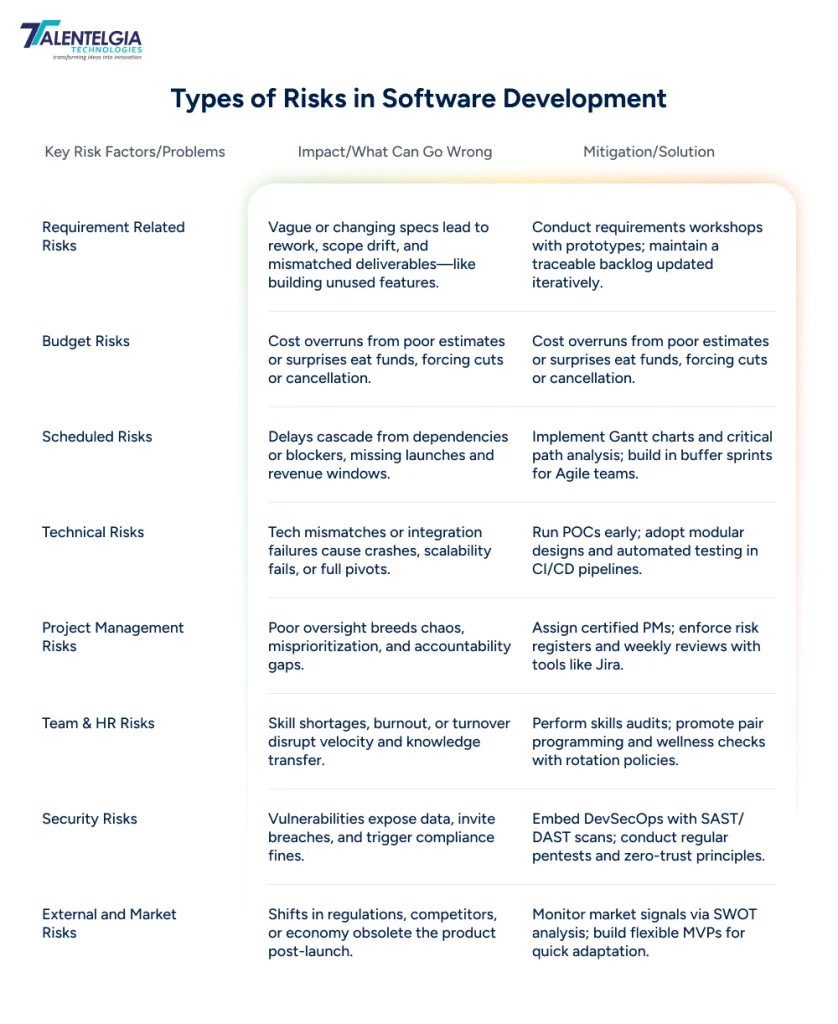
Top 10 Common Reasons of Software Projects Failure & How To Prevent Them?
Software projects derail from repeating predictable errors that erode progress, from vague starts to rushed finishes. Each reason below follows a consistent pattern: a detailed explanation of the problem’s ripple effects and vivid examples across four to five lines, followed by targeted solutions to sidestep the trap entirely.
1. Unclear Project Requirements
Unclear requirements create a fog from day one, where teams build features based on assumptions rather than facts, sparking endless revisions and misdirected effort. Picture starting an e-commerce app without confirming if users need social logins or guest checkout—months later, core functionality gets scrapped, frustrating everyone involved. This issue snowballs as stakeholders add conflicting inputs mid-stream, turning a straightforward build into a patchwork of compromises.
Solutions:
- Co-create detailed user stories: Host kickoff workshops with prototypes in Figma to lock in visuals and priorities early.
- Build a living requirements doc: Use tools like Confluence for version control, with sign-offs at every milestone.
- Trace back to business goals: Link each requirement to measurable outcomes to spot drifts quickly.
2. Wrong Tech Stack
Choosing the wrong tech stack forces teams into constant workarounds, slowing development and risking scalability issues down the line. For instance, selecting a heavy framework like Angular for a lightweight mobile-first dashboard means bloated load times and recruitment headaches when specialists are scarce. Over time, this mismatch breeds technical debt, as hacks pile up to compensate for poor fit.
Also Read: How to choose the right tech stack for your startup …
Solutions:
- Prototype shortlisted stacks: Test top options like React vs. Vue on sample tasks to measure speed and ease.
- Match team expertise first: Survey skills and pick familiar tools, like Node.js for JavaScript pros.
- Design for swapability: Use modular architecture to pivot stacks without full rewrites.
3. Lack of Communication
Poor communication turns teams into silos, where devs code one vision while clients expect another, leading to “not what I asked for” surprises at demos. In a mobile app project, unclear handoffs might result in backend APIs that don’t sync with frontend UI, causing delays as fingers point across channels. Without clear channels, small confusions compound into major realignments. Remote setups amplify this, with time zones turning quick clarifications into day-long waits.
Solutions:
- Set daily check-ins: Run quick standups via Slack or Zoom to surface blockers instantly.
- Unify updates in one tool: Centralize progress in Jira with shared dashboards for real-time visibility.
- Define roles upfront: Use RACI charts to eliminate “who owns this?” debates.
4. Underestimated Timeline
Underestimating timelines sets impossible paces, ignoring real-world hurdles like debugging marathons or shifting priorities, which erode morale and force overtime. A web app pegged at three months might stretch to six when integrations reveal hidden complexities, leaving buffers nonexistent and deadlines shattered. Teams rush corners, introducing bugs that demand even more time to fix. Stakeholders lose faith as promises slip, straining relationships further.
Solutions:
- Use historical baselines: Review past projects for realistic velocity on similar tasks.
- Add smart buffers: Factor in 20-30% extra time for surprises, tracked via burndown charts.
- Refine iteratively: Hold planning poker sessions every sprint to adjust on the fly.
5. Scope Creep
Scope creep sneaks in through “quick tweaks” that accumulate, bloating projects beyond original plans and diluting focus on must-haves. An initial CRM tool evolves into a full analytics suite without extra budget, overwhelming devs and disappointing launch results as priorities blur. Clients keep piling on without grasping impacts, while teams juggle shifting targets. What starts small ends up doubling costs and timelines unexpectedly.
Solutions:
- Enforce change requests: Require formal tickets assessing impact before approving adds.
- Prioritize with MoSCoW: Categorize features as Must/Should/Could/Won’t to defer extras.
- Review scope weekly: Revisit backlogs in sprint planning to trim ruthlessly.
6. Gaps in Developer Skill Set & Project Requirements
Skill gaps leave teams stumbling on unfamiliar terrain, producing subpar code or endless trial-and-error that inflates timelines. Assigning a React Native newbie to a complex AR feature means steep learning curves mid-project, diverting time from innovation to basics. Bugs multiply from inexperience, and seniors burn out firefighting instead of architecting. Progress stalls as confidence wanes across the board.
Solutions:
- Audit skills early: Create a matrix matching team strengths to needs, filling gaps via hires or training.
- Pair program strategically: Buddy juniors with seniors for hands-on knowledge transfer.
- Invest in targeted upskilling: Dedicate sprint time to tutorials on key tools like Docker.
7. Poor Project Management
Weak project management lets chaos fill the void, with no clear milestones or accountability, causing tasks to drift and risks to blindside everyone. Without oversight, a SaaS platform might miss security audits until compliance demands halt progress abruptly. Dependencies go unseen, creating domino delays. Motivation dips in the unstructured drift.
Solutions:
- Appoint a strong PM: Choose someone versed in Agile with tools like Asana for automated tracking.
- Map dependencies visually: Use Gantt charts to flag bottlenecks before they hit.
- Monitor with key metrics: Track velocity and risks in weekly reviews.
8. Unrealistic Expectations
Unrealistic expectations promise miracles in tight windows, setting up inevitable shortfalls that damage trust and momentum. Clients demanding a full AI recommendation engine in a month overlook data prep realities, leading to half-baked demos and strained relationships. Gaps widen between hype and delivery, fostering blame cycles. Future collaborations suffer from the fallout.
Solutions:
- Align via roadmaps: Co-design phased plans highlighting quick wins first.
- Quantify feasibility: Share effort estimates tied to value for grounded discussions.
- Facilitate tough talks: Bring in neutral voices for expectation resets.
9. No End-User Involvement
Excluding end-users builds products in isolation, yielding interfaces that confuse rather than delight, with low adoption post-launch. A fintech app without user tests might bury key actions behind unintuitive menus, dooming engagement from the start. Assumptions about “obvious” flows prove wrong, requiring overhauls. Valuable feedback loops stay silent until it’s too late.
Solutions:
- Loop in users early: Run usability sessions with tools like UserTesting from prototype stage.
- Gather ongoing feedback: Embed surveys and analytics for iterative tweaks.
- Evolve personas: Update user profiles based on real behaviors quarterly.
10. Lack of Proper Testing
Skipping rigorous testing invites production disasters, where uncaught bugs erode user faith and demand hotfixes. A rushed e-learning platform launch with broken video streams turns early excitement into refunds and bad reviews. Edge cases lurk unnoticed, amplifying under load. Reputation takes lasting hits from preventable crashes.
Solutions:
- Adopt test-first habits: Write unit tests alongside code with Jest or PyTest.
- Automate pipelines: Set CI/CD gates in GitHub Actions to block bad merges.
- Simulate real chaos: Run load tests and edge-case drills pre-release.
Conclusion
Even small errors in a single project may turn out to be a disaster for an entire portfolio. Unresolved issues can lead to delays, increased costs, and wasted resources. With Talentelgia’s project management experts, businesses can achieve tremendous growth in  multi-project environment. Our strategies will strengthen your multi-project setup, from smart portfolio planning and budget control to active risk mitigation.
If you suspect that there could be budgeting error, communication issue, or insufficient risk management, it is time to reach out to our experts.














 Sales Enquiries:
  Business queries:
  HR:
HR: 


