



 Healthcare Software Development Services
 Healthcare App Development Services
 Real Estate Web Development Services
 Real Estate App Development Company
 E-Commerce App Development Services
 E-Commerce Web Development Services
 Blockchain E-commerce Development Company
 Fintech Software Development
 Fintech App Development Services
 E-Learning App Development Services
 Restaurant App Development Company
 Mobile Game Development Company
 Travel App Development Company
 Automotive Web Design
 AI Traffic Management System
 AI Inventory Management Software
 Logistics App Development Services
 Machine Learning Development
 ChatGPT integration services
  AI Development Company
  AI Integration Services
  Natural Language Processing Company
 Mobile App Development
  IOS App Development
  Android App Development
  Cross-Platform App Development
  Augmented Reality (AR) App Development
  Virtual Reality (VR) App Development
  Web App Development
  SaaS App Development
 Custom Software Development Services
  Flutter
  React Native
  Swift (IOS)
  Kotlin (Android)
  Mean Stack Development
  AngularJS Development
  MongoDB Development
  Nodejs Development
  Database Development
 Ruby on Rails Development
 Expressjs Development
  Full Stack Development
  Web Development Services
  Laravel Development
  LAMP Development
  Custom PHP Development
  .Net Development
  User Experience Design Services
  User Interface Design Services
  Automated Testing
  Manual Testing
  Digital Marketing Services
 Ride-Sharing And Taxi Services
 Food Delivery Services
 Grocery Delivery Services
 Transportation And Logistics
 Car Wash App
 Home Services App
 ERP Development Services
 CMS Development Services
 LMS Development
 CRM Development
 DevOps Development Services
 AI Business Solutions
 AI Cloud Solutions
 AI Chatbot Development
 API Development
 Blockchain Product Development
 Cryptocurrency Wallet Development
 About Talentelgia
  Our Team
  Our Culture
 Healthcare App Development Services
 Real Estate Web Development Services
 E-Commerce App Development Services
 E-Commerce Web Development Services
 Blockchain E-commerce
Development Company
Blockchain E-commerce
Development Company Fintech App Development Services
 Blockchain Fintech
Development Company
Blockchain Fintech
Development Company E-Learning App Development Services
 Restaurant App Development Company
 Mobile Game Development Company
 Travel App Development Company
 AI Traffic Management System
 AI Inventory Management Software
 AI Development Company
 ChatGPT integration services
 AI Integration Services
 Machine Learning Development
 Machine learning consulting services
 Blockchain Development
 Blockchain Software Development
 Smart contract development company
 NFT marketplace development services
 Asset tokenization companies
 DeFi Wallet Development Company
 IOS App Development
 Android App Development
 Cross-Platform App Development
 Augmented Reality (AR) App
Development
Augmented Reality (AR) App
Development Virtual Reality (VR) App Development
 Web App Development
 Flutter
 React
Native
React
Native Swift
(IOS)
Swift
(IOS) Kotlin (Android)
 MEAN Stack Development
 AngularJS Development
 MongoDB Development
 Nodejs Development
 Database development services
 Expressjs Development
 Full Stack Development
 Web Development Services
 Laravel Development
 LAMP
Development
LAMP
Development Custom PHP Development
 User Experience Design Services
 User Interface Design Services
 Automated Testing
 Manual
Testing
Manual
Testing About Talentelgia
 Our Team
 Our Culture

Deciding on the correct approach to development is one of the most crucial decisions to make for any modern business building digital products. The argument of low-code vs high code is becoming more heated as low-code providers promise quicker time to delivery, lower cost, and less reliance on large engineering teams. On the face of it, low-code seems like the easy shortcut to innovation. But such barriers can also create constraints in a number of real-world cases, rather than adding to long-term value.
Low-code tools work best for quick prototypes and lightweight applications in app development, but they’re not always suitable for complex, scalable, or performance-oriented systems. In traditional high-code development, while the process can be slower and more resource-intensive, you gain deeper flexibility, stronger control, and long-term reliability. This blog demystifies low-code vs traditional development, compares low-code vs no-code approaches, and breaks down when low-code helps—and when it can actually cost more than it saves.
What is Low-Code Development?
Low-code development is a software development methodology that enables developers to create apps through visual interfaces, without writing tons of manual code. What’s more, it minimizes the requirement for in-depth programming knowledge and fatsens the production of web and mobile apps.
Low-code solutions often offer visual workflows, templated forms, database connectors, and API connections. Developers and, in certain cases, even non-technical users, can build out application features by piecing together components rather than coding everything from the ground up. This is what makes low-code great for internal tools, dashboards, automation workflows, and simplistic customer-facing applications.
The endgame of low-code development is more output with fewer resources. Companies employ it to develop and release Minimum Viable Products (MVPs), automate the workflow of common processes, and adapt rapidly to new needs. Yet, for larger or complex systems, low-code might add some development agility and use case utility/reach, but still not suffice for the levels of control required in traditional high-code (full) development.
What is High-Code (Traditional) Development?
High-code (traditional) development: The typical way of building software sees developers author applications in programming languages like Java, Python, JavaScript, C#, or Go. Each of the core features, workflows, and plugins is built on top of custom code — providing teams with complete control over how their app is being designed, built, or optimized.
In high-code development, engineers use frameworks, libraries, and tools to design systems from scratch. This solution is demanding in technical expertise, it takes a long time to develop, and you need solid engineering processes – but at the same time, it gives more depth, better performance tuning, and vastly more architectural flexibility for each device.
These are traditionally used for advanced products, massive platforms, and mission-critical systems in which scalability, security, and fine-grained code control are essential. Although it requires more effort and resources than low-code platforms, high-code development frequently results in applications that have greater long-term value, especially for applications that need to scale, integrate deeply, or support large volumes of transactions.
Low Code vs Traditional Development
| Low-Code Development | Traditional (High-Code) Development |
| Applications are built using visual builders, drag-and-drop components, and prebuilt modules | Applications are built by writing detailed custom code using programming languages and frameworks |
| Development is much faster because many features are ready to use out of the box | Development takes more time since most features are coded and tested from scratch |
| Requires minimal to moderate coding knowledge to build working apps | Requires strong programming skills and experienced developers |
| Customization is possible but often limited by platform capabilities | Full customization is possible at every layer of the application |
| Platform handles much of the underlying architecture automatically | Developers design and control the full system architecture |
| Best suited for small to mid-level complexity applications and rapid prototypes | Ideal for complex, large-scale, and long-term enterprise systems |
| Performance optimization options are limited to what the platform supports | Performance can be deeply optimized at code, database, and infrastructure levels |
| Integrations are usually done through built-in connectors and plugins | Integrations can be fully custom-built for any external system |
| There is a higher risk of vendor lock-in with specific low-code platforms | Lower vendor lock-in because tech stack choices are flexible |
| Lower initial cost and smaller teams can deliver working products | Higher initial investment in time, developers, and infrastructure |
Low Code vs No-Code Development
| Low-Code | No-Code |
| Allows developers to add custom code when needed for advanced logic | Does not allow custom coding and relies fully on visual configuration |
| Designed for developers and technically skilled business users | Designed mainly for non-technical users and business teams |
| Supports moderately complex business applications | Best suited for very simple apps and workflows |
| Offers flexibility through scripts, APIs, and extensions | Flexibility is limited to built-in platform features |
| Custom integrations with external systems are usually supported | Integrations are limited to predefined connectors |
| More control over workflows and data handling | Very limited control over internal logic |
| Can scale to a reasonable level depending on the platform | Scalability is usually limited |
| Learning curve is moderate but still easier than full coding | Very easy to learn and use quickly |
| Suitable for internal tools, dashboards, and process automation | Suitable for simple forms, landing pages, and basic automation |
When to Use a Low-Code Platform
A low-code platform is most effective when rapidity, low cost, and quick delivery are more important than extensive tailoring and having full control over architecture. It is at its best when you are trying to build applications quickly, have a clear idea of requirements, and the complexity involved is rather manageable. “No longer do teams have to spend months coding up full software development; they can get a functional solution live in weeks with visual tools and ready-made parts.
Low-code platforms serve well in the creation of MVPs, internal business apps, workflow automation systems, as well as dashboards and customer portals with not-so-complex logic. They are also useful when development resources are scarce, and business teams want to be able to contribute directly to how the app is being built. Low-code is frequently used by organizations to prove out new ideas, digitize manual processes, or as a temporary or departmental use case.
But with the low code, you should be careful when long-term scalability or deep performance tuning is considered a business-critical unit. In such circumstances, high-code development in the traditional sense can perhaps provide better long-term value.
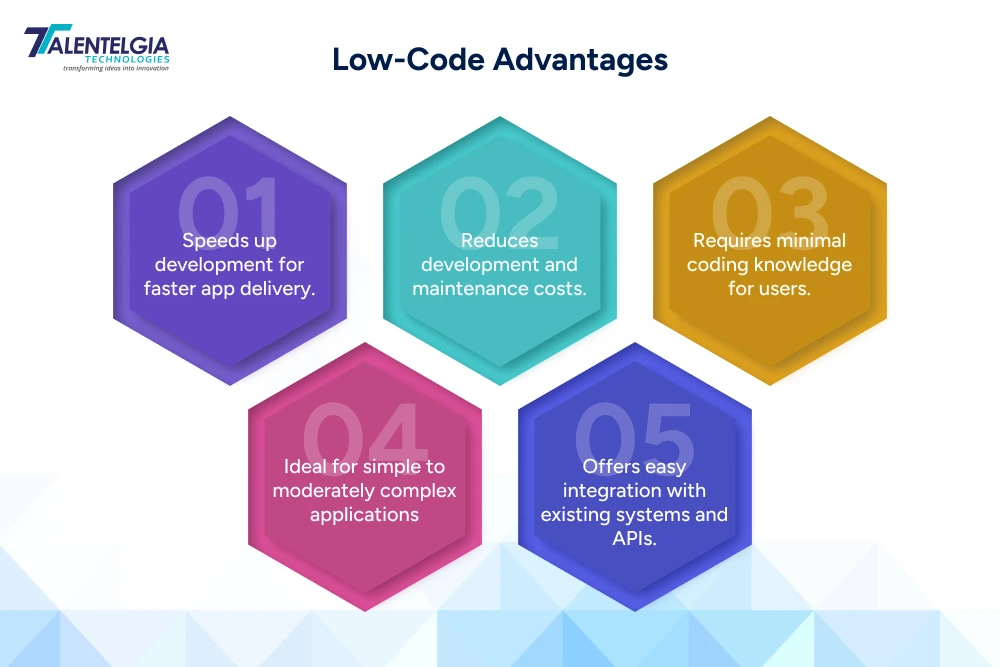
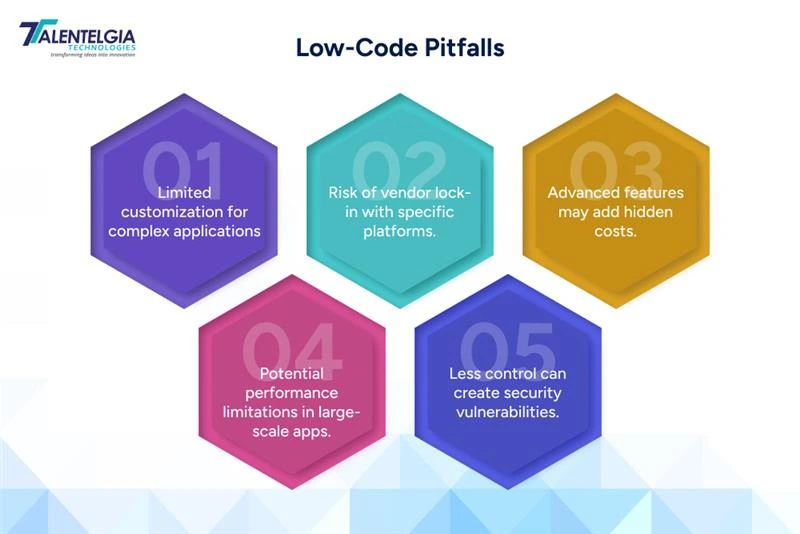
Low-Code Advantages and Pitfalls
Low-Code Pitfalls
High Code vs Low Code: Making the Right Choice
When it comes to high code vs low code, however, there’s no right or wrong answer beyond what approach suits your project — that, of course, depends on your project’s needs, complexity, schedule, and longer-term goals. Both are valuable in their proper context, and both can cause problems if misapplied.
When speed and efficiency are the main concerns, however, low-code is the way to go. When you need to quickly release an MVP, automate work within the company, or develop relatively simple business applications, low-code platforms can facilitate a huge reduction in both time and budget. They are particularly helpful when the rules of the game aren’t rapidly changing, and your app isn’t calling for feature-rich customization or heavy-duty performance tuning.
When you need to have the maximum control over your product, more advanced features, clear security architecture, and sustainable scalability, high code development is the best choice. More complex customer-facing platforms, higher traffic systems, and those with changing requirements can follow traditional development as there are fewer constraints on the platform and developers are freer to apply or not architecture rules.
In countless real-world situations, the best path is not entirely low-code or high-code; it’s a hybrid. Many teams use low-code for speed in parts of their application, while relying on high-code to power critical systems that require flexibility and scale. The right decision is about your software development strategy for business risk, technical complexity, and growth plans.
Conclusion
Whether you should go low-code or high-code is going to depend very much on what it is that you are creating and how far it needs to grow. Low-code platforms are great for fast delivery, automation, and low-to-moderate application complexity, but can also confer constraints and reduce future value if placed in front of highly complex systems. The high-code approach is time and skill-consuming but allows for maximum control, scalability, and customization.
By weighing the scope of your project, its performance requirements, and roadmap for the future, you will be able to determine the approach that yields a more pragmatic, durable return on investment.













 Sales Enquiries:
  Business queries:
  HR:
HR: 


