


 Healthcare Software Development Services
 Healthcare App Development Services
 Real Estate Web Development Services
 Real Estate App Development Company
 E-Commerce App Development Services
 E-Commerce Web Development Services
 Blockchain E-commerce Development Company
 Fintech Software Development
 Fintech App Development Services
 E-Learning App Development Services
 Restaurant App Development Company
 Mobile Game Development Company
 Travel App Development Company
 Automotive Web Design
 AI Traffic Management System
 AI Inventory Management Software
 Logistics App Development Services
 Machine Learning Development
 ChatGPT integration services
  AI Development Company
  AI Integration Services
  Natural Language Processing Company
 Mobile App Development
  IOS App Development
  Android App Development
  Cross-Platform App Development
  Augmented Reality (AR) App Development
  Virtual Reality (VR) App Development
  Web App Development
  SaaS App Development
 Custom Software Development Services
  Flutter
  React Native
  Swift (IOS)
  Kotlin (Android)
  Mean Stack Development
  AngularJS Development
  MongoDB Development
  Nodejs Development
  Database Development
 Ruby on Rails Development
 Expressjs Development
  Full Stack Development
  Web Development Services
  Laravel Development
  LAMP Development
  Custom PHP Development
  .Net Development
  User Experience Design Services
  User Interface Design Services
  Automated Testing
  Manual Testing
  Digital Marketing Services
 Ride-Sharing And Taxi Services
 Food Delivery Services
 Grocery Delivery Services
 Transportation And Logistics
 Car Wash App
 Home Services App
 ERP Development Services
 CMS Development Services
 LMS Development
 CRM Development
 DevOps Development Services
 AI Business Solutions
 AI Cloud Solutions
 AI Chatbot Development
 API Development
 Blockchain Product Development
 Cryptocurrency Wallet Development
 About Talentelgia
  Our Team
  Our Culture
 Healthcare App Development Services
 Real Estate Web Development Services
 E-Commerce App Development Services
 E-Commerce Web Development Services
 Blockchain E-commerce
Development Company
Blockchain E-commerce
Development Company Fintech App Development Services
 Blockchain Fintech
Development Company
Blockchain Fintech
Development Company E-Learning App Development Services
 Restaurant App Development Company
 Mobile Game Development Company
 Travel App Development Company
 AI Traffic Management System
 AI Inventory Management Software
 AI Development Company
 ChatGPT integration services
 AI Integration Services
 Machine Learning Development
 Machine learning consulting services
 Blockchain Development
 Blockchain Software Development
 Smart contract development company
 NFT marketplace development services
 Asset tokenization companies
 DeFi Wallet Development Company
 IOS App Development
 Android App Development
 Cross-Platform App Development
 Augmented Reality (AR) App
Development
Augmented Reality (AR) App
Development Virtual Reality (VR) App Development
 Web App Development
 Flutter
 React
Native
React
Native Swift
(IOS)
Swift
(IOS) Kotlin (Android)
 MEAN Stack Development
 AngularJS Development
 MongoDB Development
 Nodejs Development
 Database development services
 Expressjs Development
 Full Stack Development
 Web Development Services
 Laravel Development
 LAMP
Development
LAMP
Development Custom PHP Development
 User Experience Design Services
 User Interface Design Services
 Automated Testing
 Manual
Testing
Manual
Testing About Talentelgia
 Our Team
 Our Culture
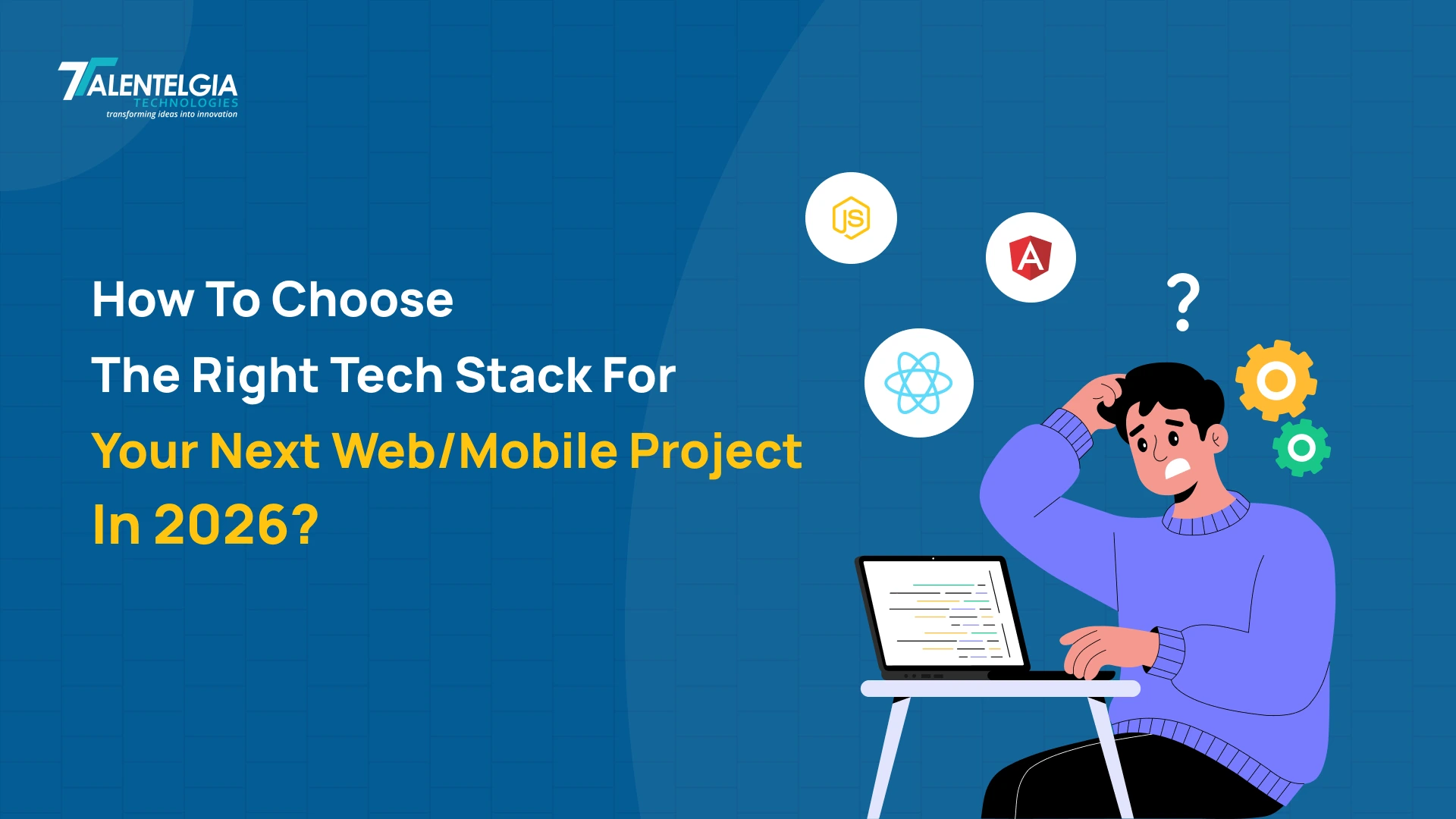
The web development industry is evolving exponentially, and so is the importance of evaluating your tech stack, as creating web applications is much more than working on products. The expectations include speed, scalability, security, the ability to function on varying devices, and a positive user experience. Whether it’s a startup or a major enterprise, located anywhere in the world, being able to develop applications with these attributes is crucial to business success.
Developing web apps is driven by user demand and rapid technological innovation. Application development companies work with new frameworks, cloud native architectures, and automation-first workflows. These tech stacks let you build genuine positive digital experiences. Statistics show that 75% of users judge an organization’s credibility based solely on its website design. Moreover, 40% of users bounce from a site that takes more than 3 seconds to load. So it’s obvious that to make your business flourish in 2026, you must choose the best tech stack for web and mobile development. Let’s dive deeper into this article!
Understanding Tech Stacks In 2026: Examples, Key Components & Benefits
When setting up a new business, most entrepreneurs start with a game plan, a clear vision, and a strategy they intend to follow to achieve success. However, that vision starts to get blurry when it comes to choosing a specific tech stack and knowing how to integrate that into the business. It feels right to have several options at the moment, but in most cases, it has a negative result on the business with respect to cost, speed, talent, and opportunities. This post will help you focus on the challenges of how to choose the right tech stack in 2026 and finding a suitable solution for the long term.
What Is a Technology Stack?
A technology stack (or tech stack) is the complete combination of tools, languages, frameworks, and infrastructure used to build, run, and maintain a web or mobile application. It covers everything from what users see on the screen to the servers, databases, and cloud services working behind the scenes. Technology plays a specific role, and changing one component can affect performance, scalability, security, cost, and even how easy it is to hire developers for your project.
Vital Components of a Modern Tech Stack:
Below are some of the key components of a modern tech stack that work together to build scalable and high-performing applications. Each component plays a specific role, from user experience to backend processing and infrastructure.
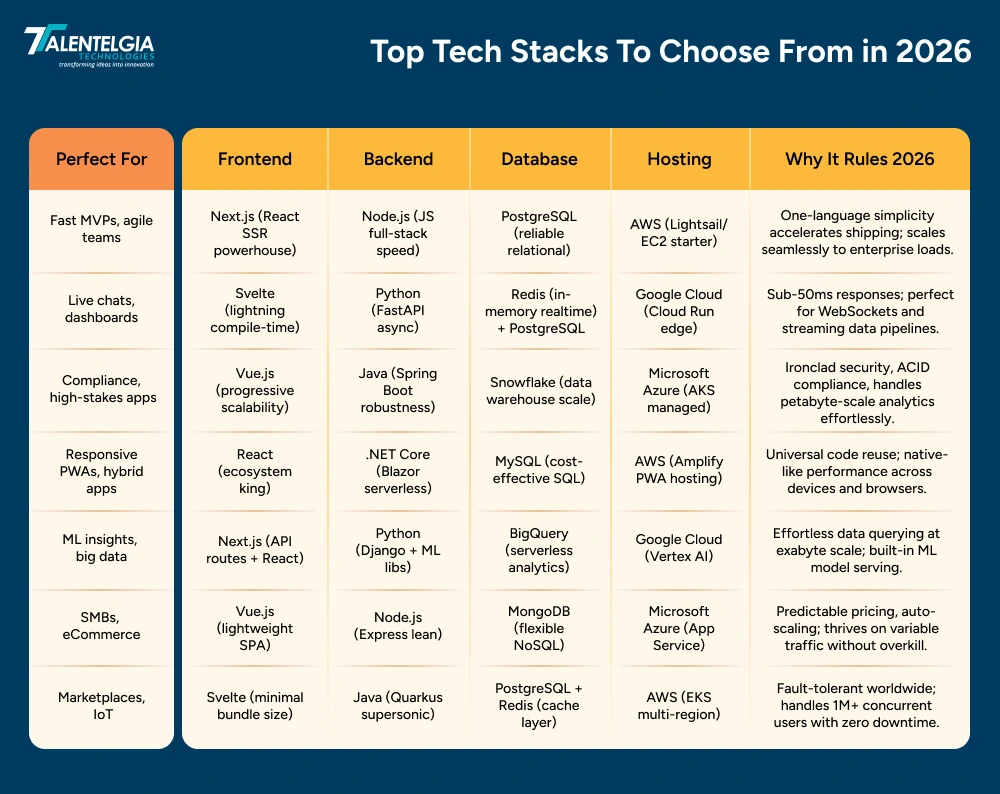
1. Frontend (Client-Side Layer)
This is everything the user sees and interacts with in the browser or mobile app. The frontend stack defines user experience, accessibility, responsiveness, and how fast your app feels.
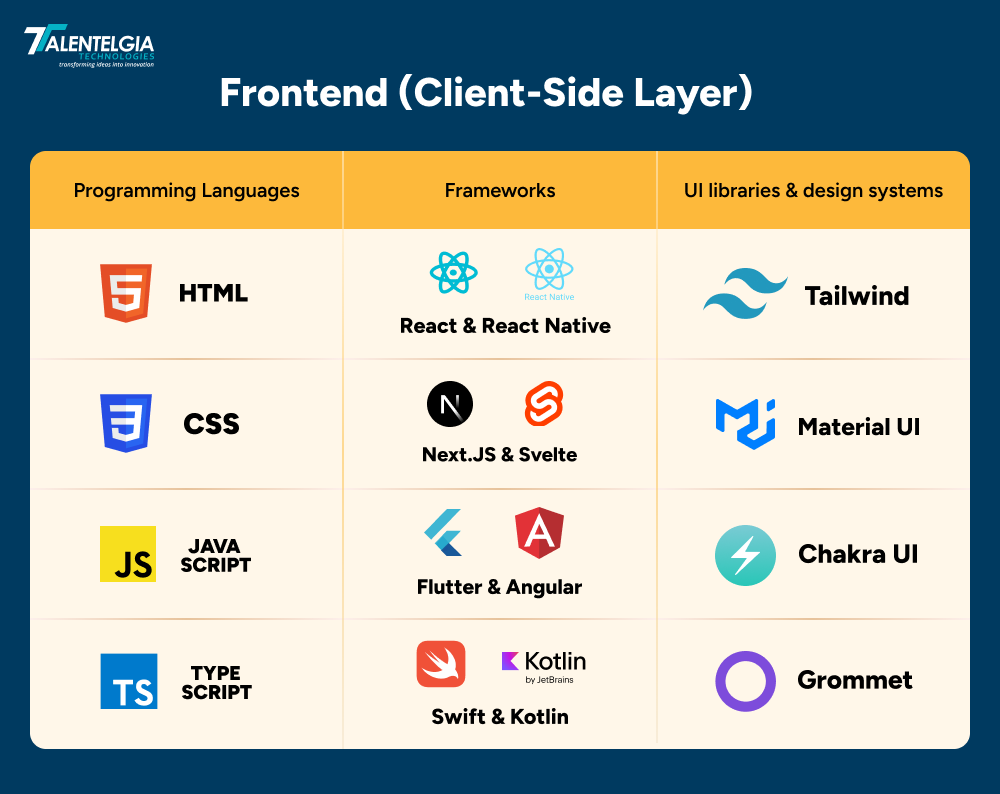
2. Backend (Server-Side Layer)
This is the engine room—it processes requests, enforces business rules, and talks to databases and external services. The backend is responsible for authentication, authorization, data processing, integrations, and performance under load.
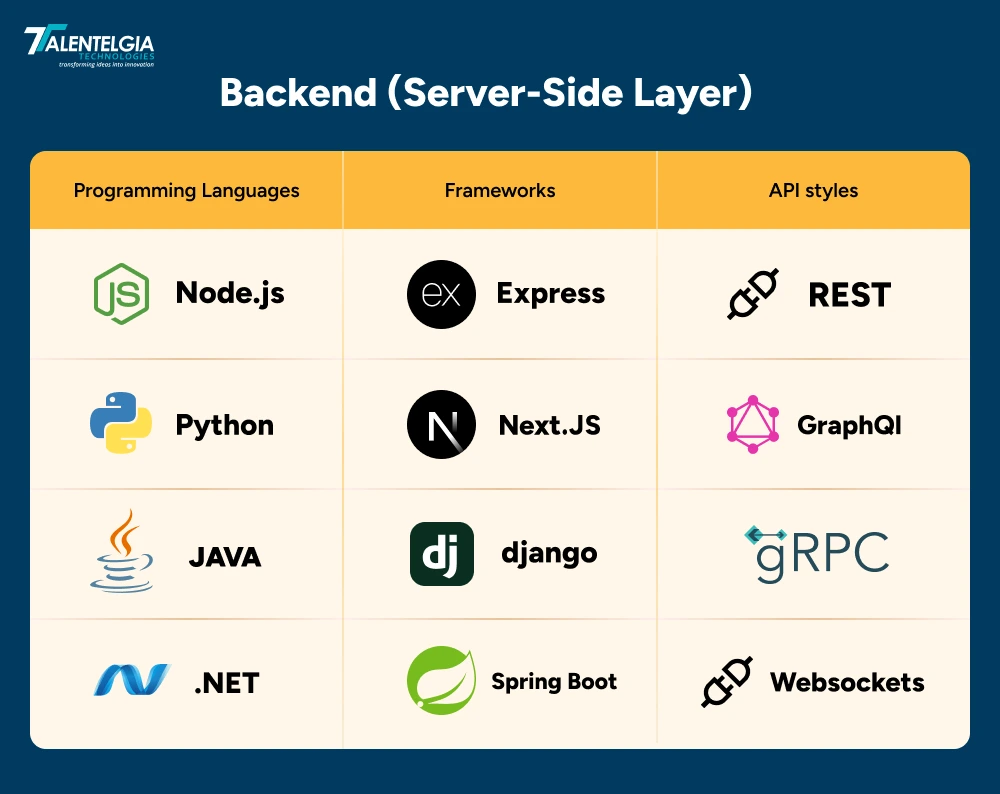
3. Databases & Storage
This layer stores and retrieves data for your application. Choosing the right database impacts consistency, reporting, analytics, and how easily you can scale or change features later.
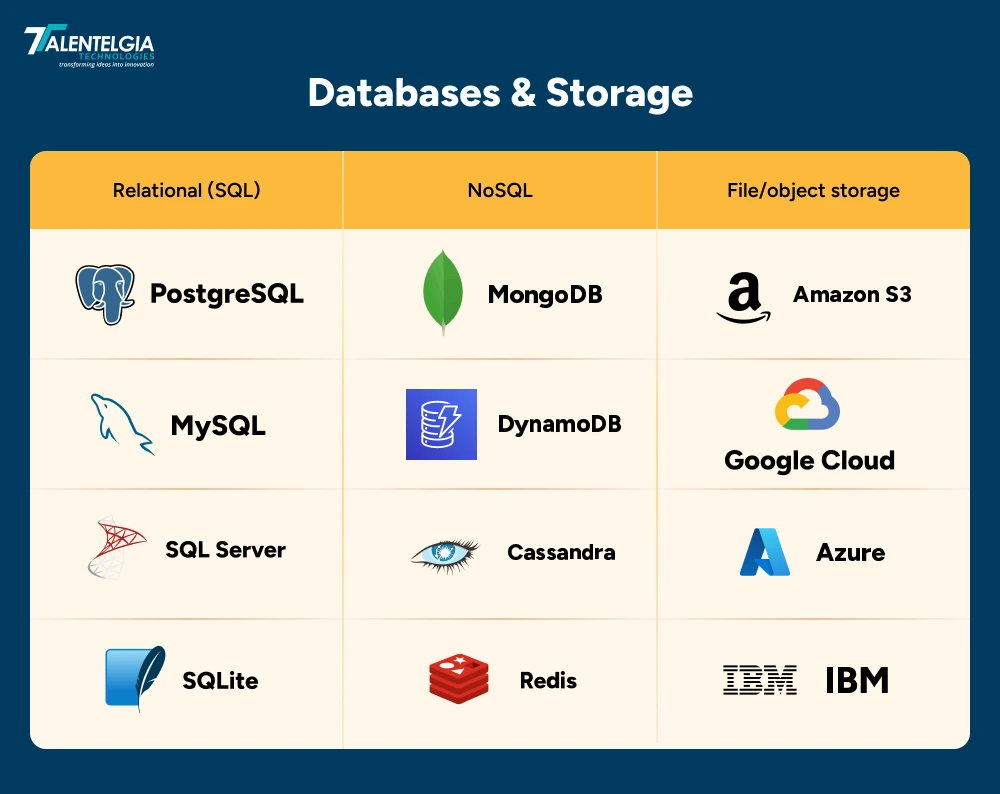
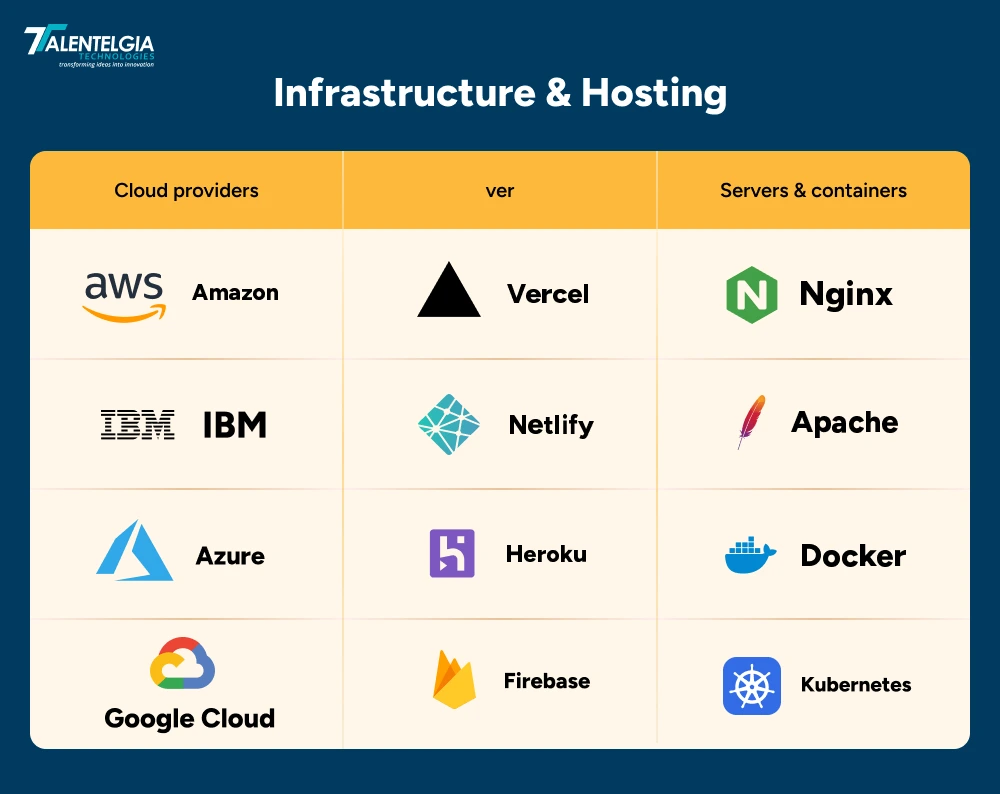
4. Infrastructure & Hosting
These are the environments and platforms where your application runs. Infrastructure decisions drive uptime, scalability, latency, and operational cost.
Why Choosing The Right Tech Stack Matters In 2026?
The web or mobile app solution that you plan to launch is determined by various elements from your chosen tech stack. The tech stack you choose influences the development speed and performance of your application. Whether you’re building an MVP or enterprise solution, tech stack selection for web and mobile apps is crucial for:
1. Direct impact on growth and scalability
A tech stack now functions as a growth decision, not just a technical one. The languages, frameworks, and cloud services you choose determine how easily your product can handle more users, more data, and new features without painful rewrites.
Example: Many startups that picked trendy but immature frameworks had to rebuild their platforms once they hit growth, losing months of roadmap and budget to rework.
2. Faster Time-to-market, innovation speed, and cost
In 2026, competition is often won by the teams that ship faster and iterate safely, and your stack is a significant lever on that speed. Choosing tools that integrate cleanly, automate deployment, and provide strong observability makes it far easier to run experiments, A/B tests, and frequent updates in production.
3. Stronger Security, compliance, and risk management
Security and compliance requirements are stricter, and your tech stack heavily influences how safely and cheaply you can meet them. Picking a stack with mature security tooling, long-term vendor support, and strong best-practice documentation significantly reduces your operational and legal risk over the life of the product.
4. AI-readiness and modern product capabilities
By the end of 2026, AI will no longer be a “nice to have” layer; it will be embedded into core user experiences, automation, and analytics. If you choose technologies that make AI integration painful, you limit your ability to add intelligent features, personalization, and automation that users increasingly expect.
5. Hiring, developer experience, and long-term maintainability
There is a structural shortage of experienced developers in the IT sector, so your stack directly affects how easily you can attract and retain talent. The wrong stack can lock you into rare skills, high salaries, and long recruitment cycles, while a sensible, mainstream stack gives you a larger talent pool and more predictable maintenance over the years.
6. Future-proofing in a fast-changing landscape
Technology cycles are shortening, and stacks chosen must be able to evolve without repeated ground-up rewrites. In other words, the right tech stack is the foundation for sustainable product evolution, not just a collection of tools you use to ship version 1.0. Trends like multi-cloud, edge computing, low-code platforms, and pervasive AI will continue to shape how applications are built and deployed.
Key Factors To Consider When Choosing a Tech Stack In 2026
Choosing a tech stack is less about picking “the best framework” and more about aligning technology with your product, team, and long-term vision. This section walks through the key factors you should evaluate before committing.
- Scalability and Performance Needs: Choose tools that can handle 10x more users, data, and traffic than you have today. Prioritize architectures that support caching, load balancing, and horizontal scaling from the start.
- Project Type, Size & Complexity: Match your stack to what you’re building—simple content sites, real-time apps, or enterprise systems all have different needs. Clarify scope, critical features, and complexity so you don’t over- or under-engineer.
- Team Expertise & Hiring Market: Leverage technologies your team already knows to avoid slowdowns and steep learning curves. Favor widely used stacks so hiring and onboarding new developers stay predictable and straightforward.
- Maintainability, Ecosystem & Community: A strong ecosystem and active community reduce bugs, accelerate development, and improve support. Choose mature, well-documented tools that are likely to be maintained for years.
- Security, Compliance & Data Protection: Your stack should make it easy to protect sensitive data and meet regulatory requirements. Look for built-in support and integrations for secure auth, encryption, and auditing.
Step-by-Step Guide to Choosing the Best Tech Stack for Web and Mobile Development
In 2026, selecting a tech stack goes beyond simply following a trend; it’s about fitting your business goals and your vision for the long haul. Every business has its own unique variables, and as such, there is not one perfect answer.
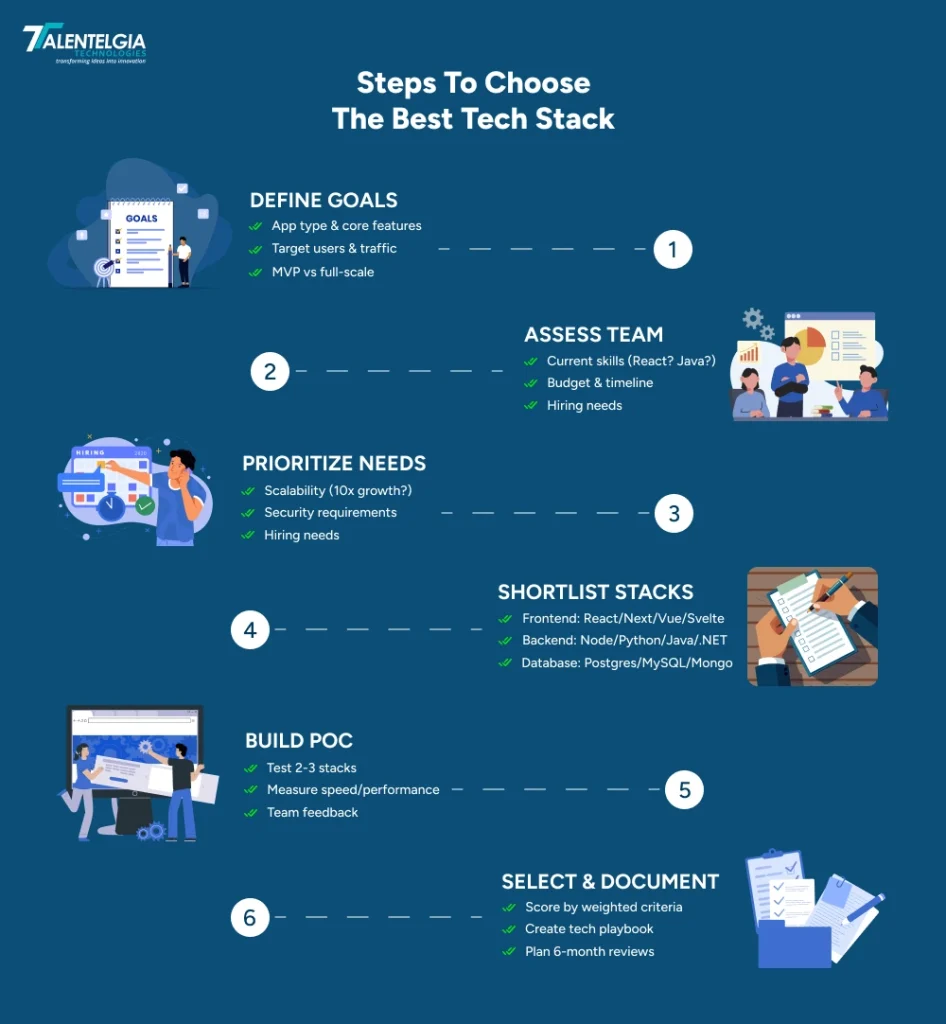
However, guiding you along a few simple steps can help you decide and find the best tech stack for web/mobile development in 2026:
Step 1: Define Clear Project Goals and Requirements
- Start by documenting your app’s core purpose, target users, key features, and success metrics.
- Distinguish between must-have MVP features (e.g., user auth, basic CRUD) and nice-to-haves (e.g., AI recommendations, real-time chat).
- Map technical needs like real-time updates, offline support, or heavy data processing to narrow frontend/backend/database options early.
Step 2: Assess Team Skills and Resource Constraints
- Inventory your team’s expertise in languages (JavaScript, Python, Kotlin/Swift) and frameworks (React, Flutter, Django).
- Factor in budget, timeline, and hiring ease—favor stacks like MERN/MEAN for JS teams or Flutter for rapid cross-platform mobile.
- Balance speed (e.g., Firebase for quick MVPs) with scalability to avoid costly rewrites later.
Step 3: Evaluate Scalability, Performance, and Security
- Project traffic growth and peak loads; test if stacks support horizontal scaling, caching (Redis), and CDNs.
- Prioritize security-first choices with built-in auth (OAuth/JWT), encryption, and compliance tools for GDPR/AI regs.
- Prototype high-risk features (e.g., payments, real-time sync) to validate performance before full commitment.
Step 4: Research Popular 2026 Stacks by Category
- Web: Frontend (Next.js 15, SvelteKit, Remix); Backend (Node.js/Bun, FastAPI, Spring Boot); DB (PostgreSQL, MongoDB, Supabase).
- Mobile: Cross-platform (Flutter 4.0, React Native 0.76); Native (SwiftUI 6, Jetpack Compose); Backend (Firebase, AWS Amplify).
- Compare via POCs: build a simple user flow in 2-3 stacks to measure dev speed and output quality.
Step 5: Check Ecosystem, Community, and AI-Readiness
- Verify active maintenance, npm/PyPI package health, and community size (Stack Overflow, GitHub stars).
- Ensure AI compatibility: vector DB support (Pinecone), easy LLM API integration, and edge deployment (Vercel, Cloudflare).
- Review long-term viability—avoid declining stacks; prioritize those with strong corporate backing or massive adoption.
Step 6: Build and Test Prototypes (POC/MVP)
- Create small proofs-of-concept for your top 2-3 stacks, focusing on critical paths (auth, data sync, UI performance).
- Measure metrics: build time, bundle size, latency, DX (developer experience), and deployment ease.
- Gather team feedback and iterate—eliminate stacks that fail real-world tests.
Step 7: Plan for DevOps, Monitoring, and Future Evolution
- Select CI/CD (GitHub Actions, Vercel), monitoring (Sentry, Datadog), and hosting (AWS, Vercel, Render) that match your stack.
- Design modular architecture (micro-frontends/services) for easy swaps as needs change (e.g., add WebAssembly later).
- Document migration paths and schedule 6-month reviews to stay ahead of trends like Wasm or agentic AI.
Step 8: Finalize, Document, and Commit
- Score stacks against weighted criteria (40% team fit, 20% scalability, 15% cost, etc.) and select your winner.
- Create a tech stack playbook: approved libraries, patterns, and escalation paths for future decisions.
- Launch confidently, knowing your choice balances today’s speed with tomorrow’s growth.
So, Which Tech Stack Is The Best For You?
Did you find reading our blog tech stack selection for web and mobile apps worth your time?
As we have discussed above, finding the best tech stack is quite demanding, which requires you to evaluate project details, cost estimate, development time, and stack characteristics. Don’t pursue what's trending if it doesn't align with your project. It is your business objective and the stack to enable you to achieve it the best way possible.
We hope that this blog has given you a broad overview of selecting the best web development stack and aligned with your project goals. Selecting the wrong stack can be costly. If you have any questions, you can contact the web app development company Talentelgia. Make your choice today!










 Sales Enquiries:
  Business queries:
  HR:
HR: 


