



 Healthcare App Development Services
 Real Estate Web Development Services
 E-Commerce App Development Services
 E-Commerce Web Development Services
 Blockchain E-commerce Development Company
 Fintech App Development Services
 Fintech Web Development
 Blockchain Fintech Development Company
 E-Learning App Development Services
 Restaurant App Development Company
 Mobile Game Development Company
 Travel App Development Company
 Automotive Web Design
 AI Traffic Management System
 AI Inventory Management Software
 Machine Learning Development
 ChatGPT integration services
  AI Development Company
  AI Integration Services
  Generative AI Development Services
  Natural Language Processing Company
 Mobile App Development
  IOS App Development
  Android App Development
  Cross-Platform App Development
  Augmented Reality (AR) App Development
  Virtual Reality (VR) App Development
  Web App Development
  SaaS App Development
 Flutter
  React Native
  Swift (IOS)
  Kotlin (Android)
  Mean Stack Development
  AngularJS Development
  MongoDB Development
  Nodejs Development
  Database Development
 Ruby on Rails Development
 Expressjs Development
  Full Stack Development
  Web Development Services
  Laravel Development
  LAMP Development
  Custom PHP Development
  .Net Development
  User Experience Design Services
  User Interface Design Services
  Automated Testing
  Manual Testing
  Digital Marketing Services
 Ride-Sharing And Taxi Services
 Food Delivery Services
 Grocery Delivery Services
 Transportation And Logistics
 Car Wash App
 Home Services App
 ERP Development Services
 CMS Development Services
 LMS Development
 CRM Development
 DevOps Development Services
 AI Business Solutions
 AI Cloud Solutions
 AI Chatbot Development
 API Development
 Blockchain Product Development
 Cryptocurrency Wallet Development
 About Talentelgia
  Our Team
  Our Culture
 Healthcare App Development Services
 Real Estate Web Development Services
 E-Commerce App Development Services
 E-Commerce Web Development Services
 Blockchain E-commerce
Development Company
Blockchain E-commerce
Development Company Fintech App Development Services
 Finance Web Development
 Blockchain Fintech
Development Company
Blockchain Fintech
Development Company E-Learning App Development Services
 Restaurant App Development Company
 Mobile Game Development Company
 Travel App Development Company
 Automotive Web Design
 AI Traffic Management System
 AI Inventory Management Software
 AI Development Company
 ChatGPT integration services
 AI Integration Services
 Machine Learning Development
 Machine learning consulting services
 Blockchain Development
 Blockchain Software Development
 Smart contract development company
 NFT marketplace development services
 Asset tokenization companies
 DeFi Wallet Development Company
 IOS App Development
 Android App Development
 Cross-Platform App Development
 Augmented Reality (AR) App
Development
Augmented Reality (AR) App
Development Virtual Reality (VR) App Development
 Web App Development
 Flutter
 React
Native
React
Native Swift
(IOS)
Swift
(IOS) Kotlin (Android)
 MEAN Stack Development
 AngularJS Development
 MongoDB Development
 Nodejs Development
 Database development services
 Expressjs Development
 Full Stack Development
 Web Development Services
 Laravel Development
 LAMP
Development
LAMP
Development Custom PHP Development
 User Experience Design Services
 User Interface Design Services
 Automated Testing
 Manual
Testing
Manual
Testing About Talentelgia
 Our Team
 Our Culture
In 2026, data-driven decision-making has become a necessity rather than a competitive advantage, making financial analysis software an essential tool for modern businesses. With growing volumes of financial data, evolving compliance requirements, and the rise of AI-powered analytics, organizations are actively searching for the best financial analysis software to improve forecasting, budgeting, risk management, and overall financial performance. From startups to large enterprises, the right financial tools can deliver real-time insights, automate complex calculations, and support smarter strategic planning.
In this blog, we highlight the top financial analysis software in 2026, comparing their key features, benefits, and use cases to help businesses choose the right solution—one that reflects modern software development standards for accurate, scalable, and future-ready financial analysis.
Key Evaluation Criteria for Financial Analysis Software
Before exploring specific tools, it is important to understand the technical parameters that define a best-in-class financial analysis platform in 2026:
- Advanced Analytics & Forecasting – AI/ML-based predictive modeling and scenario planning
- Data Integration – Seamless connectivity with ERP, CRM, accounting, and banking systems
- Scalability & Performance – Ability to handle large datasets with low latency
- Automation & Workflow Management – Reduced manual intervention in reporting and budgeting
- Security & Compliance – Role-based access, encryption, and regulatory compliance
- Visualization & Reporting – Interactive dashboards and customizable reports
Top Financial Analysis Software in 2026: Features, Use Cases, and Benefits
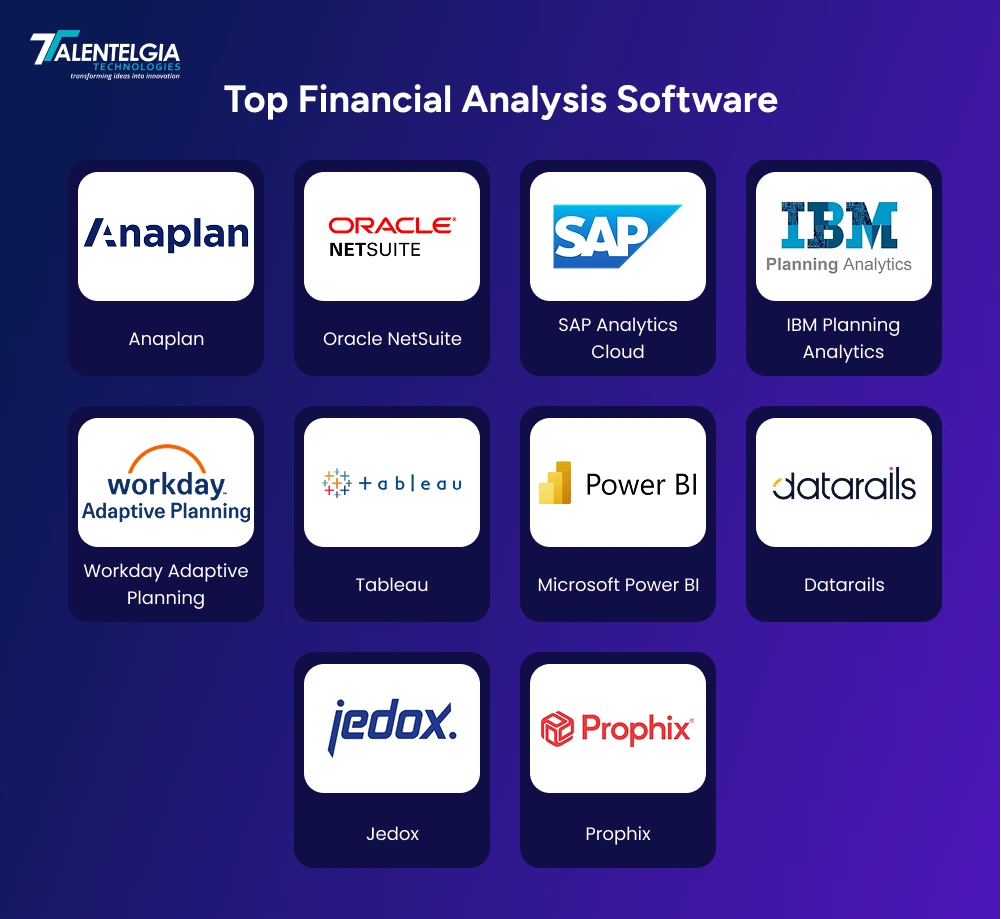
1. Anaplan — Best for Enterprise-Scale Scenario Complexity
Anaplan stands out in 2026 for its ability to handle extremely complex, interconnected financial scenarios across large organizations. Unlike traditional FP&A tools that work in isolated models, Anaplan’s connected planning architecture links finance with supply chain, sales, HR, and operations in real time.
What makes Anaplan unique is its Hyperblock™ in-memory engine, which allows thousands of variables to update instantly when assumptions change. This makes it ideal for organizations that frequently run high-impact “what-if” simulations—such as M&A planning, global pricing changes, or supply chain disruptions.
Best suited for: Large enterprises, global organizations, and businesses with complex multi-department planning requirements.
- Connected Planning Engine: Links financial, operational, and sales data in real time.
- Multi-Dimensional Scenario Modeling: Simulates thousands of variables instantly.
- Dynamic What-If Analysis: Evaluate the impact of strategic decisions on performance.
- Role-Based Dashboards: Custom views for finance, operations, and executive teams.
- Version Control & Collaboration: Track scenario versions and workflow input.
Core Strengths:
Anaplan excels in connected planning, allowing finance, operations, and sales teams to collaborate using a single source of truth.
Ideal Use Cases:
Best suited for large enterprises and organizations with complex financial structures and multi-department planning needs.
Integrations:
ERP systems, CRM platforms, cloud data warehouses.
Pricing Model:
Enterprise subscription-based pricing.
2. Oracle NetSuite
NetSuite’s key differentiator is that financial analysis is natively embedded inside an ERP, not layered on top of it. In 2026, this makes NetSuite especially valuable for businesses that want transaction-level accuracy in their financial insights.
Instead of relying on data exports or sync jobs, finance teams can analyze profitability, cash flow, and revenue trends directly from live operational data—orders, inventory, billing, and expenses. This tight coupling reduces reconciliation issues and improves audit readiness.
Best suited for: Startups, SMEs, and mid-sized businesses looking for an all-in-one financial management and analytics solution.
Key Features:
- Native ERP + Financial Analytics: Eliminates data replication or sync tools.
- Real-Time General Ledger Reporting: Live view of key financial metrics.
- Revenue Recognition Management: Compliant generation of revenue schedules.
- Built-In KPI Dashboards: Trend tracking across cash flow, AR/AP, and profitability.
- Audit Trails: Traceable transaction histories for compliance.
Core Strengths:
Native integration with ERP modules ensures accurate and real-time financial insights.
Ideal Use Cases:
SMEs and mid-sized businesses are looking for an all-in-one financial management solution.
Integrations:
CRM systems, eCommerce platforms, and third-party analytics tools.
Pricing Model:
Subscription-based, varies by modules and users.
3. SAP Analytics Cloud
for predictive and prescriptive financial analysis, using machine learning to explain why performance changed and what is likely to happen next.
Its Smart Predict and Smart Discovery features automatically detect patterns, drivers, and anomalies in financial data. For SAP-heavy enterprises, this eliminates the need for separate data science tools to generate forward-looking insights.
Best suited for: Large enterprises and SAP-centric organizations with advanced analytics and planning needs.
Key Features:
- Predictive Analytics Engine: Machine-learning-powered future performance forecasting.
- Smart Discovery & Insights: Automated driver analysis and anomaly detection.
- Integrated Planning & BI: One platform for planning, reporting, and predictive modeling.
- Collaborative Storyboards: Share visual narratives across teams.
- Live SAP ERP Connectors: Deep integration with SAP S/4HANA and ECC.
Core Strengths:
Deep integration with SAP ERP ecosystems and strong predictive capabilities.
Ideal Use Cases:
Enterprises already using SAP solutions for financial and operational data.
Integrations:
SAP S/4HANA, SAP ERP, third-party data sources.
Pricing Model:
Enterprise licensing with scalable options.
4. IBM Planning Analytics
IBM Planning Analytics (TM1) is uniquely suited for organizations where model accuracy, speed, and data volume matter more than UI simplicity. In 2026, it remains a top choice for financial institutions, manufacturing giants, and regulated industries.
Its multidimensional OLAP engine allows finance teams to build deeply granular models—down to SKU, customer, or contract level—without performance degradation. Unlike lighter FP&A tools, TM1 can process massive datasets with strict calculation logic.
Best suited for: Large enterprises and organizations with complex financial modeling and consolidation needs.
Key Features:
- OLAP Engine for Complex Models: Handles very large financial datasets with agility.
- Rule-Based Calculations: Custom calculation logic for highly accurate outputs.
Hierarchical Data Structures: Drill into financial data by business unit or dimension. - Automated Consolidations: Closed-period financial aggregations.
- Advanced Security Controls: Fine-grained access and permissions.
Core Strengths:
Exceptional performance for complex and large-scale financial models.
Ideal Use Cases:
Large enterprises with intensive budgeting, forecasting, and consolidation needs.
Integrations:
ERP systems, data warehouses, Excel.
Pricing Model:
Subscription-based enterprise pricing.
5. Workday Adaptive Planning
Adaptive Planning’s uniqueness lies in how it empowers finance teams to own and modify models themselves. In 2026, it is widely adopted by organizations that want agility without complex system administration.
Finance users can create new versions, adjust assumptions, and roll out changes without scripting or technical intervention. This makes Adaptive especially effective in fast-changing environments like SaaS, services, and high-growth companies.
Best suited for: Mid-sized to large organizations focused on agile financial planning and cross-functional collaboration.
Key Features:
- Driver-Based Planning: Link financial drivers to outcomes dynamically.
- Continuous Rolling Forecasts: Plan beyond static annual models.
- Self-Service Modeling: Finance users build models without IT support.
- Workforce Planning Integration: Align staffing with budget and revenue forecasts.
- Cross-Functional Scorecards: Performance metrics shared across departments.
Core Strengths:
Ease of use, combined with powerful planning features, makes it accessible for finance teams.
Ideal Use Cases:
Mid-sized to large organizations focusing on agile financial planning.
Integrations:
Workday ERP, HR systems, CRM platforms.
Pricing Model:
Subscription-based pricing.
6. Tableau
Tableau is not an FP&A system — and that’s exactly its strength. Its uniqueness lies in how effectively it communicates financial insights, especially to non-finance stakeholders.
In 2026, Tableau is heavily used to translate complex financial results into intuitive visual narratives for board meetings, investor presentations, and executive reviews. It excels at trend comparison, variance analysis, and interactive drill-downs.
Best suited for: Finance teams and analysts focused on reporting, visualization, and executive dashboards.
Key Features:
- Drag-and-Drop Visual Analytics: Rapid creation of interactive visuals.
- Multi-Source Data Blending: Combine finance data with operational or customer data.
- Executive Dashboards: High-impact visuals for strategic reviews.
- Ad Hoc Exploration: Analysts can probe data without SQL knowledge.
- Mobile Visual Access: Secure dashboards accessible on devices.
Core Strengths:
Best-in-class visualization for uncovering financial trends and insights.
Ideal Use Cases:
Finance teams focused on reporting, storytelling, and data-driven insights.
Integrations:
Databases, cloud platforms, Excel, ERP systems.
Pricing Model:
Role-based subscription pricing.
7. Microsoft Power BI
Power BI’s differentiation is accessibility. In 2026, it is one of the most widely deployed financial analytics tools because it scales horizontally across organizations, not just within finance teams.
Its deep integration with Excel, Teams, and Microsoft 365 allows financial insights to flow directly into daily workflows. Power BI is often used as the “financial visibility layer” across departments rather than a standalone finance tool.
Best suited for: Small to mid-sized businesses and organizations already using Microsoft tools.
Key Features:
- Natural Language Queries (Q&A): Ask questions in plain English and get insights.
- Embedded Analytics: Embed visuals into apps or portals.
- Automated Refresh Schedules: Scheduled updates from live data sources.
- AI Visuals with Cognitive Services: Sentiment, clustering, and forecasting visuals.
- Integration with Microsoft 365: Seamless with Excel, Teams, and SharePoint.
Core Strengths:
Strong integration with the Microsoft ecosystem and affordability.
Ideal Use Cases:
Small to mid-sized businesses and Microsoft-centric organizations.
Integrations:
Excel, Azure, ERP, and CRM systems.
Pricing Model:
Subscription-based with free and premium tiers.
8. Datarails
Datarails is unique because it does not try to replace Excel. Instead, it industrializes it. In 2026, this makes Datarails ideal for finance teams that rely on Excel logic but need enterprise-grade control.
It centralizes data behind the scenes while allowing users to keep existing formulas, layouts, and workflows. This dramatically reduces change resistance and training costs compared to full FP&A replacements.
Best suited for: SMEs and finance teams heavily reliant on Excel.
Key Features:
- Excel-Native Workflow: Users work in Excel while enterprise logic runs in the backend.
- Centralized Data Repository: Finance data consolidated from multiple sources.
- Automated Data Sync: Eliminate manual copy-paste work.
- Pre-Built Financial Templates: Fast templates for FP&A workflows.
- Version Control + Audit History: Track changes across versions and users.
Core Strengths:
Ideal for finance teams that rely heavily on Excel but need enterprise-level control.
Ideal Use Cases:
SMEs and finance teams transitioning from spreadsheets to structured FP&A.
Integrations:
ERP systems, accounting software, and Excel.
Pricing Model:
Subscription-based pricing.
9. Jedox
Jedox differentiates itself through model flexibility. In 2026, it is frequently chosen when standard FP&A templates don’t fit the business.
Organizations can design custom planning logic, financial hierarchies, and performance frameworks without being locked into predefined structures. This makes Jedox particularly attractive for hybrid business models or complex group structures.
Best suited for: Mid-sized to large organizations seeking flexible and customizable financial planning solutions.
Key Features:
- Configurable Planning Models: Build custom structures without coding.
- Integrated Scorecards & KPIs: Align metrics across finance and business units.
- Scenario Comparison Views: Side-by-side analysis of different forecasts.
- In-Memory Processing: Fast response for complex calculations.
- Excel, Web, Mobile Access: Multiple interfaces for different users.
Core Strengths:
Flexible modeling capabilities and strong performance management features.
Ideal Use Cases:
Organizations seeking customizable financial planning solutions.
Integrations:
ERP systems, BI tools, Excel.
Pricing Model:
Modular subscription pricing.
10. Prophix
Prophix’s uniqueness lies in process standardization. In 2026, it is commonly used by finance teams that want consistency, control, and auditability across planning and reporting cycles.
Rather than offering unlimited flexibility, Prophix enforces structured workflows, approvals, and timelines. This reduces errors and ensures compliance, especially in regulated or multi-entity environments.
Best suited for: Mid-sized businesses seeking a balance between advanced functionality and ease of use.
Key Features:
- Standardized Workflow Automation: Formalize budget and forecast cycles.
- Financial Consolidation Engine: Multi-company and currency support.
- Built-In Audit and Compliance Tools: Track revisions and approvals.
- AI-Assisted Planning: Suggest scenarios based on historical patterns.
- Role-Based Financial Dashboards: Custom views for finance users.
Core Strengths:
User-friendly interface with strong automation capabilities.
Ideal Use Cases:
Mid-sized organizations seeking structured and scalable FP&A tools.
Integrations:
ERP systems, accounting platforms, and Excel.
Pricing Model:
Subscription-based pricing.
Financial Analysis Software Comparison Table (2026)
| Software | Best For | Key Strength | Business Size | Deployment |
| Anaplan | Connected planning & forecasting | Enterprise-grade scenario modeling | Large enterprises | Cloud |
| Oracle NetSuite | All-in-one ERP + financial analysis | Real-time financial visibility | SMBs & Mid-size | Cloud |
| SAP Analytics Cloud | Predictive financial analytics | AI-driven insights & SAP integration | Large enterprises | Cloud |
| IBM Planning Analytics | Complex financial modeling | High-performance calculations | Enterprises | Cloud / On-Prem |
| Workday Adaptive Planning | Agile FP&A | Ease of use & continuous planning | Mid–Large | Cloud |
| Tableau | Financial reporting & dashboards | Advanced data visualization | All sizes | Cloud / Desktop |
| Microsoft Power BI | Budget-friendly BI & analytics | Microsoft ecosystem integration | SMBs & Mid-size | Cloud |
| Datarails | Excel-based FP&A automation | Spreadsheet-native workflows | SMBs | Cloud |
| Jedox | Performance management | Flexible modeling & EPM | Mid–Large | Cloud / On-Prem |
| Prophix | Structured FP&A | Automation & usability | Mid-size | Cloud |
What Is Financial Analysis Software?
Financial analysis software helps businesses analyze financial data, forecast performance, manage budgets, and support strategic decision-making using automation, AI-driven insights, and real-time reporting.
How to Choose the Right Financial Analysis Software in 2026
When selecting financial analysis software, businesses should evaluate:
- Scalability and data handling capacity
- AI-powered forecasting and analytics
- Integration with ERP, CRM, and cloud systems
- Ease of use and reporting flexibility
- Cost structure and deployment model
Conclusion: Choosing the Right Financial Analysis Software in 2026
As financial data grows more complex and decision cycles become shorter, choosing the right financial analysis software in 2026 is critical for maintaining accuracy, agility, and competitive advantage. While off-the-shelf platforms like enterprise FP&A and BI tools offer powerful capabilities, they may not always align perfectly with unique business workflows, data structures, or scalability requirements.
That’s where custom financial analytics solutions deliver the greatest value—by aligning technology directly with business strategy.









 Sales Enquiries:
  Business queries:
  HR:
HR: 


