


 Healthcare Software Development Services
 Healthcare App Development Services
 Real Estate Web Development Services
 Real Estate App Development Company
 E-Commerce App Development Services
 E-Commerce Web Development Services
 Blockchain E-commerce Development Company
 Fintech Software Development
 Fintech App Development Services
 E-Learning App Development Services
 Restaurant App Development Company
 Mobile Game Development Company
 Travel App Development Company
 Automotive Web Design
 AI Traffic Management System
 AI Inventory Management Software
 Logistics App Development Services
 Machine Learning Development
 ChatGPT integration services
  AI Development Company
  AI Integration Services
  Natural Language Processing Company
 Mobile App Development
  IOS App Development
  Android App Development
  Cross-Platform App Development
  Augmented Reality (AR) App Development
  Virtual Reality (VR) App Development
  Web App Development
  SaaS App Development
 Custom Software Development Services
  Flutter
  React Native
  Swift (IOS)
  Kotlin (Android)
  Mean Stack Development
  AngularJS Development
  MongoDB Development
  Nodejs Development
  Database Development
 Ruby on Rails Development
 Expressjs Development
  Full Stack Development
  Web Development Services
  Laravel Development
  LAMP Development
  Custom PHP Development
  .Net Development
  User Experience Design Services
  User Interface Design Services
  Automated Testing
  Manual Testing
  Digital Marketing Services
 Ride-Sharing And Taxi Services
 Food Delivery Services
 Grocery Delivery Services
 Transportation And Logistics
 Car Wash App
 Home Services App
 ERP Development Services
 CMS Development Services
 LMS Development
 CRM Development
 DevOps Development Services
 AI Business Solutions
 AI Cloud Solutions
 AI Chatbot Development
 API Development
 Blockchain Product Development
 Cryptocurrency Wallet Development
 About Talentelgia
  Our Team
  Our Culture
 Healthcare App Development Services
 Real Estate Web Development Services
 E-Commerce App Development Services
 E-Commerce Web Development Services
 Blockchain E-commerce
Development Company
Blockchain E-commerce
Development Company Fintech App Development Services
 Blockchain Fintech
Development Company
Blockchain Fintech
Development Company E-Learning App Development Services
 Restaurant App Development Company
 Mobile Game Development Company
 Travel App Development Company
 AI Traffic Management System
 AI Inventory Management Software
 AI Development Company
 ChatGPT integration services
 AI Integration Services
 Machine Learning Development
 Machine learning consulting services
 Blockchain Development
 Blockchain Software Development
 Smart contract development company
 NFT marketplace development services
 Asset tokenization companies
 DeFi Wallet Development Company
 IOS App Development
 Android App Development
 Cross-Platform App Development
 Augmented Reality (AR) App
Development
Augmented Reality (AR) App
Development Virtual Reality (VR) App Development
 Web App Development
 Flutter
 React
Native
React
Native Swift
(IOS)
Swift
(IOS) Kotlin (Android)
 MEAN Stack Development
 AngularJS Development
 MongoDB Development
 Nodejs Development
 Database development services
 Expressjs Development
 Full Stack Development
 Web Development Services
 Laravel Development
 LAMP
Development
LAMP
Development Custom PHP Development
 User Experience Design Services
 User Interface Design Services
 Automated Testing
 Manual
Testing
Manual
Testing About Talentelgia
 Our Team
 Our Culture
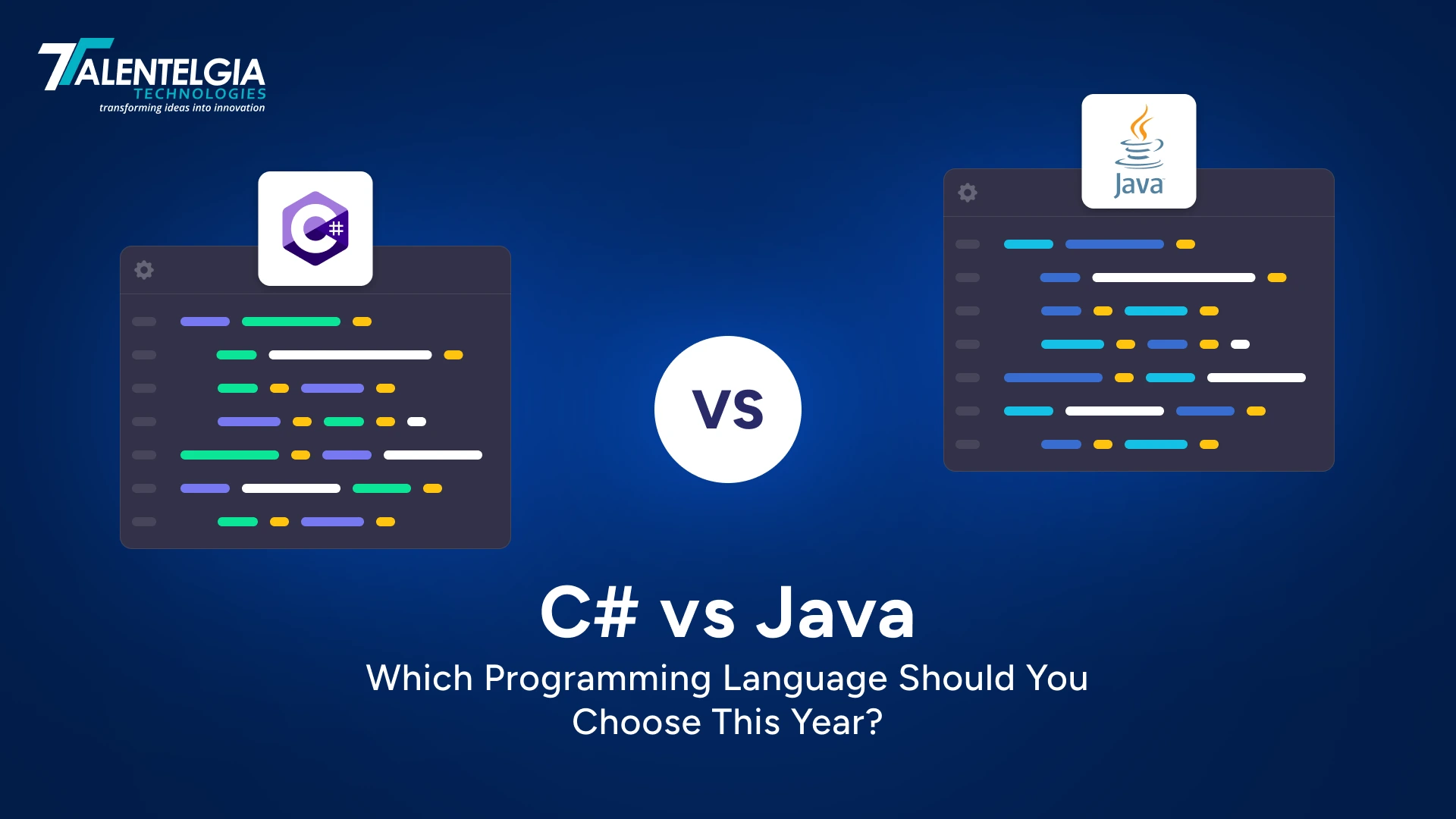
Selecting the best programming language is a tough decision that depends on your project size, scope of work, and budget – and it becomes even more difficult to choose between two nice competing languages like C# and Java. The C# vs Java debate is nothing new, as both languages have been driving forces behind enterprise-level software development for years, powering applications, web platforms, mobile solutions, and cloud systems. Both languages have really good performance, reliability, and scalability, so a comparison is required for developers and companies as well.
When comparing C sharp vs Java, ecosystem support, ease of development, platform portability, and future maintenance matter a lot. Another – but by no means less important – factor a developer would consider is C sharp vs Java performance, the application speed, as well as how intensive it is on memory management and runtime efficiency, can significantly affect the user experience and scalability of any system.
This blog gives a perfect description of C # vs Java with their basics, advantages, disadvantages, and performance comparison. You should come away from this guide with a clearer notion of which language best serves your project needs and coding desires.
What is C # (C sharp)?
C# (read C sharp) is a new programming language developed by Microsoft. It is one of the base languages for the .NET Framework, and it’s primarily used for creating desktop applications, cloud-based solutions, and mobile applications as well. C# is known for its clean syntax, strong typing, and easy-to-use documentation – enabling developers to produce cleaner and more maintainable code.
C# was created to provide the power of C++ in an easier language (and thus less costly) to maintain and learn. It enforces basic programming paradigms such as object-orientation, asynchronous code, and automatic memory management by tracing garbage collection. These, as well as other qualities, would make C# an attractive option for performance-heavy, large applications.
The C # vs. Java topic never ends. C# is characterized by its seamless integration with MS tools, such as Visual Studio, and the fact that it works well with the Windows environment. In time, the addition of. NET Core and .NET 5+, C# has become a cross-platform language, and developers can create applications that work well on Windows, Linux, or macOS.
Pros of C#
C# is an awesome and developer-friendly language for making modern applications. Its rich tooling support, performance, and flexibility have made it a favorite of everyone from startups to big enterprises.
- Easy to Learn and Use
It has an easy and readable syntax, friendly for beginners, but still powerful enough to work with anything basic.
- Strong Integration with .NET
Seamless integration with the .NET Framework has been accessible with rich libraries and rapid development.
- High Performance
C# is a high-performance language that is suitable for scalable servers and has the requisite development environment to support complex operations.
- Cross-Platform Support
Modern. NET allows C# apps to run anywhere—on Windows, Linux, and macOS.
- Excellent Development Tools
Visual Studio and VS Code provide world-class debugging, testing, and productivity experiences.
- Built-In Security
Facilities such as type safety and automatic memory management also contribute to the reduction of certain types of vulnerabilities and losses, resulting in the extension of application stability.
- Versatile Use Cases
C# is commonly used for web development, cloud-based development (including Azure), and game/VR apps, among other things.
Cons of C#
While C# offers many advantages, it also has certain limitations that developers should consider. Understanding these drawbacks helps in deciding whether C# is the right choice for a specific project.
- Dependency on the .NET Ecosystem
C# applications rely heavily on the .NET framework, which may limit flexibility for projects that need to operate outside this ecosystem. - Higher Memory Usage
Due to garbage collection and runtime overhead, C# applications can consume more memory compared to lower-level languages. - Learning Curve for Advanced Features
Although basic syntax is easy to grasp, mastering advanced concepts like asynchronous programming and memory optimization can be challenging. - Performance Overhead
In some scenarios, managed code and runtime abstraction may introduce slight performance overhead compared to native languages. - Limited Low-Level Control
C# provides less control over hardware and system resources, making it less suitable for low-level or system programming tasks. - Platform-Specific Optimization Challenges
Despite cross-platform support, fine-tuning applications for different operating systems may require additional effort.
What is JAVA?
Java is an OOP programming language developed learnjavaSun Microsystems and also by Oracle. It is also platform-independent, that is, Java programs can be executed on any machine that has the Java Virtual Machine (JVM). It’s this “write once, run anywhere” magic that has popularized Java as one of the best languages for writing enterprise, web, and smartphone applications.
Robustness, security, and scalability are big pluses for Java. It provides automatic memory management with garbage collection and has a more or less traditional object-oriented structure, making it primarily implementable objects such as interfaces, classes, methods, etc., which facilitates the building of reliable applications. Its main use is in backend software, massive enterprise-level systems, Android apps, and cloud platforms.
When it comes to talking about C sharp vs Java, Java is notable for its mature ecosystem, big community support, and trustworthiness in the long run. Java is a good fit for applications that must be portable and compatible on various platforms because of its predictable performance across diverse environments.
Read More: What Is OOP Language and OOP Programming?
Pros of Java
Java is an established, popular programming language used for a wide range of content from enterprise software applications to mobile apps. Being stable, transportable, and supported by a strong community, it is often chosen for the long run by many organizations.
- Platform Independence
3A7F0″ Write Once, Run Anywhere ” Java is commonly used in developing applications for any platform and others. - Strong Performance
Since Sun finally got its head from its asses and put in some ice for the JVM, Java now performs well on the most diverse platforms. - Robust Security
Java includes features to ensure the security of applications when it is used in networked environments, with a focus on preventing restrictions from being easily bypassed. - Highly Scalable
Java is ideal for large-scale and enterprise-level applications that require high performance. - Vast Ecosystem and Community
Development and troubleshooting are made easy with a full array of frameworks, libraries, and global community support. - Strong Multithreading Support
Java has built-in support for multithreaded programming, which increases the responsiveness of applications and reduces processing time.
Cons of Java
There are still some disadvantages of Java, and you should weigh them before developing any application in the Java language.
- Verbose Syntax
Code with Java can easily be long and wordy, leading to longer development times than one would get from more succinct languages. - Higher Memory Consumption
Java apps may simply consume more memory because of extra JVM overhead and garbage collection tasks. - Slower Startup Time
It seems that JVM loading could mean a slower initialization startup (for small and lightweight applications specifically). - UI Development Limitations
It’s not generally “trendy” for classic desktop UI development against other, newer frameworks and languages (also, who develops a new Java/Swing app in 2020). - Performance Overhead
Java can be said to be as fast or even faster, but it is already highly optimized, and performance-critical code written using native languages might be. orient language execution model. - Not Ideal for Low-Level Programming
Java has no direct access to hardware or system resources; thus, it can’t be the language of choice for low-level programming solutions.
Read More: Best Java Frameworks
C# vs JAVA
When comparing C# vs Java, it’s clear that both are popular, fast, and powerful languages that continue to age well, maintaining their dominance in modern software development.A lot of things they have in common, like OOP concept, automatic storage management, and a strong ecosystem. But which way you should go when depends on things like your development environment, project needs, and long-term viability.
Performance is one of the hottest topics when comparing C sharp vs Java. Both have just-in-time compilation & efficient runtimes, but C sharp vs Java performance can differ depending on the type of application and operating system. Other C# can be very efficient on the. NET and is used within the Windows ecosystem for on-premises and cloud solutions, while Java can boast of similar performance across multiple operating systems through the JVM. Knowing these distinctions can aid in choosing the best programming language for you before delving into a side-by-side comparison.

Conclusion
Comparison between C # vs Java tells that both are robust, can be trusted, and are ideal for developing modern applications. And there are pros and cons to both languages, with the choice also being driven by project goals, platform requirements, and team knowledge. Regardless of whether it's enterprise software, cloud-based apps, or complex systems, C# and Java are significant players in the modern development world.
Performance and ecosystem are big factors when comparing C sharp vs Java. When it comes to C# vs Java performance, C# as an engine wins out in the .NET and Microsoft, and Java: Java performance is consistent and quite stable across platforms due to the JVM, as described in several previous pages. In the end, it's all about knowing your needs and adopting the language that fits better with your long-term plan.












 Sales Enquiries:
  Business queries:
  HR:
HR: 


