



 Healthcare Software Development Services
 Healthcare App Development Services
 Real Estate Web Development Services
 Real Estate App Development Company
 E-Commerce App Development Services
 E-Commerce Web Development Services
 Blockchain E-commerce Development Company
 Fintech Software Development
 Fintech App Development Services
 E-Learning App Development Services
 Restaurant App Development Company
 Mobile Game Development Company
 Travel App Development Company
 Automotive Web Design
 AI Traffic Management System
 AI Inventory Management Software
 Logistics App Development Services
 Machine Learning Development
 ChatGPT integration services
  AI Development Company
  AI Integration Services
  Natural Language Processing Company
 Mobile App Development
  IOS App Development
  Android App Development
  Cross-Platform App Development
  Augmented Reality (AR) App Development
  Virtual Reality (VR) App Development
  Web App Development
  SaaS App Development
 Custom Software Development Services
  Flutter
  React Native
  Swift (IOS)
  Kotlin (Android)
  Mean Stack Development
  AngularJS Development
  MongoDB Development
  Nodejs Development
  Database Development
 Ruby on Rails Development
 Expressjs Development
  Full Stack Development
  Web Development Services
  Laravel Development
  LAMP Development
  Custom PHP Development
  .Net Development
  User Experience Design Services
  User Interface Design Services
  Automated Testing
  Manual Testing
  Digital Marketing Services
 Ride-Sharing And Taxi Services
 Food Delivery Services
 Grocery Delivery Services
 Transportation And Logistics
 Car Wash App
 Home Services App
 ERP Development Services
 CMS Development Services
 LMS Development
 CRM Development
 DevOps Development Services
 AI Business Solutions
 AI Cloud Solutions
 AI Chatbot Development
 API Development
 Blockchain Product Development
 Cryptocurrency Wallet Development
 About Talentelgia
  Our Team
  Our Culture
 Healthcare App Development Services
 Real Estate Web Development Services
 E-Commerce App Development Services
 E-Commerce Web Development Services
 Blockchain E-commerce
Development Company
Blockchain E-commerce
Development Company Fintech App Development Services
 Blockchain Fintech
Development Company
Blockchain Fintech
Development Company E-Learning App Development Services
 Restaurant App Development Company
 Mobile Game Development Company
 Travel App Development Company
 AI Traffic Management System
 AI Inventory Management Software
 AI Development Company
 ChatGPT integration services
 AI Integration Services
 Machine Learning Development
 Machine learning consulting services
 Blockchain Development
 Blockchain Software Development
 Smart contract development company
 NFT marketplace development services
 Asset tokenization companies
 DeFi Wallet Development Company
 IOS App Development
 Android App Development
 Cross-Platform App Development
 Augmented Reality (AR) App
Development
Augmented Reality (AR) App
Development Virtual Reality (VR) App Development
 Web App Development
 Flutter
 React
Native
React
Native Swift
(IOS)
Swift
(IOS) Kotlin (Android)
 MEAN Stack Development
 AngularJS Development
 MongoDB Development
 Nodejs Development
 Database development services
 Expressjs Development
 Full Stack Development
 Web Development Services
 Laravel Development
 LAMP
Development
LAMP
Development Custom PHP Development
 User Experience Design Services
 User Interface Design Services
 Automated Testing
 Manual
Testing
Manual
Testing About Talentelgia
 Our Team
 Our Culture
It is not surprising that embedded systems jobs are booming, particularly for software developers and programmers who are experienced in C++. Because C++ has low-level functionality and produces efficient code, it has been the go-to programming language for embedded systems development for a long time. However, despite the long-standing C++ domination, C and C++ have a new competitor that has been growing in popularity since the last decade: Rust.
According to Stack Overflow developer survey, Rust has been voted the most popular programming language and is increasingly used in place of C++ for its better efficiency and safer programming language in modern software development. In fact, more than 80% of developers who use it also want to use it next year. Although Rust and C++ have much in common, both these programming languages have enough unique characteristics and differences that will make them more or less suited for a specific use case. Thus, developers will need to consider the various advantages and disadvantages of two programming languages to choose the most suitable option for a specific project.
This article aims to help you make that decision by comparing Rust vs. C++ in terms of performance, use, and overall efficiency.
Understanding The Difference Between Rust and C++: Competition or Evolution?
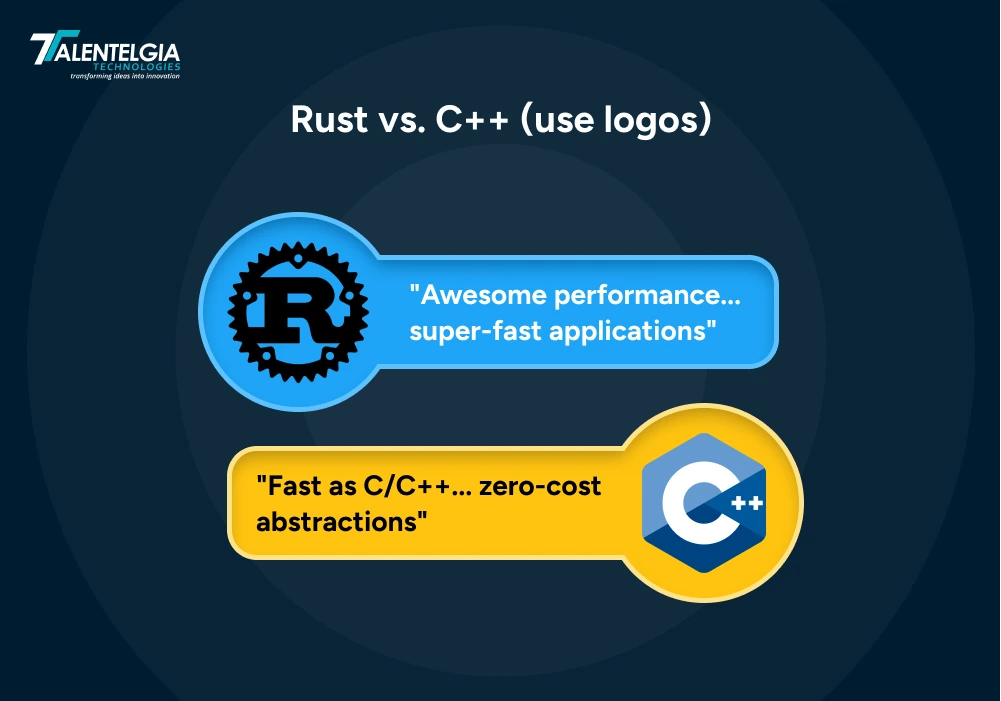
C++ is one of the oldest programming languages, tracing its lineage back over 36 years, and has been a staple in the programming world for a long time, so long that the general population, even those not in the technical field, may have at one time readily engaged with a C++ program.
Rust, on the other hand, still being young, only released in the 2010s, has a long way ahead of it. But the big question is whether Rust can rival C++’s versatility, speed, and attributes that have dominated the programming scene for decades? Let’s find out!
Read more: What are The Most Popular Programming Languages ?
What Is The Rust Programming Language?
Rust, launched by Mozilla in 2010 and reaching 1.0 stable in 2015, is a systems programming language that delivers C/C++-level performance with ironclad memory and thread safety—no garbage collector needed. Its ownership model tracks every piece of data precisely: “who owns it, who can borrow it, how long can they hold it?” The compiler rejects unsafe code before it runs, eliminating 70% of security vulnerabilities like buffer overflows, null pointer dereferences, and data races at compile time. Rust’s motto: “Blazingly fast, memory safe, fearless concurrency.”
Key Features of Rust:
- Ownership & Lifetimes: Every value has a single owner; borrowing rules prevent use-after-free and double-free bugs automatically.
- Fearless Concurrency: Send/Sync traits guarantee thread safety—data races are compile errors, not runtime crashes.
- Zero-Cost Abstractions: Traits (like supercharged interfaces), pattern matching (destructuring everything), enums with data—runs as fast as hand-written assembly.
- Cargo Ecosystem: One-command builds, 100K+ crates on crates.io with enforced semantic versioning—no “dependency hell.”
- Cross-Platform Powerhouse: Native WebAssembly target (#1 Wasm language), Linux kernel drivers accepted since 2022, Android NDK support.
- Tooling Excellence: Clippy (AI linter), rust-analyzer (VSCode IntelliSense), rustfmt (auto-formatting).
Pros of Rust:
- Unmatched Safety: Microsoft reports 0% memory bugs in Rust code vs. 70% in C++. AWS Firecracker microVM runs billions of Lambda invocations.
- Performance Match: Benchmarks show Rust within 1-5% of C++; sometimes faster due to fearless optimization.
- Developer Favorite: Stack Overflow’s “most loved” language 8 years straight (88% want to keep using it).
- Growing Fast: Discord (2.5M concurrent users), Dropbox, and Solana blockchain all rewrote C++ in Rust.
Cons of Rust::
- Steep Learning Curve: “Fighting the borrow checker” phase lasts 1-3 months—frustrating for C++ veterans.
- Longer Compile Times: 2-5x slower than C++ due to exhaustive safety checks.
- Smaller Ecosystem: 100K crates vs. C++’s millions of libraries; some domains (GUI, games) still maturing.
- No Exceptions: Result/Option enums force explicit error handling (pro for reliability, con for verbosity).
Best Use Cases: New systems projects, WebAssembly, cloud infrastructure, blockchain. Real wins: Linux kernel (Rust drivers 2022+), AWS (Firecracker), Discord backend.
What Is The C++ Programming Language?
C++, created by Bjarne Stroustrup in 1979 as “C with Classes,” has evolved over 45+ years into the world’s most versatile, performant multi-paradigm language. Powers 70% of desktop software, every major game engine (Unreal, Unity), OS kernels (Windows, Linux), and browsers (Chrome). “Zero-overhead principle”: You control exactly what the compiler generates—no hidden runtime costs. C++23/26 keep it cutting-edge.
Key Features of C++:
- Multi-Paradigm Mastery: Procedural (C-style), OOP (classes/inheritance), generic (templates), functional (lambdas, std::function).
- Ultimate Performance Control: Inline assembly, SIMD intrinsics, manual memory via RAII/smart pointers, link-time optimization.
- Standard Template Library (STL): Vectors, maps, algorithms, smart_ptr—battle-tested for 25+ years.
- Modern Evolution: C++20 modules (no more header hell), concepts (template constraints), coroutines, executors (async).
- Massive Ecosystem: Boost (1K+ libs), Qt (GUI), Unreal (games), vcpkg/conan (packaging)—mature tools for everything.
- Hardware Access: Direct GPU compute (CUDA), embedded (Arduino), real-time systems.
Pros of C++:
- Fastest Execution: 1-5% edge over Rust in microbenchmarks; unbeatable for latency-critical code.
- Unmatched Maturity: 40M+ devs worldwide, every supercomputer TOP500 runs C++, $200B gaming industry.
- Total Control: Write OS kernels, browsers, rockets—NASA, Google Chrome, Unreal Engine 5 all C++.
- Ecosystem King: Libraries for everything, huge talent pool, stable ABI across compilers.
Cons of C++:
- Memory Safety Nightmares: 70% Microsoft bugs = memory corruption (Heartbleed, EternalBlue). Manual new/delete hell.
- Undefined Behavior Roulette: Signed overflow, iterator invalidation—bugs lurk for years.
- Complex Syntax: Templates = “write-only code,” 17+ standards since 1998.
- Build Hell: CMake configurations span 100+ files; reproducible builds = dark art.
- Concurrency Risks: std::thread + mutex = data race city without heroic effort.
Best Use Cases: Game engines, OS/development tools, high-frequency trading, embedded/real-time systems, Chrome (3 billion users), Unreal (AAA games), Windows kernel.
So, Which One To Choose, Rust or C++?
This comparison is tricky, and it is unfair to point at one language and say it is better than others. Luckily, it does not have to be one: Rust and C++ share similarities and can be integrated. Both languages have proven to be valuable tools in software development, and for individuals seeking to enhance their skills, recruiting C++ developers can be highly beneficial due to their expertise in performance optimization and customizability.
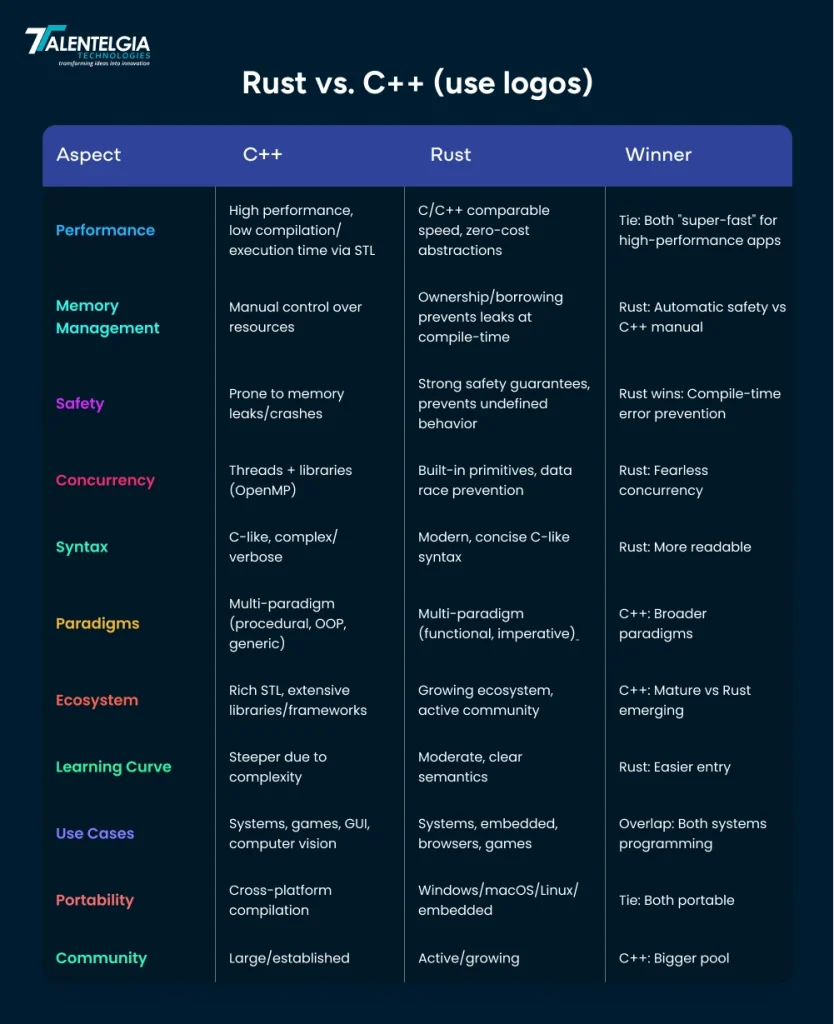
If you need speed for the project, then you are safe with either choice, and it then becomes a question of safety with Rust or customizability with C++. Other than that, you will get all the core features with either of the two options.
Final Words
Rust and C++ are less competitors and more colleagues. C++ is the seasoned warrior: tried and tested; a giant in the industry; a fundamental part of software, games, and supercomputing. Rust is the scrappy newcomer: safe by default, more modern, and designed specifically to mitigate the programs that C++ leaves to the developer's control.
There is no final winner in this debate. Both languages are top-tier in their own right. C++ offers unrivaled control and freedom to developers in all areas of programming. Rust, in exchange for a bit of control, offers more reliability by resolving many issues at compile time, making the project safer in the long run.














 Sales Enquiries:
  Business queries:
  HR:
HR: 


