


 Healthcare Software Development Services
 Healthcare App Development Services
 Real Estate Web Development Services
 Real Estate App Development Company
 E-Commerce App Development Services
 E-Commerce Web Development Services
 Blockchain E-commerce Development Company
 Fintech Software Development
 Fintech App Development Services
 E-Learning App Development Services
 Restaurant App Development Company
 Mobile Game Development Company
 Travel App Development Company
 Automotive Web Design
 AI Traffic Management System
 AI Inventory Management Software
 Logistics App Development Services
 Machine Learning Development
 ChatGPT integration services
  AI Development Company
  AI Integration Services
  Natural Language Processing Company
 Mobile App Development
  IOS App Development
  Android App Development
  Cross-Platform App Development
  Augmented Reality (AR) App Development
  Virtual Reality (VR) App Development
  Web App Development
  SaaS App Development
 Custom Software Development Services
  Flutter
  React Native
  Swift (IOS)
  Kotlin (Android)
  Mean Stack Development
  AngularJS Development
  MongoDB Development
  Nodejs Development
  Database Development
 Ruby on Rails Development
 Expressjs Development
  Full Stack Development
  Web Development Services
  Laravel Development
  LAMP Development
  Custom PHP Development
  .Net Development
  User Experience Design Services
  User Interface Design Services
  Automated Testing
  Manual Testing
  Digital Marketing Services
 Ride-Sharing And Taxi Services
 Food Delivery Services
 Grocery Delivery Services
 Transportation And Logistics
 Car Wash App
 Home Services App
 ERP Development Services
 CMS Development Services
 LMS Development
 CRM Development
 DevOps Development Services
 AI Business Solutions
 AI Cloud Solutions
 AI Chatbot Development
 API Development
 Blockchain Product Development
 Cryptocurrency Wallet Development
 About Talentelgia
  Our Team
  Our Culture
 Healthcare App Development Services
 Real Estate Web Development Services
 E-Commerce App Development Services
 E-Commerce Web Development Services
 Blockchain E-commerce
Development Company
Blockchain E-commerce
Development Company Fintech App Development Services
 Blockchain Fintech
Development Company
Blockchain Fintech
Development Company E-Learning App Development Services
 Restaurant App Development Company
 Mobile Game Development Company
 Travel App Development Company
 AI Traffic Management System
 AI Inventory Management Software
 AI Development Company
 ChatGPT integration services
 AI Integration Services
 Machine Learning Development
 Machine learning consulting services
 Blockchain Development
 Blockchain Software Development
 Smart contract development company
 NFT marketplace development services
 Asset tokenization companies
 DeFi Wallet Development Company
 IOS App Development
 Android App Development
 Cross-Platform App Development
 Augmented Reality (AR) App
Development
Augmented Reality (AR) App
Development Virtual Reality (VR) App Development
 Web App Development
 Flutter
 React
Native
React
Native Swift
(IOS)
Swift
(IOS) Kotlin (Android)
 MEAN Stack Development
 AngularJS Development
 MongoDB Development
 Nodejs Development
 Database development services
 Expressjs Development
 Full Stack Development
 Web Development Services
 Laravel Development
 LAMP
Development
LAMP
Development Custom PHP Development
 User Experience Design Services
 User Interface Design Services
 Automated Testing
 Manual
Testing
Manual
Testing About Talentelgia
 Our Team
 Our Culture
Go is becoming very popular as a programming language. If you want to improve your software or learn something new, Go is a great choice because it is fast, easy to understand, and can handle heavy workloads.
Go was created by three Google engineers—Robert Griesemer, Rob Pike, and Ken Thompson—to solve problems that come with building large and complex systems. Today, many big platforms like YouTube, Docker, Kubernetes, Cloudflare, Uber, and Twitch use Go to run their services.
This blog will give you an introduction to the meaning of Go, the development of its strengths and weaknesses, and common examples of its use, so you can understand the family of languages that comprise Golang and why it is becoming one of the preferred programming languages for developers around the globe.
What is Golang?
The language’s official name is “Go,” although it is commonly referred to by its domain name (golang.org).
Golang is an open-source programming language created by Google. It is a compiled language and statically typed. Because it was designed to handle large applications, it has easy access to concurrent operation capabilities, as well as many features that make programming simple (e.g., a clean code syntax) and fast compilation.
Why Was Golang Created?
The purposes of Go’s design include fitting everything in a single binary file. It aimed to provide:
- Faster compilation
- Cleaner syntax
- Easy concurrency
- Fewer memory management headaches
- Strong performance like C/C++ but with more simplicity
Why Is Golang So Popular? Key Benefits and Advantages
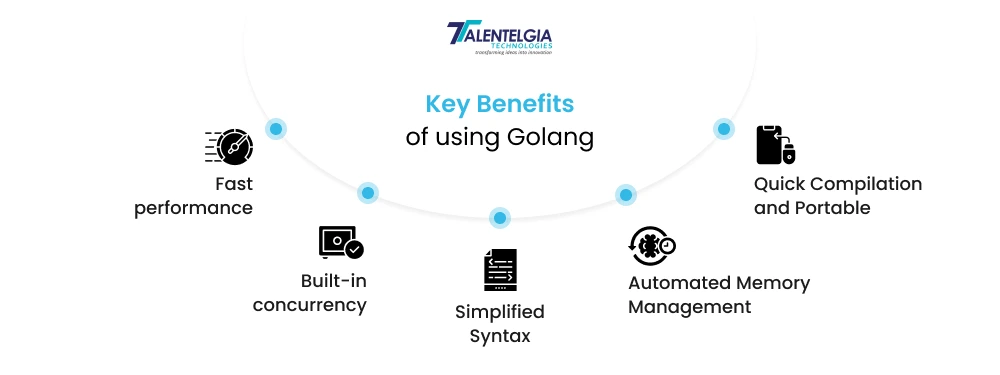
All of these combined make it an ideal programming language for the current distributed/cloud computing world.
Before going further into what this programming language can be used to create, we need to first take a look at the reasons that people think it is a great programming language to get into, and the primary reason that makes it attractive.
Following is a list of the 5 biggest benefits of GoLang and the reasons why many developers use it:
1. Fast performance comparable to C/C++
Go is a compiled language, which means your code runs fast. It’s good for stuff that needs to be quick, like servers, networking tools, and cloud software.
2. Built-in concurrency
One of the cool parts about Go is how it deals with concurrency. It lets different parts of your app run at the same time without causing problems. Goroutines and channels make it simple to run a lot of things at once. Docker and Kubernetes use Go because they have to handle many tasks without issues.
3. Simplified and streamlined syntax
Go has a simple syntax. This helps developers write code faster and make fewer mistakes. New coders can pick up Go and start being productive way quicker than with more complex languages like Java, C++, and Rust.
4. Automated Memory Management
The use of automated garbage collection in Golang reduces your chances of memory leak issues as well as simplifies life as a Golang developer.
5. Quick Compilation Cross-Platform and Portable
The speed at which Golang compiles is incredible, and because of its ability to compile for all operating systems from a single compiler, Golang can compile very quickly. Some examples of large users of Golang are Docker and Kubernetes due to their need for concurrent and efficient processes.
What is Golang Used For? Common Uses and Applications
Now that we understand its strengths, let’s explore the most common applications of the Go programming language.
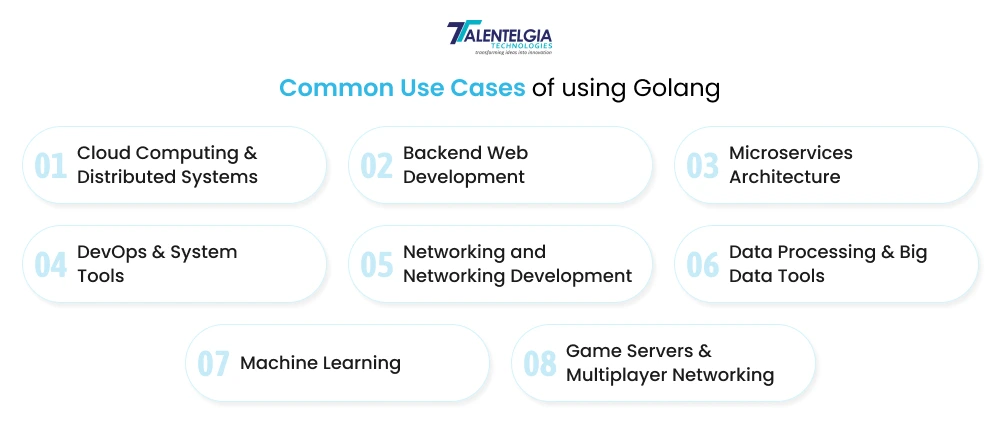
1. Cloud Computing & Distributed Systems
Cloud Infrastructure is an area where Go has many benefits. Docker, Kubernetes, Terraform are major tools for use within a cloud environment, and they all use Go as their language of development.
Concurrency is managed in Go significantly better than any other programming language. Microservices heavily rely on the use of parallel processes and scalability.
Examples of Cloud Use Cases:
- Container orchestration (Kubernetes)
- Cloud service automation (Terraform)
- Server orchestration tools
- CI/CD pipelines
- Cloud-native microservices
If you’re building cloud platforms or distributed systems, Golang is often the top recommended choice.
2. Backend Web Development
The Go programming language is very common for building web servers and back-end APIs. Its speed, ease of use, and concurrency make it easy for developers to create a back end for their applications that can easily handle the load and grow with time.
How To Use Go For Creating Backend Services?
- Faster response times
- Less time waiting for requests
- Easy to create, easy to use APIs
- Higher request volume processed
Some of the best-known Go web frameworks are:
- Gin
- Echo
- Fiber
- Beego
There are many companies, including Uber, Netflix, and Dropbox, that use Go for building backend services.
3. Microservices Architecture
Microservices architecture involves creating smaller, independent services to run applications. Due to the characteristics of the Go Language, such as:
- The small binary size of compiled binaries
- Simple parallelism, meaning processes can execute concurrently without synchronous locks
- Rapid execution time of compiled binaries.
- Rapid and easy deployment process (no custom server settings)
Many companies developing microservices have migrated to Go from NodeJS, Java, or Python as they scale.
4. DevOps & System Tools
Go’s increasing popularity as a language for the development of DevOps tools is due to several factors, including:
- Golang interacts very well with the system resources.
- Golang allows you to compile to a single compiled binary.
- Golang is portable.
Examples are:
- Docker – A container engine.
- Kubernetes – An orchestration platform.
- Prometheus – A monitoring tool.
- Terraform – An infrastructure as code tool.
If you’re involved in DevOps, likely, you’ve already worked with multiple tools that were built using Go without even knowing there is a Go version of them!
5. Networking and Networking Development
The Go programming language is a preferred platform for creating fast and efficient networking software because it has a concurrency model that allows many different connections to take place at the same time.
Uses include:
- Domain name servers
- Firewalls
- Proxies
- Load balancers
- Virtual private network servers
- Chat servers
6. Command-Line Interfaces (CLI Tools)
The Go programming language also lends itself to creating many types of command-line interface (CLI) tools. Today, most CLI tools are developed using the Go language, resulting in small, fast, and portable executables.
Benefits of creating CLI tools with Go:
- No requirement for a larger runtime
- Quick execution
- Simple installation
- Cross-platform functionality (OS X, Windows, Linux)
Some popular CLI tools created in Go are:
- Hugo (a static site builder)
- The Kubernetes Command-Line Interface (kubectl)
- The Docker Command-Line Interface
- The Firebase Command-Line Interface
7. Data Processing & Big Data Tools
Go’s speed makes it great for handling large volumes of data.
Applications include:
- Real-time data streaming
- ETL pipelines
- Log processing
- Data transformation engines
Companies like Uber and Twitch use Go for real-time data pipelines.
8. Machine Learning (Growing Use Case)
While not as popular as Python for machine learning, Go is gaining adoption for ML infrastructure and high-performance models — especially where speed matters.
ML Libraries in Go:
- Gorgonia
- Goml
- Fuego
Go shines in ML deployment pipelines, backend ML services, and real-time predictions.
9. Game Servers & Multiplayer Networking
Although Go isn’t typically used for building game engines, it is excellent for developing:
- multiplayer game servers
- matchmaking systems
- real-time state synchronisation
Its speed and concurrency give it an edge over languages like Python or JavaScript for server-intensive gaming systems.
Conclusion
Golang has rapidly become one of the leading technologies of the last decade, with cloud computing, microservices, real-time systems, as well as its distributed architecture. Due to its clean syntax, advanced concurrency model, and outstanding performance capabilities, Go provides an excellent opportunity for businesses to develop next-generation, high-volume software applications (scalable).

Because of the straightforward syntax, new developers can get up to speed with GoLang much faster than they can with more complex programming languages, such as Java, C++, or Rust.

You now have the information you require to make an informed decision about whether or not to use the Go programming language for your upcoming project by reviewing the meaning, definition, and benefits of this programming language, as well as the current use cases of Golang in today’s market.

 If your goal is speed, simplicity, and scalability — Go is almost always the right choice.













 Sales Enquiries:
  Business queries:
  HR:
HR: 


